 Semiahmoo Exterior
 Why New Roofs in Drayton Harbor Take More Punishment
Drayton Harbor sits right where fresh rain off the Strait meets salt air coming off the water, and that combination is hard on a roof. Salt-laden moisture works into fasteners, flashing, and any exposed metal faster than it would a few miles inland, which is why roofs here often show corrosion or streaking before they show their age in square footage. Add in Whatcom County's long, wet winters and the near-constant low-angle sun that keeps north-facing slopes shaded and damp for months at a time, and you get ideal conditions for moss, algae, and slow-building moisture damage under the surface.
None of that means a roof here is doomed to fail early. It means a new roof installation has to be built with the actual environment in mind — the right underlayment, the right fastener hardware, the right attention to ventilation and drainage — rather than a generic install that would be fine in a drier climate but starts breaking down on a Drayton Harbor roofline within a few seasons.
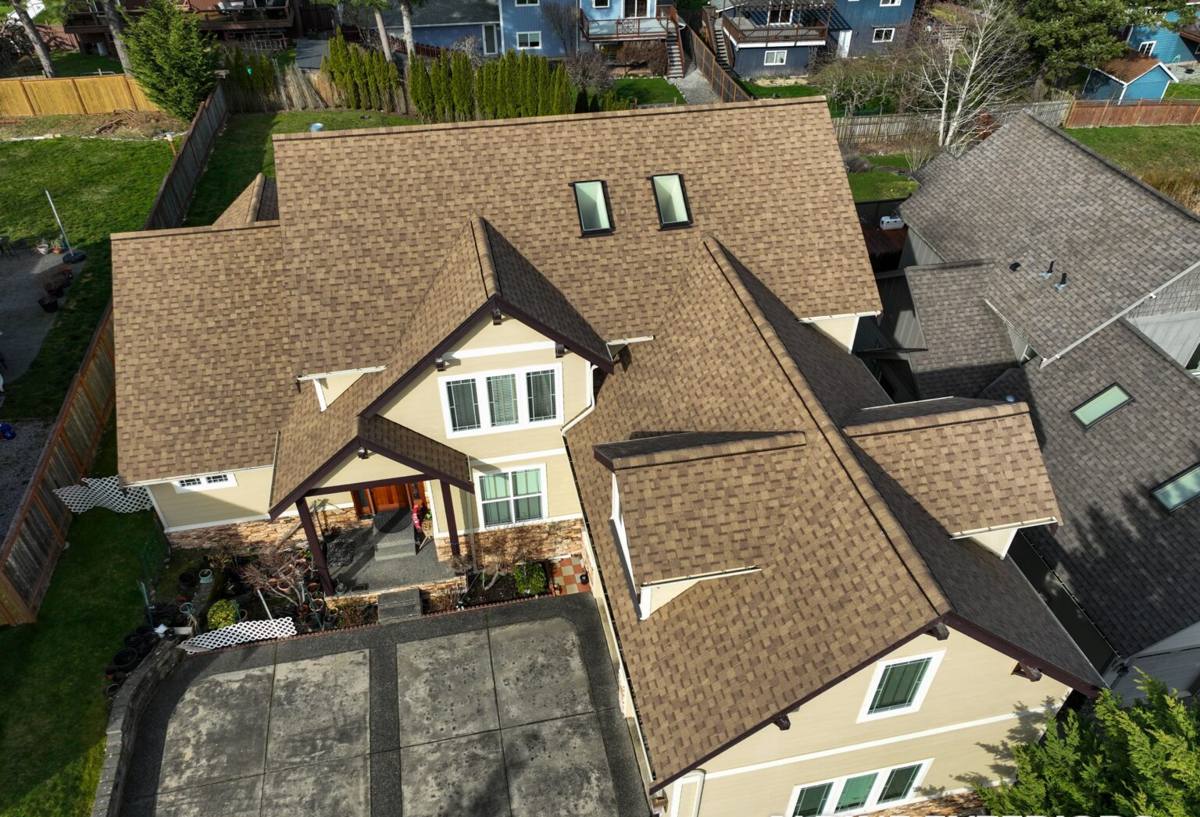
Signs Your Drayton Harbor Home Needs a New Roof
Roofs rarely fail all at once. They give warning signs first, and in this climate those signs often show up as moisture problems before they show up as visible shingle damage. Here's what we look for, and what you can check from the ground:
- Moss or algae streaking that keeps coming back within a season or two of cleaning
- Granules collecting in gutters or at downspout outlets
- Shingles that are cupping, curling, or look thinner than the surrounding field
- Soft spots or noticeable sag when walking the attic or looking along the roofline
- Water stains on interior ceilings, especially near chimneys, skylights, or valleys
- Rusted or lifting flashing around vents, chimneys, and wall intersections
- A roof that's approaching or past the manufacturer's expected service life for its material
If you're seeing more than one of these, it's worth having someone look at the whole system — decking, flashing, ventilation — rather than patching the symptom you can see and leaving the cause underneath.
What a Correct New Roof Installation Actually Involves
A new roof is more than removing old shingles and nailing down new ones. In a climate that pushes this much moisture at a roof, the parts you don't see matter as much as the parts you do.
Tear-Off and Deck Inspection
We strip the roof down to the deck rather than layering over existing material. That's the only way to actually see what's underneath — soft or delaminated plywood, old leaks that were never addressed, or framing that's been quietly absorbing moisture. Any damaged decking gets replaced before anything new goes down, because a new roof over a compromised deck just hides the problem for a while.
Underlayment and Water-Entry Protection
Underlayment is the roof's backup plan, and given how much driving rain this area gets, it earns its keep. We use synthetic underlayment across the field and self-adhered ice-and-water membrane at the vulnerable points — eaves, valleys, and around any roof penetration — so that if wind-driven rain gets past the shingles, it doesn't get past the deck.
Flashing Details
Flashing failures are one of the most common causes of roof leaks, and they're rarely the roofer's most glamorous line item, which is why they get skipped or reused on cheaper jobs. Chimneys, skylights, sidewalls, and any roof-to-wall transition get new step and counter flashing, properly lapped and sealed, not old flashing bent back into place.
Ventilation
Balanced intake and exhaust ventilation keeps the attic close to outdoor temperature and lets moisture escape instead of condensing under the deck. Poor ventilation is one of the quieter causes of premature roof failure and moss growth in this climate, because a warm, damp attic feeds both problems from underneath while the roof looks fine from above.
Choosing the Right Roofing Material for Salt Air and Moss
There's no single "best" roofing material — the right choice depends on your budget, your roof's exposure to wind and salt, and how much long-term maintenance you're willing to take on. Here's how the common options actually perform in a Drayton Harbor setting.
| Material | Performance in Salt Air / Moisture | Moss Resistance | General Lifespan |
|---|---|---|---|
| Architectural asphalt shingle | Good with proper fasteners and flashing; standard choice | Moderate — benefits from algae-resistant granules and good airflow | 25–30 years, install-dependent |
| Standing seam metal | Very good when properly coated and fastened; watch for galvanic corrosion at dissimilar-metal contact points | Good — steep slope and slick surface discourage moss buildup | 40–50+ years |
| Cedar shake | Attractive but higher maintenance in wet, shaded conditions | Poor without regular treatment and cleaning | 20–30 years with upkeep |
| Synthetic/composite shingle | Good; resists moisture absorption better than natural wood | Moderate to good depending on product | 30–50 years |
For most homes near the harbor, we lean toward architectural asphalt with algae-resistant granules or standing seam metal, simply because both hold up well against the moss and salt exposure without demanding constant upkeep. Cedar shake can still be the right call for a homeowner who wants the look and is committed to regular maintenance — we'll walk you through that trade-off honestly rather than talk you out of what you want.
Our New Roof Installation Process
- On-site inspection and honest assessment — including attic ventilation and any signs of existing moisture damage
- Written estimate covering material options, scope of work, and timeline, with no vague allowances
- Permitting handled before work begins, per Whatcom County and City of Blaine requirements where applicable
- Tear-off, deck inspection, and any necessary decking repair
- Underlayment, ice-and-water membrane, and flashing installed at all vulnerable points
- Roofing material installed to manufacturer specification, including proper nailing pattern and exposure
- Ventilation checked and corrected if intake or exhaust is inadequate
- Final walkthrough with the homeowner and cleanup of the site, including magnetic sweep for nails
Permits, Code, and Whatcom County Considerations
New roof installations typically require a building permit, and inspections may apply depending on scope and whether structural work is involved. We handle the permitting process as part of the job rather than leaving it to the homeowner, and we build to current code for wind exposure and moisture protection appropriate to this coastal part of Whatcom County. If your property has HOA design guidelines or is in a shoreline or flood-adjacent zone, we'll flag anything that needs sign-off before work starts, not after.
Cost Factors for a New Roof in Drayton Harbor
Every roof is different, so we won't quote a number without seeing the job, but these are the main variables that move the price up or down:
| Factor | Why It Matters |
|---|---|
| Roof size and pitch | More surface area and steeper slopes take more material and labor time |
| Number of layers to remove | Tearing off multiple old layers adds disposal cost and labor |
| Deck condition | Rotted or soft decking found during tear-off requires replacement before install |
| Material choice | Asphalt, metal, and specialty materials carry different upfront costs and lifespans |
| Roof complexity | Valleys, dormers, skylights, and chimneys add flashing detail and labor time |
| Access | Steep sites, limited driveway access, or tall structures affect staging and safety requirements |
Broadly, homeowners in this area should expect new roof installation to run from the mid four figures for a small, simple asphalt roof up into five figures for larger homes, steeper pitches, or premium materials like standing seam metal. We'll give you a firm, itemized number after a walkthrough — not a phone-quote guess.
Why Local Experience in Drayton Harbor Matters
A roofing crew that works this stretch of Whatcom County regularly knows things that don't show up in a general roofing manual — which slopes hold moss the longest because of tree cover and shade, which flashing details tend to fail first under this area's wind-driven rain, and how much ventilation a typical local attic actually needs versus what a spec sheet assumes. That local pattern recognition shows up in fewer callbacks and a roof that's built for the conditions it will actually face, not just the conditions on a national average.
It also matters for logistics — knowing local permitting turnaround, working efficiently around the area's weather windows, and being reachable afterward if a question comes up, rather than being a crew that did one job in the area and moved on.
If your roof is showing its age or you're just weighing your options, we're happy to take a look and give you a straight answer — no pressure, no hard sell. Use the form below to request a free estimate for your Drayton Harbor property.