 Semiahmoo Exterior
 Two Different Materials, One Big Decision
When a homeowner in Semiahmoo starts pricing out new siding, two products almost always end up on the short list: James Hardie fiber cement and LP SmartSide engineered wood. Both are miles ahead of old vinyl or bare cedar in terms of durability and looks. Both are backed by real manufacturers with real engineering behind them. But they are not the same material, and they do not behave the same way once they're on a house that sits a short walk from Semiahmoo Bay and Drayton Harbor.
We install James Hardie exclusively. We don't install LP SmartSide, and we think homeowners deserve a straight answer about why, rather than a sales pitch that skips the trade-offs. This page walks through what each product actually is, where LP SmartSide holds up well, and where our experience with Whatcom County's climate — salt air, driving rain off the Strait, and a moss season that can run half the year — pushed us toward fiber cement as the only product we're willing to stand behind.
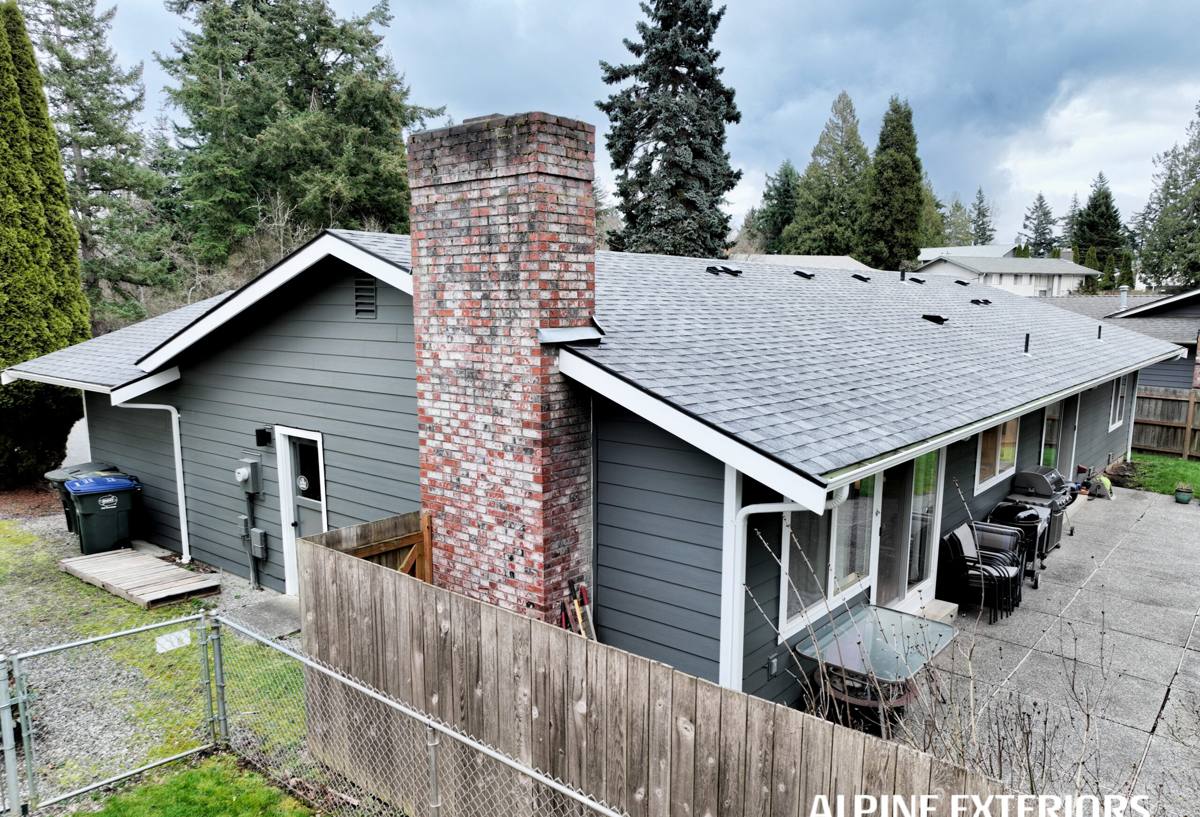
What LP SmartSide Gets Right
LP SmartSide is an engineered wood product: strand-based wood substrate treated with resins and zinc borate for insect and rot resistance, then finished with a factory primer or coating. It's lighter than fiber cement, generally faster to install, and it holds paint well when new. It also costs less upfront than James Hardie in most markets, which matters to a lot of families budgeting a full re-side.
We're not going to pretend engineered wood is a bad product across the board. In dry, moderate climates, installed correctly and maintained on schedule, it can perform well for years. The manufacturer stands behind it with a real warranty. Plenty of houses around the Pacific Northwest wear it without major issues. The trouble isn't that LP SmartSide is a scam — it's that it's a wood-based product, and wood-based products are judged differently once you put them in a marine, high-moisture environment for decades rather than years.
Where Engineered Wood Runs Into Trouble in a Salt-Air, High-Moisture Climate
Semiahmoo sits right on the water, and that changes the math on any wood-based exterior product. Three things compound here that don't show up the same way in a drier inland climate:
Salt Air and Coatings
Salt-laden air accelerates the breakdown of paint and coatings on any substrate, but it's especially unforgiving on a wood-based product where the coating is the primary barrier keeping moisture out of the strand board core. Once that coating starts to chalk or crack near a coastline, the clock on the substrate underneath starts running faster than it would fifty miles inland.
Driving Rain
Wind-driven rain off the Strait of Georgia doesn't just fall on siding — it gets pushed sideways into laps, seams, and butt joints. Engineered wood is more forgiving of moisture than raw cedar, but it's still a wood product at its core, and any point where water can sit against an unsealed cut edge or a failed caulk joint is a point where swelling and edge deterioration can start.
A Long Moss and Algae Season
Whatcom County's moss season isn't a two-month event — the combination of shade, moisture, and mild temperatures keeps organic growth viable on north-facing walls and under eaves for much of the year. Moss and algae hold moisture against the siding surface far longer than open air would, which is exactly the condition that stresses a coated wood substrate the most.
None of this means LP SmartSide fails on every house in Semiahmoo. It means the margin for error — in installation quality, in caulk maintenance, in repainting schedules — is thinner here than it is in a lot of the country, and we'd rather not build our reputation on a product where a missed caulk joint or a skipped repaint can turn into a substrate problem five or ten years down the road.
What James Hardie Fiber Cement Actually Is
James Hardie siding is made from Portland cement, sand, and cellulose fiber, cured into a dense, stable board. There's no wood strand core to swell, and the material itself is non-combustible — it doesn't feed a fire the way wood-based siding can. It's heavier and less forgiving to cut and fasten than engineered wood, which is exactly why installation quality matters so much (more on that below), but the base material itself doesn't share the same moisture vulnerability as a wood substrate.
That's the core of our position: in a climate that throws salt air, sideways rain, and near-constant dampness at a house, we want a substrate that isn't wood to begin with.
Comparing the Two Side by Side
| Factor | James Hardie Fiber Cement | LP SmartSide Engineered Wood |
|---|---|---|
| Core material | Cement, sand, cellulose fiber | Strand wood with resin binders |
| Combustibility | Non-combustible | Combustible (treated, but wood-based) |
| Moisture behavior | Does not swell or rot; engineered for wet climates | Resists moisture better than raw wood, but core can swell if coating fails |
| Finish | Factory-applied ColorPlus baked-on finish available | Factory primer; typically needs field topcoat |
| Repainting interval | ColorPlus: often 15 years before repaint is needed | Typically 5-10 years depending on exposure |
| Weight/installation | Heavier; requires correct fastening and clearances | Lighter, generally faster to install |
| Upfront cost | Higher material and labor cost | Lower upfront cost |
| Warranty | Long-term, often transferable to a new owner | Manufacturer warranty, terms vary by product line |
Hardie's Climate-Engineered Product Lines
James Hardie doesn't sell one universal board — it engineers formulations for different regional climates, and that regional engineering is a big part of why we chose the brand. The HZ5 formulation, designed for wetter, colder climates like the Pacific Northwest, is built to resist moisture intrusion and freeze-thaw stress better than a one-size-fits-all product. For a house in Semiahmoo dealing with salt air and a long wet season, that's not a marketing detail — it's the difference between a product engineered for our conditions and one adapted from a formula built for somewhere drier.
ColorPlus Finish vs. Field-Applied Coatings
One of the most underrated differences between these two products is how the color gets on the board in the first place. James Hardie's ColorPlus finish is baked on in a controlled factory environment, in multiple coats, under conditions no job site can replicate. That finish is warrantied separately from the substrate and typically holds up 10-15 years before it needs attention — a big deal when repainting a full house means scaffolding, prep, and real labor cost.
Engineered wood products are usually shipped with a factory primer and finished with a field-applied topcoat, meaning the final coat's durability depends heavily on site conditions and applicator skill on the day it goes up — and in a salt-air environment, that coating is doing more of the protective work than it would inland.
Warranty Structure Matters More Than the Sticker
Both manufacturers offer real warranties, but read the fine print on any siding warranty before assuming it covers what you think it does. Coverage on wood-based products can be more heavily conditioned on maintenance — repainting on schedule, caulk upkeep, prompt repair of any coating failure — because the manufacturer knows the coating is the primary defense for the substrate underneath. James Hardie's warranty structure, paired with a non-combustible, non-wood substrate, gives us a product we're comfortable standing behind for the long haul, including transferability if the home sells.
Why Installation Quality Decides Everything
No siding product performs to spec if it's installed wrong, and this is true of both James Hardie and LP SmartSide. But because fiber cement is heavier and more particular about fastening, clearances, and joint treatment, poor installation shows up faster and worse. Here's what correct James Hardie installation actually requires:
- Proper fastener type, placement, and depth — over-driven or under-driven nails compromise the board's performance
- Correct clearance from grade, roof lines, and decks so water can't wick into the bottom edge
- Factory-cut or properly sealed field cuts — any exposed edge needs to be treated per Hardie's specifications
- Proper flashing and house-wrap integration behind the siding, not just caulk at the surface
- Correct joint and butt-seam treatment to keep wind-driven rain from getting behind the board
- Following Hardie's published installation manual for the specific HZ zone and climate
This is why we treat installation as seriously as the material choice itself. A great product installed poorly will disappoint a homeowner just as fast as a lesser product — maybe faster, given how much rain a Semiahmoo house actually sees in a year.
Making the Right Call for Your House
If you're comparing bids and one contractor is proposing engineered wood and another is proposing fiber cement, don't just compare the number on the page. Ask about the finish system, the warranty conditions, the maintenance schedule you're signing up for, and how each product has actually performed on homes near the water in this county. We made our decision to install James Hardie exclusively after weighing exactly those factors against what Whatcom County's climate does to a house year after year — not because it's the cheapest option, but because it's the one we're comfortable putting our name behind.
If you're weighing your options for a re-side in Semiahmoo, we're happy to walk your home with you, point out where moisture and salt exposure are doing the most damage, and give you a straightforward, no-pressure estimate for what correct James Hardie installation would look like on your house.