 Semiahmoo Exterior
 A Traditional Look With Modern Trade-Offs
Primed spruce siding has a long history in the Pacific Northwest. It's a real wood product, it takes paint well when it's fresh, and it gives a home the kind of clean, traditional lap profile a lot of homeowners in Semiahmoo grew up with. We understand the appeal. But after years of working on homes throughout Whatcom County, we made a decision as a company: we don't install primed spruce siding anymore. This page explains why, honestly, without exaggerating the downsides or pretending the product is worthless. It's a fair product for the wrong climate, and we think homeowners deserve to know that before they spend money on it.
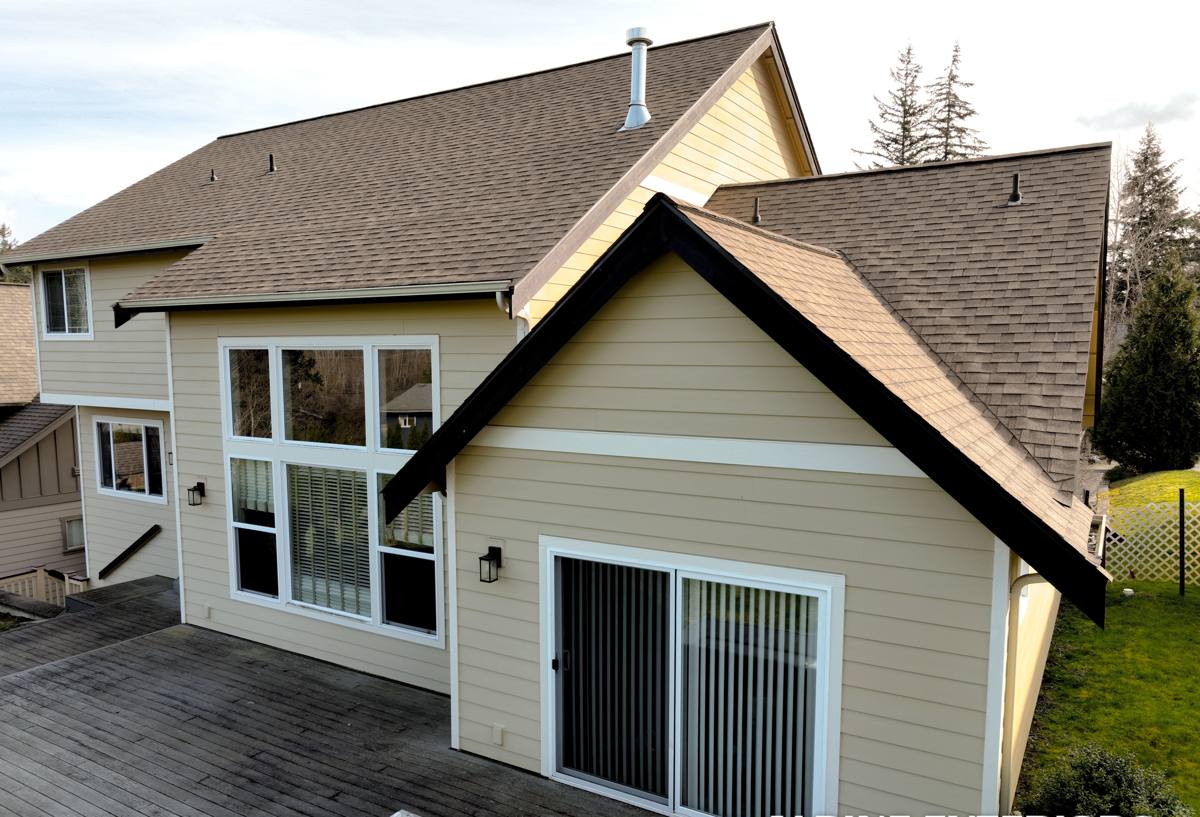
What Primed Spruce Siding Actually Is
Primed spruce siding is solid wood — usually finger-jointed or solid-sawn spruce boards — that comes from the mill with a factory-applied primer coat. The primer is meant to seal the wood and give painters a head start, but it is not a finish coat. The homeowner or builder still needs to apply at least one, usually two, coats of quality exterior paint after installation, and then maintain that paint system indefinitely.
Because it's a natural wood product, every board is slightly different. Grain, density, and moisture content vary piece to piece, even within the same bundle. That's part of what gives painted wood siding its character. It's also part of what makes it unpredictable once it's on a house exposed to real Pacific Northwest weather.
Where It Performs Reasonably Well
- Inland, drier climates with less direct wind-driven rain exposure
- Homes with deep roof overhangs that keep most wall surfaces sheltered
- Owners who are committed to a strict repaint and caulk-inspection schedule every few years
- Detail trim work and accent areas where small quantities are used and closely monitored
Why Whatcom County's Climate Changes the Math
Semiahmoo sits right on the water, and that matters more than most homeowners realize when they're picking a siding material. Salt air accelerates the breakdown of paint films and metal fasteners. Driving rain off the Strait pushes moisture sideways into lap joints and butt seams that would stay dry in a more sheltered location. And Whatcom County's long, damp moss season means algae and moss growth get a head start on painted wood surfaces every single year, holding moisture against the wood far longer than the paint film was designed to tolerate.
Wood siding doesn't have to get soaked to have a problem — it just has to stay damp longer than it dries out. In this region, that cycle repeats for months at a stretch, not days. Spruce is a softer, more moisture-permeable wood than some other species used in siding, which means it swells and shrinks more with each wet-dry cycle. That movement is exactly what breaks paint adhesion at the seams and end grain first.
The Specific Failure Points We See
- End grain absorption — cut ends at butt joints soak up moisture fastest, and factory priming rarely seals the field-cut ends on site
- Paint film cracking — repeated swelling and shrinking eventually cracks even a well-applied paint coat, opening a path for water
- Fastener staining and splitting — nails that aren't fully corrosion-resistant can bleed or work loose as the wood moves
- Moss and algae buildup — organic growth holds moisture against the surface long after a rain event has passed
- Delayed discovery — rot often starts behind the paint film, where it's invisible until the damage is advanced
The Maintenance Reality
This is the part that matters most for a homeowner's long-term cost, and it's the part that often gets underplayed at the point of sale. Primed spruce siding is not a "prime it once and forget it" product. It's a paint system that needs active upkeep for the life of the siding.
| Maintenance Task | Typical Interval | Why It's Needed |
|---|---|---|
| Full repaint | Every 5-8 years (often sooner near salt air) | Paint film breaks down from UV, moisture cycling, and salt exposure |
| Caulk inspection and renewal | Annually | Joint sealant fails faster than the paint film around it |
| Moss and algae removal | 1-2 times per year | Prevents prolonged moisture contact on painted surfaces |
| Spot repair of cracked/peeling paint | As soon as noticed | Exposed wood absorbs water almost immediately |
| Rot inspection at joints and trim | Every 1-2 years | Catches hidden decay before it spreads to framing |
Add that up over 20-30 years and the total cost of ownership on primed spruce siding often exceeds what homeowners expect when they compare the lower upfront material price to something like fiber cement. The sticker price isn't the real price — the maintenance schedule is.
Why We Won't Cut Corners on Installation Sensitivity
Wood siding is genuinely installation-sensitive, more so than most manufactured products. Proper end-cut sealing, back-priming, correct nail placement, and adequate flashing at every penetration are not optional extras — they're the difference between a siding job that lasts and one that fails early. The problem is that these details are labor-intensive, easy to skip under schedule pressure, and largely invisible once the siding is painted and installed. A crew in a hurry can leave cut ends unsealed and nobody will know until the wood starts to fail from the inside, years later.
We'd rather not put our name on a product where the margin for error is that thin and the failure mode is that hidden. That's not a knock on wood siding as a material — it's an honest statement about the labor discipline it demands and the risk that discipline gets skipped somewhere along the way, on our crew or a future one doing repairs.
What We Install Instead: James Hardie Fiber Cement
We standardized on James Hardie fiber cement siding for every home we side, and it comes down to matching the material to the actual climate our customers live in. Hardie board is engineered cement, sand, and cellulose fiber — it doesn't absorb water the way wood does, it doesn't feed moss and algae growth the way a soft wood surface can, and it's non-combustible.
The Practical Differences
- Factory-applied ColorPlus finish — a baked-on finish that resists fading and chipping far longer than field-applied paint on wood, cutting the repaint cycle dramatically
- HZ5 product engineering — Hardie's HZ10 and HZ5 climate zone lines are built for exactly the wet, humid, coastal conditions Whatcom County sees year-round
- Dimensional stability — fiber cement doesn't swell and shrink with moisture the way wood does, so the paint or factory finish isn't fighting constant movement at the seams
- Transferable warranty — a real backing that follows the home if it sells, which matters to buyers doing due diligence in this market
- Non-combustible core — a meaningful safety advantage that wood siding simply cannot offer
None of this means fiber cement is maintenance-free — no exterior siding is. It still needs caulk checks, and the factory finish still benefits from periodic cleaning to keep salt residue and organic growth from building up. But the maintenance burden is a fraction of what wood siding demands, and the failure modes we see with wood — hidden rot behind an intact-looking paint film — are far less common with an engineered cement product.
A Fair Comparison
| Factor | Primed Spruce Siding | James Hardie Fiber Cement |
|---|---|---|
| Upfront material cost | Lower | Moderate to higher |
| Repaint cycle | 5-8 years, often sooner in coastal air | Factory finish typically holds 15+ years |
| Moisture absorption | High — wood is naturally permeable | Very low — engineered cement composite |
| Combustibility | Combustible | Non-combustible |
| Installation sensitivity | High — errors are hidden and costly | Moderate — still requires correct technique, but material itself doesn't absorb mistakes the same way |
| Warranty structure | Varies by paint manufacturer, not the siding itself | Manufacturer-backed, transferable siding warranty |
If You Already Have Primed Spruce Siding
If your Semiahmoo home already has painted wood siding on it, that's not an emergency, and we're not going to tell you to tear it off tomorrow. What we'd suggest is being proactive about the maintenance items above — especially caulk joints, cut ends, and moss growth near the ground and under overhangs where moisture lingers longest. When you do reach the point of needing significant repairs or a full repaint, that's the natural moment to evaluate whether switching to fiber cement makes more sense for the next 30 years than repeating the same wood maintenance cycle.
Our Honest Bottom Line
Primed spruce siding isn't a bad product — it's a product that asks a lot of the climate it's installed in and the crew that installs it. In a sheltered, dry inland location with an owner committed to a strict maintenance schedule, it can hold up reasonably well. On the water in Whatcom County, with salt air, driving rain, and a moss season that runs most of the year, we've seen that maintenance burden turn into a recurring expense and, eventually, hidden rot that costs far more to fix than it would have cost to install the right material the first time. That's why we install James Hardie fiber cement on every home we side, and why we're upfront about it before you sign anything.
If you're planning a siding project in the Semiahmoo area and want a straight answer about what will actually hold up on your home, we're happy to take a look and talk through it. Reach out for a free, no-pressure estimate — no obligation, no sales pressure, just an honest assessment.