 Semiahmoo Exterior
 Two Fiber Cement Products, One Standard We Hold To
If you've been pricing out siding replacement in Semiahmoo or anywhere else in Whatcom County, you've probably run into more than one brand of fiber cement siding. James Hardie is the name most homeowners recognize, but Cemplank shows up regularly too, often at a lower bid price through big-box lumber yards and building supply chains. Both are fiber cement products — a mix of cement, sand, and cellulose fiber pressed into boards and panels. On paper, they can look similar. In practice, we've found enough differences in how these products are engineered, finished, and supported after installation that we made a decision several years ago: we install James Hardie siding exclusively. We don't install Cemplank.
This page is not an attack on Cemplank as a product. It's fiber cement, and fiber cement as a category is a real upgrade over vinyl or wood in a climate like ours. What we want to walk through here is why the specific differences between these two manufacturers matter enough, especially in a marine climate with salt air, driving rain, and a long moss season, that we standardized on one and stopped installing the other.
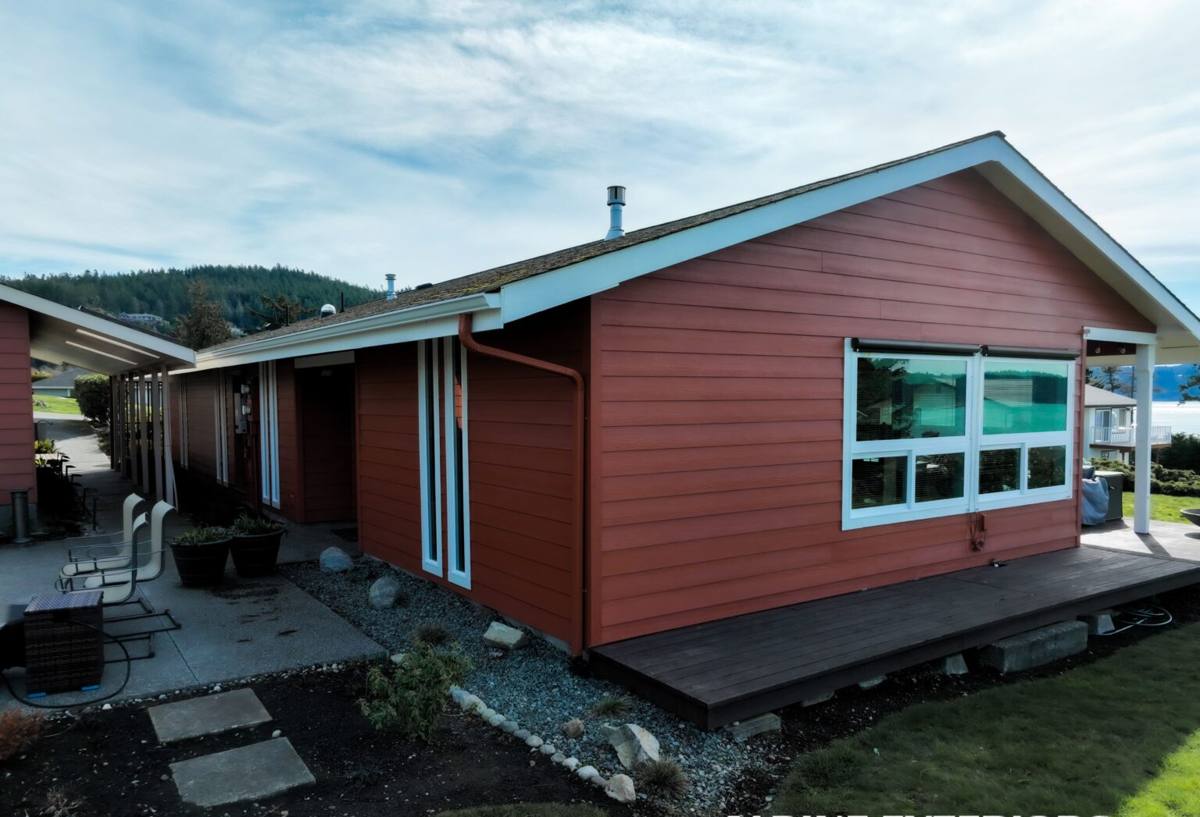
What Cemplank Gets Right
Fair is fair. Cemplank is a genuine fiber cement product, not an imitation. That means it shares the core advantages fiber cement has over other siding categories:
- It's non-combustible, unlike vinyl or wood-based siding.
- It resists rot, pests, and the kind of moisture damage that eventually wrecks cedar and engineered wood products in this region.
- It holds paint and factory finishes better than wood over the long run.
- It's dimensionally stable, meaning it doesn't expand and contract with humidity the way wood siding does.
For homeowners comparing categories rather than brands, moving from vinyl or aging cedar to any legitimate fiber cement product is a step up. We're not going to pretend otherwise. The differences that matter to us show up once you get past the category and into the specifics of manufacturing, engineering, and support.
Why We Still Don't Install It
Manufacturing and Batch Consistency
Fiber cement performance depends heavily on how consistently it's manufactured — the cement-to-fiber ratio, curing process, and moisture content all affect how a board behaves once it's on a wall. James Hardie manufactures at scale with tight, well-documented process controls specifically because the company's whole business model rests on siding performing predictably for decades. We've found that consistency matters more than it sounds like it should when you're installing hundreds of linear feet on a single home — inconsistent boards mean inconsistent cutting, fastening, and finish behavior, which shows up later as warping, uneven paint wear, or fastener pull-through.
Climate-Specific Engineering
James Hardie builds region-specific product lines — HZ5 and similar formulations engineered for climates with sustained moisture exposure and freeze-thaw cycling, which describes Whatcom County for a good chunk of the year. That engineering isn't cosmetic. It affects how the board handles moisture absorption at cut edges, how it performs behind a rainscreen, and how it holds up through repeated wet-dry cycles. We haven't seen the same depth of climate-zone engineering documented for Cemplank's product line, and when we're putting our name behind an installation that has to perform through 30+ inches of annual rainfall and salt-laden air off the Strait, we don't want to guess.
Factory Finish and Warranty Structure
James Hardie's ColorPlus finish is baked on in a controlled factory environment and backed by a specific finish warranty separate from the product warranty itself — meaning fade, chip, and peel are addressed under a defined, documented process. Cemplank's finish and warranty terms are structured differently, and in our experience the paperwork and support behind a claim are less standardized. When a warranty claim actually needs to happen ten or fifteen years down the road, the clarity of that process is the whole point of having a warranty in the first place.
Long-Term Availability and Color Matching
Siding gets damaged — a tree limb, a ladder, storm debris. When that happens five or ten years after installation, you need to source matching material: same profile, same color, same batch characteristics if possible. James Hardie's distribution network in the Pacific Northwest is deep enough that matching material is rarely a problem. We've run into more friction sourcing matching Cemplank product regionally, particularly for less common profiles or discontinued colors, which turns a small repair into a bigger, more visible patch job.
Installer Training and Certification
James Hardie runs a formal contractor certification program with installation training, inspection standards, and manufacturer-backed accountability if something's installed wrong. That structure gives us — and you — a second layer of quality control beyond our own crew's judgment. We haven't found an equivalent program behind Cemplank installations in this market, which means the entire quality burden sits on the installer with no manufacturer backstop.
Why the Semiahmoo Climate Makes This a Real Decision, Not a Brand Preference
Whatcom County siding doesn't have an easy job. Homes here, especially close to the water around Semiahmoo, deal with a combination most siding products in the country never see: salt-laden air off Semiahmoo Bay and the Strait of Georgia, long stretches of driving rain pushed sideways by wind, and a moss and algae season that can run nine months out of twelve on north-facing and shaded walls. Add in freeze-thaw swings during winter cold snaps and you've got a siding envelope that's under constant low-grade stress even when nothing dramatic is happening.
That combination is exactly why the differences between fiber cement products stop being theoretical. A board that's engineered and finished for a drier, milder climate can still function reasonably well in a place like Semiahmoo — for a while. The question is what happens at year eight, or year fifteen, when finish integrity, moisture behavior at cut edges, and fastener performance start to separate a well-engineered product from an adequate one. We'd rather make that call before installation than find out during a warranty dispute.
Cemplank vs. James Hardie: A Side-by-Side Look
| Factor | Cemplank | James Hardie |
|---|---|---|
| Base material | Fiber cement | Fiber cement |
| Climate-specific formulations | Limited documentation regionally | Region-specific lines (e.g., HZ5) engineered for wet, freeze-thaw climates |
| Factory finish system | Available, warranty terms vary | ColorPlus factory finish with dedicated finish warranty |
| Regional distribution/matching | Inconsistent for some profiles and colors | Established Pacific Northwest distributor network |
| Installer certification program | No formal manufacturer certification found | Formal certified contractor program with inspection standards |
| Typical purchase channel | Big-box lumber/building supply | Certified contractors and specialty distributors |
What This Should Mean for Your Siding Decision
You don't have to take our brand preference on faith. Whatever contractor you're vetting, and whatever product they're proposing, here's a practical checklist worth running through before you sign anything:
- Ask what specific product line is being quoted, not just "fiber cement" — the formulation matters.
- Ask whether that product line is engineered for wet, coastal, or freeze-thaw climates, and ask to see that documented, not just described.
- Ask what the factory finish warranty covers, how long it runs, and what the claims process actually looks like.
- Ask whether the installer carries any manufacturer certification for that specific product.
- Ask how easily matching material can be sourced locally five or ten years from now if a repair is needed.
- Get the warranty document itself, not just a verbal summary — read what's actually covered.
Any contractor who can't answer these clearly, for whatever product they're recommending, is worth a second look regardless of brand.
A Note on Cost Differences
We'll be straightforward: Cemplank and similar lower-cost fiber cement products are often priced below James Hardie, and that price gap is real. For a homeowner working with a tight budget, that difference matters, and we're not going to pretend it doesn't. What we'd ask you to weigh against the upfront number is the cost of a repair or repaint fifteen years earlier than expected, the hassle of sourcing mismatched replacement material, and the difference between having a manufacturer-backed installation program behind your project versus not. On a home you plan to own for a decade or more in this climate, the lifecycle math has generally worked out in Hardie's favor for the projects we've done — but that's a conversation worth having project by project, not a rule we apply blind.
Why We Standardized on James Hardie
We didn't choose to install only one fiber cement brand because of a marketing relationship or because it's the name homeowners already recognize. We chose it because narrowing to one product line lets our crews specialize — every install, every flashing detail, every trim transition is done the same certified way every time, instead of our team juggling installation quirks across multiple manufacturers. It lets us stand fully behind the finished product, because we're not troubleshooting inconsistencies between batches or product lines. And it means when a Semiahmoo homeowner calls us in year twelve about a repair, we know exactly what's on the wall and exactly how to match it.
None of this is about telling you Cemplank is a bad product. It's about telling you honestly why we don't put it on homes ourselves, and why, after installing siding through everything this stretch of Whatcom County coastline throws at a house, we've landed on James Hardie as the standard we're willing to warranty our workmanship against.
If you're weighing siding options for a home in Semiahmoo or anywhere nearby, we're happy to walk through what we see on your specific house and give you a straight answer — no pressure, no upsell. Reach out for a free estimate using the form below.