 Semiahmoo Exterior
 Why This Decision Is Harder Near the Water
If you own a home in Semiahmoo or anywhere along the Whatcom County shoreline, you already know your siding works harder than siding fifty miles inland. Salt-laden air corrodes fasteners and trim faster, driving rain off the Strait finds every gap in a wall system, and the long gray moss season here means organic growth gets a head start on any surface that stays damp. That combination is exactly why the repair-or-replace question comes up more often for coastal Whatcom homes than it does elsewhere in the state.
There's no single right answer — a lot depends on the age of your siding, what it's made of, and how much of the problem is cosmetic versus structural. This page walks through how to actually evaluate it, not just guess.
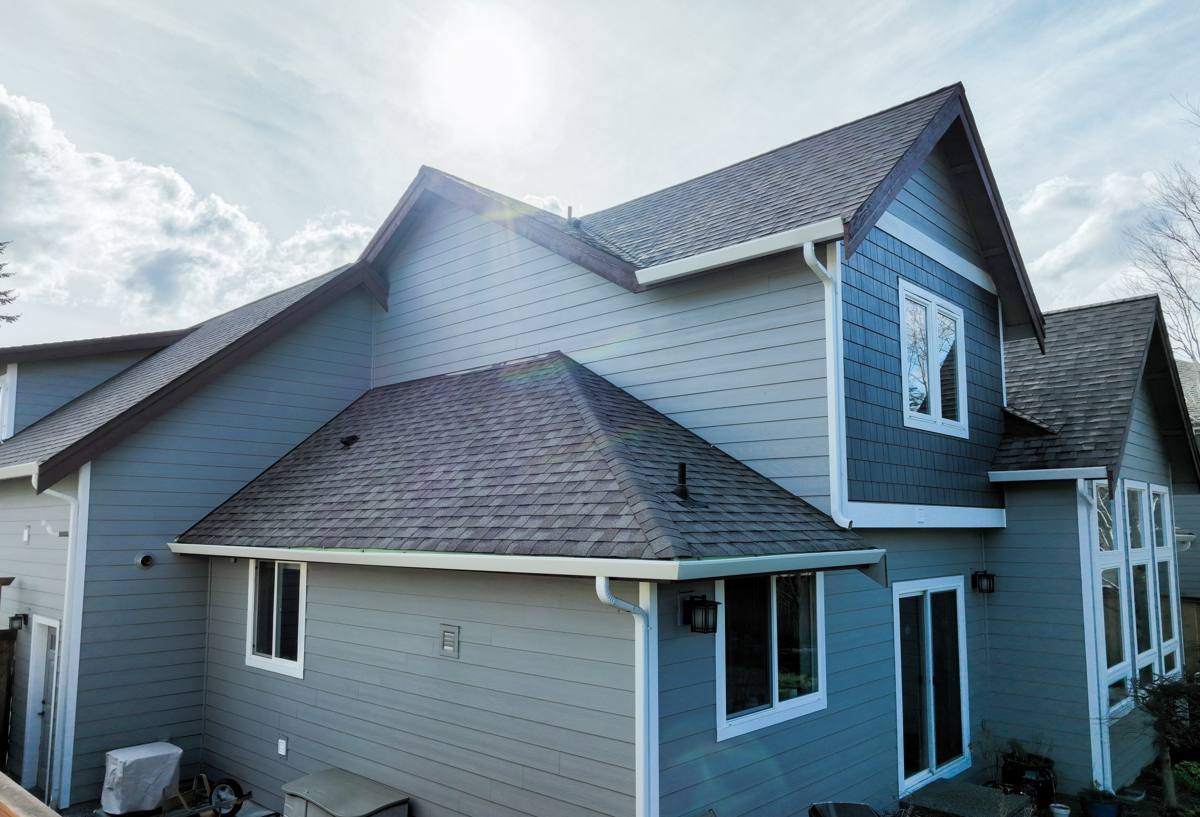
Start With What's Actually Failing
Before anyone talks price, the first job is figuring out whether you're looking at a surface problem or a system problem. Those get fixed very differently.
Surface-Level Issues
- Faded or chalky paint on a small section, usually the south or west-facing walls
- Isolated moss or algae staining on shaded, north-facing siding
- A handful of cracked or split boards from an impact or age
- Caulking that's shrunk or pulled away at trim joints
System-Level Issues
- Soft, spongy, or crumbling siding when pressed — a sign of moisture intrusion behind the surface
- Widespread cupping, buckling, or warping across multiple walls
- Staining that follows a pattern (below windows, at butt joints, along the bottom course) suggesting water is getting behind the cladding, not just sitting on top of it
- Visible rot at corners, trim, or wherever siding meets a roofline or deck ledger
- Siding that's original to a home built more than 25-30 years ago, especially with wood or older composite products
Surface issues are usually a repair. System issues, especially anything involving moisture behind the cladding, are almost always a sign that repair is a delay tactic, not a fix.
The Moisture Test Most Homeowners Skip
A lot of siding failure in this climate isn't about the siding itself — it's about what's happening behind it. Semiahmoo gets enough driving rain off the water that any small gap, failed caulk joint, or missing flashing detail becomes a slow leak path over a few wet seasons. The siding can look fine from the driveway while the sheathing behind it is already compromised.
If you're on the fence, a contractor can probe suspect areas (near window heads, at the bottom of walls, around old fastener holes) with a moisture meter or simply by pressing a screwdriver into the material. Soft, punky wood-based material — sheathing, trim, or the siding itself — means water has been getting in for a while, and that's a replacement conversation, not a caulk-and-paint one.
Age and Material Matter as Much as Condition
What your siding is made of changes how much life a repair actually buys you.
| Material | Typical Lifespan | Repair Viability |
|---|---|---|
| Cedar lap siding | 20-30 years with regular refinishing | Good if caught early; poor once rot sets in, since replacement boards rarely match weathered originals |
| Vinyl siding | 20-30 years, shorter in high-UV or salt exposure | Panels are hard to color-match once faded; cracked panels are easy to swap but discontinued colors are common |
| Primed spruce/wood composite (older) | 10-20 years, often less in wet coastal exposure | Prone to swelling at cut edges and fastener points; repairs tend to fail again in the same spots |
| Fiber cement (James Hardie) | 30-50 years with factory finish intact | Individual boards can be replaced cleanly; ColorPlus finish keeps repairs from being an obvious patch |
The practical takeaway: on an aging wood or older composite wall, a repair is often just resetting the clock on the same failure mode. On fiber cement, a targeted repair genuinely holds up, because the material itself isn't the weak point.
When Repair Is the Right Call
Repair makes sense when the damage is contained, the underlying wall assembly is dry, and the siding still has real service life left. Good candidates:
- A single wall or a few boards damaged by an isolated event (storm debris, a ladder, a tree limb)
- Localized moss staining that hasn't compromised the material underneath
- Siding under 15 years old that's otherwise sound
- Trim or caulk failures caught before water reached the sheathing
In these cases, spending money to replace an entire elevation — or the whole house — doesn't make financial sense. A skilled repair, properly flashed and sealed, can hold for years.
When Replacement Is the Honest Answer
Replacement becomes the right call once the problems are spread across the house or once the underlying wall assembly is wet. Some situations where we'll tell a homeowner straight up that repair isn't worth doing:
- Rot or soft spots showing up on more than one wall or elevation
- Siding material that's discontinued, so patches will always be a visible mismatch
- A house that's had recurring paint or caulk failures every few years — a sign the underlying material or original installation detailing isn't holding up to this climate
- Original siding on a 25+ year old home, where even the "good" sections are near the end of their service life
- Any siding showing damage patterns consistent with missing or failed weather barrier / flashing behind it
Patch-repairing a wall system that's structurally tired usually costs more over five years than one properly done replacement — you end up paying for repeated repair visits and eventually for replacement anyway, on top of whatever moisture damage accumulated while you waited.
Cost Factors Worth Understanding
Homeowners often assume repair is automatically the cheaper path. Sometimes it is. But the real cost comparison depends on more than square footage.
| Factor | Favors Repair | Favors Replacement |
|---|---|---|
| Extent of damage | Isolated, one or two walls | Spread across the house |
| Age of siding | Under 15 years | Over 20-25 years |
| Material availability | Matching material still made | Discontinued profile or color |
| Moisture behind cladding | Dry sheathing confirmed | Soft/wet sheathing found |
| Energy and moisture performance | Wall assembly already performing well | Opportunity to correct a weather barrier or flashing problem while walls are open |
| Long-term plans | Selling or moving within a few years | Staying long-term, want it solved once |
A Practical Inspection Checklist
Before calling anyone, walk your own exterior with this list. It won't replace a professional assessment, but it'll tell you which conversation you're likely to be having.
- Press on siding near the bottom of walls and below windows — does it feel soft?
- Look for consistent staining patterns, not just random discoloration
- Check caulk joints at trim, windows, and corners for gaps or cracking
- Note whether moss or algae is isolated to shaded areas or spreading everywhere
- Check the age of the siding against typical material lifespans
- Look inside, if accessible, for staining on interior walls near exterior corners — a sign water has gotten further than the siding surface
Why We Point Most Replacements Toward James Hardie
When a homeowner in Semiahmoo does need a full replacement, we install James Hardie fiber cement siding exclusively. It's not the only siding product on the market, but it's the one that holds up best to what this specific stretch of coastline throws at a house year after year: salt exposure, sustained damp periods that feed moss and algae, and driving rain that tests every joint. Fiber cement doesn't rot, isn't a food source for moss the way bare wood can be, and the factory-applied ColorPlus finish holds color without the repaint cycle that wood and some composites need. It's also non-combustible, which matters increasingly to insurers and homeowners alike.
We won't pretend Hardie is the cheapest option on day one — it isn't. But when you're weighing a repair-vs-replace decision, the material you replace with should be one you're not having this same conversation about again in ten years.
Getting a Straight Answer for Your Home
The honest version of this decision usually requires eyes on the actual siding and, where there's any doubt, a probe of the material behind it. A five-minute look from the sidewalk isn't enough to tell you whether you're looking at a $600 repair or a full replacement — and guessing wrong in either direction costs you money.
If you're trying to figure out where your home falls on this spectrum, we're happy to take a look and give you a straight assessment — repair, replace, or wait and watch — with no pressure either way. Reach out for a free estimate using the form below.