 Semiahmoo Exterior
 Signs Your Roof Needs Replacing, Not Just Repair
Every roof reaches a point where patching stops making financial sense. The trick is knowing where that line is before a small leak becomes a rot problem in your sheathing and framing. A few individual repairs over the life of a roof is normal. Repeated repairs in the same area, or repairs popping up in new spots every wet season, usually mean the underlying material has aged out even if the surface still looks passable from the ground.
Age and material lifespan
Standard three-tab asphalt shingles are typically rated for 15-20 years, architectural (laminated) shingles for 25-30, and metal roofing for 40-50 or more. In Semiahmoo's marine climate, actual service life often lands at the lower end of these ranges because of near-constant moisture exposure. If your roof is within a few years of its rated lifespan and you're already seeing granule loss or curling, replacement planning should start now, not after the next leak.
Visible damage signs
Cupped, curling, or cracked shingles, bald spots where granules have washed off, dark streaking that won't scrub off, and daylight visible through the attic sheathing are all signs the roof covering has failed structurally, not just cosmetically. Soft spots when walking the roof, sagging rooflines, and recurring interior water stains near ceilings or exterior walls point to problems below the shingles themselves.
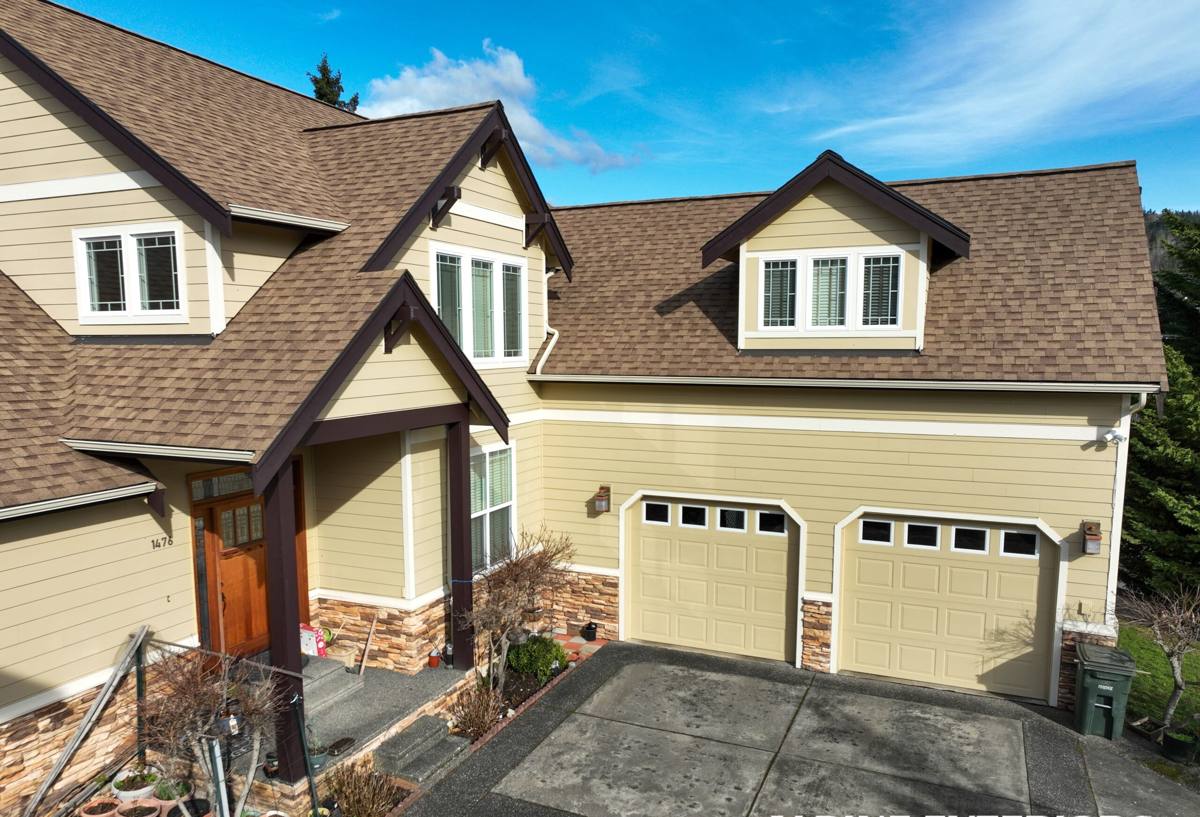
Why Roofs Wear Faster in Semiahmoo's Marine Climate
Semiahmoo sits right on the water, and that proximity to Semiahmoo Bay and Drayton Harbor means roofs here take a different kind of beating than roofs 30 miles inland. Salt-laden air accelerates corrosion on exposed metal fasteners, flashing, and vent boots faster than a standard warranty assumes. Driving rain off the water pushes moisture sideways under shingle edges and around penetrations, which is exactly where poor flashing detail shows up first as a leak.
Then there's moss. Whatcom County's long wet season, mild temperatures, and heavy tree cover create ideal conditions for moss and algae growth on north-facing and shaded roof slopes for much of the year. Left unmanaged, moss lifts shingle edges, holds moisture against the roof deck, and shortens the life of the covering regardless of how good the material was on installation day.
Roofing Material Options for Whatcom County Homes
There's no single correct roofing material for every home — the right choice depends on your roof's pitch, your home's style, your budget, and how much long-term maintenance you're willing to do. Here's an honest look at what's commonly used in this region.
| Material | Typical Lifespan | Moss/Salt Air Resistance | Maintenance |
|---|---|---|---|
| 3-Tab Asphalt Shingle | 15-20 years | Low — granules erode faster in constant moisture | Moss treatment every 1-2 years |
| Architectural Shingle | 25-30 years | Moderate — thicker mat sheds water better | Periodic moss/gutter maintenance |
| Standing Seam Metal | 40-50+ years | High if properly coated; watch fastener corrosion near the water | Low — moss struggles to grip smooth panels |
| Cedar Shake | 20-30 years with upkeep | Low — absorbs moisture, prone to moss and rot without regular treatment | High — regular cleaning and treatment required |
Metal roofing has gained ground in coastal Whatcom County precisely because its smooth surface resists moss colonization and it doesn't hold moisture the way shingle mats do. That said, it costs more upfront, and fastener quality matters even more given the salt exposure — a cheap fastener package will corrode and stain the panels well before the panel itself wears out.
What Correct Installation Actually Involves
The material on the shelf is only part of the story. Most roof failures in this climate trace back to installation shortcuts, not product defects. A roof that's done right in Semiahmoo needs a few things that get skipped when a crew is racing through a job.
Underlayment and ice/water shield
A synthetic underlayment rated for the region, with self-adhering ice-and-water shield membrane at eaves, valleys, and around every penetration, is what actually stops wind-driven rain from reaching the deck when a shingle tab lifts. This is not optional trim in a marine climate — it's the backup layer that does the real work during the worst storms.
Flashing details
Step flashing at wall intersections, proper counterflashing, and corrosion-resistant materials at chimneys, skylights, and vent stacks are where most leaks originate when they're done wrong. Given the salt air here, flashing and fastener metallurgy should be chosen with corrosion resistance in mind, not just cost.
Attic ventilation
Balanced intake and exhaust ventilation keeps the roof deck dry from the underside and prevents condensation from mimicking a leak. Poor ventilation also shortens shingle life from the inside out, since trapped heat and moisture degrade the shingle mat and deck sheathing over time.
What a Roof Replacement Typically Involves
A full tear-off replacement generally includes removing the old roofing down to the deck, inspecting and replacing any damaged sheathing, installing new underlayment and flashing, and laying the new roof covering. Skipping the tear-off and installing over existing shingles is sometimes offered as a cheaper option, but it hides the condition of the deck and shortens the life of the new roof — not something we'd recommend for a home taking on this much moisture exposure every year.
Roof Replacement Cost Factors
Costs vary enough by roof size, pitch, material, and existing damage that a number without a site visit isn't a useful one. What's worth understanding is which factors move the price the most, so a quote makes sense when you get it.
- Roof size and number of squares (100 sq ft units) — the single biggest cost driver
- Pitch and roof complexity — steep or cut-up roofs with many valleys and dormers take longer to install safely
- Material choice — asphalt, architectural, metal, and cedar carry very different price points
- Deck condition — rotted sheathing discovered during tear-off adds material and labor
- Number of layers being removed — tear-off of multiple existing layers takes more time
- Accessibility — steep sites, limited staging area, or difficult truck access affect labor
A reasonable contractor will walk the roof, document existing conditions, and give you a written estimate that spells out what's included — tear-off, disposal, underlayment type, flashing, ventilation work, and warranty terms — rather than a single vague number.
Moss, Algae, and Maintenance Between Replacements
Whatever material you choose, a maintenance routine will add years to it. Annual or biannual moss treatment, keeping gutters clear so water doesn't back up under the lowest course of shingles, and trimming back overhanging branches that shade the roof and drop debris all matter more here than in drier climates. Zinc or copper strips near the ridge can help suppress moss regrowth on many roof types, though they work best as part of an ongoing maintenance plan rather than a one-time fix.
When Roof Work Overlaps With Siding
Roof replacement is often the moment homeowners take a hard look at the rest of the exterior envelope, since scaffolding, staging, and disruption are already happening. If your siding is also aging out — especially older cedar, primed wood, or vinyl that's chalked, warped, or showing moisture damage — it's worth evaluating both at once rather than doing the work twice.
This is where we're direct with clients: we install James Hardie fiber cement siding exclusively, and we don't cut that corner even when it would be an easier upsell to match whatever's already on the house. Hardie's ColorPlus factory finish holds up to the same salt air and driving rain that wears out roofs here, it's non-combustible, and its HZ product lines are engineered for exactly this kind of moisture-heavy climate. If a roof project uncovers siding problems, or you're simply planning ahead, we'll give you a straight answer on whether it makes sense to combine the work.
Vetting a Roofing Contractor
Roofing draws more than its share of storm-chasers and door-knockers, especially after a bad windstorm. A few checks before signing anything protect you far more than any sales pitch.
- Confirm active Washington state contractor licensing and current liability/workers' comp insurance
- Ask for manufacturer certification if the material carries an enhanced warranty tied to certified installers
- Get a written scope that specifies underlayment type, flashing materials, and ventilation work — not just "new roof"
- Ask how tear-off debris and deck repairs are priced if rot is found once the old roofing is off
- Get local references and, where possible, look at completed work that's had at least one wet season to prove itself
- Be wary of pressure to sign same-day after a storm, especially from out-of-area crews
Permits, Codes, and Timing in Whatcom County
Roof replacements in Whatcom County typically require a building permit, and code requirements around ice/water shield coverage, ventilation, and fire ratings apply regardless of who does the work. A contractor pulling permits themselves is a good sign; one who suggests skipping the permit is not. Timing also matters here — scheduling a tear-off during a stretch of the dry season reduces the risk of the deck sitting exposed to rain mid-project, which is a real concern given how quickly weather can turn on the water.
If you're weighing repair versus replacement, comparing roofing materials for this climate, or thinking about tackling the roof and siding together, we're happy to take a look and give you a straightforward, no-pressure estimate.