 Semiahmoo Exterior
 Why Birch Bay Homes Are Hard on Windows
Birch Bay sits right on the water, and that changes what a window has to survive here compared to a house a few miles inland. The salt-laden air off the bay works on metal hardware, fasteners, and lesser cladding finishes year-round, not just during storms. Add the wind-driven rain that comes off the Strait of Georgia in the fall and winter months, and you've got moisture being pushed sideways into every seam, sill, and joint in a window assembly — not just falling straight down where a standard overhang or drip cap would catch it.
Then there's the long moss season. Whatcom County's mild, wet stretch from October through May keeps north- and west-facing exteriors damp for months at a time. Moss and algae don't just grow on roofs — they take hold on window sills, in track channels, and in any spot where water sits instead of draining. Over years, that constant dampness is what actually breaks windows down: swollen wood sashes, corroded weep holes, seals that fail early, and frames that never quite dry out between rains.
None of this means Birch Bay is a bad place for windows. It means the details that get glossed over in a typical inland installation — flashing sequence, sill pan drainage, sealant selection, hardware finish — are the details that determine whether a window lasts 10 years or 30 in this specific environment.
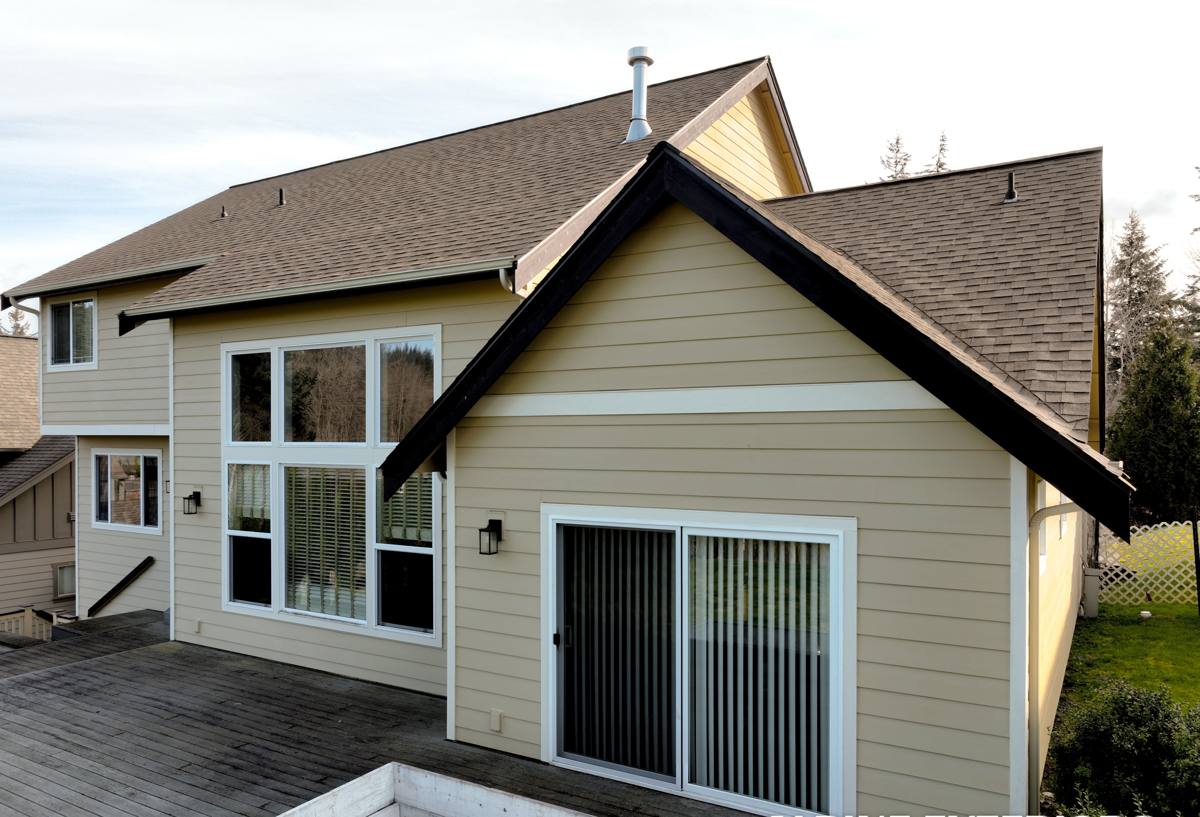
What "Correct" Actually Means for a Coastal Window Job
It Starts Below the Window, Not With the Window
A window is only as good as the opening it sits in. On a coastal replacement, we're paying as much attention to what's underneath and around the frame as we are to the window unit itself. That means a proper sill pan that sheds any water that gets past the frame back to the exterior instead of into the wall cavity, correctly lapped flashing tape so water always moves downward and outward, and a weather-resistive barrier that ties into the flashing without gaps.
Sealant Is Not an Afterthought
In driving rain, the perimeter sealant around a window is doing real structural work against wind-driven water intrusion, not just filling a gap for looks. We use sealants rated for the exposure and movement a coastal wall sees, and we tool every joint so it actually bonds rather than just sitting on the surface. A bead that looks fine from the ground can still be failing at the bond line where you can't see it.
Hardware and Fasteners Matter More Here
Standard zinc-coated fasteners and basic hardware finishes corrode faster this close to salt water. We spec stainless or coated fasteners and corrosion-resistant hardware for anything within a few miles of the bay, because a rusted-out hinge or lock mechanism a few years in is a callback waiting to happen — and it's avoidable at the time of install for a modest difference in material cost.
Frame Material: What Holds Up in Salt Air
There's no single "best" window frame material for every house, but some options are clearly better suited to a salt-air, high-moisture environment than others. Here's how the common options actually perform in conditions like Birch Bay's:
| Frame Material | Coastal Performance | Maintenance |
|---|---|---|
| Vinyl | Good corrosion resistance since there's no metal to rust; quality varies a lot by manufacturer | Low — occasional cleaning, no painting |
| Fiberglass | Excellent — dimensionally stable in wet/dry cycles, resists warping and doesn't corrode | Low — very durable finish |
| Wood, clad exterior | Good if the cladding and flashing details are done right; the interior wood still needs the exterior kept sealed | Moderate — interior wood care, watch cladding seams |
| Solid wood, unclad | Poor in direct salt/rain exposure without diligent upkeep — we generally steer clients away from this on exposed coastal walls | High — regular repainting/sealing |
| Aluminum | Conducts cold and can pit or corrode over time in salt air unless it's a marine-grade finish | Moderate to high depending on finish quality |
Our default recommendation for exposed, water-facing walls in Birch Bay is vinyl or fiberglass from a manufacturer with a documented coastal or high-moisture warranty. That's not a knock on wood-clad windows — they can absolutely work here — it's just that they demand more attentive installation and more ongoing upkeep to hold up in this exposure, and we want clients to walk in knowing that trade-off rather than finding out five years later.
Glass Packages Worth Considering Here
Frame material gets most of the attention, but the glass package affects comfort, condensation, and energy use just as much — and Whatcom County's damp, mild winters create their own condensation challenges.
- Double-pane with low-E coating: The standard baseline for this climate. Reduces heat loss and cuts down on winter condensation on the interior glass surface.
- Argon or krypton gas fill: Improves insulating performance between the panes; argon is the common, cost-effective choice for this region's temperature range.
- Triple-pane: Worth considering for north- and west-facing rooms that catch the brunt of wind and rain, or for homeowners prioritizing quiet and consistent interior temperatures. It's a real upcharge, so we evaluate it room by room rather than specifying it across the whole house by default.
- Warm-edge spacer systems: Reduce condensation risk at the edge of the glass, which is often where moisture problems show up first in a cold, wet climate.
We'll walk through which combination makes sense for your specific exposure — a bathroom window on the sheltered side of the house doesn't need the same spec as a great-room window facing open water.
How We Approach a Birch Bay Window Project
1. Walk the Whole Opening, Not Just the Window
Before we talk product, we look at the existing sill, framing, and any signs of past water intrusion — staining, soft wood, or failed caulk. This tells us whether we're dealing with a straightforward swap or whether there's rot or a flashing problem that needs to be corrected first. Skipping this step is how a brand-new window ends up sitting in a compromised opening.
2. Confirm Wind and Water Exposure Room by Room
A house near the bay rarely gets the same exposure on every wall. We factor in which elevation faces prevailing wind and rain when recommending frame material, glass package, and installation details for each opening.
3. Remove, Inspect, Repair
Once the old window is out, we inspect the framing for hidden moisture damage. Any soft or compromised wood gets repaired or replaced before the new unit goes in — installing a good window into bad framing just delays the same problem.
4. Install With a Full Moisture Management System
Sill pan, flashing tape lapped correctly, backer rod and sealant at the perimeter, and shims placed to keep the frame square without blocking drainage paths. Every layer is sequenced so water is always directed back out, never trapped.
5. Test and Finish
We check operation, confirm the unit is square and sealed, and finish interior and exterior trim to match the surrounding siding and paint. A clean tie-in at the trim line is part of keeping water out of the wall assembly, not just cosmetic.
Signs Your Current Windows Are Losing the Battle
Coastal moisture problems tend to show up gradually, which is exactly why they get ignored until they're expensive. Watch for:
- Fogging or moisture between the panes (a sign the seal has failed)
- Soft, discolored, or bubbling paint on the interior or exterior sill and casing
- Windows that stick, won't latch fully, or have visibly corroded hardware
- Moss or dark staining building up in the track or on the sill
- A persistent draft or cold spot even with the window fully closed
- Noticeable outside noise or temperature swing compared to the rest of the house
Any one of these on its own isn't an emergency, but a window showing two or three of them is usually past the point where caulking and adjustment will fix it for good.
What Affects the Cost of a Window Project Here
We don't quote sight-unseen, but these are the main factors that move the price on a Birch Bay job, roughly in order of impact:
| Factor | Why It Matters |
|---|---|
| Number and size of openings | Straightforward multiplier on materials and labor |
| Frame material chosen | Fiberglass and premium vinyl cost more upfront than basic vinyl or wood-clad |
| Condition of existing framing | Hidden rot or water damage found at removal adds repair scope |
| Wall exposure | Water-facing walls may warrant upgraded flashing details or glass packages |
| Glass package | Double vs. triple pane, gas fill, and coating options each add cost |
| Access and site conditions | Upper-story or hard-to-reach openings take more time and equipment |
| Trim and finish work | Matching existing siding, trim profiles, or paint adds finish labor |
We'll give you a clear, itemized number after we've actually looked at your windows and openings — not a ballpark based on square footage alone.
Maintenance That Actually Extends Window Life Here
Even the right window installed correctly still needs a bit of seasonal attention in a salt-air, high-moisture climate. A short annual routine goes a long way:
- Clear debris and moss from tracks and weep holes before the fall rains start
- Rinse salt residue off frames and hardware periodically, especially on water-facing sides
- Inspect exterior caulk lines each spring and re-seal any cracked or pulled-away sections
- Check that weep holes are draining freely, not clogged with dirt or moss
- Lubricate hardware and locks annually to prevent corrosion-related sticking
- Watch trim and casing paint for early signs of moisture — catching it early is a lot cheaper than replacing rotted trim
Why Local Experience in Birch Bay Actually Matters
Window installation practices that work fine in a drier, inland part of Washington can fall short right on the water. A crew that regularly works Birch Bay and the surrounding Whatcom County coastline already knows which walls take the brunt of the wind, how aggressively moss and moisture build up here compared to elsewhere, and which frame materials and details hold up over years in this exposure — not just on paper, but from having gone back to service or replace windows that were done wrong the first time.
That experience shows up in small decisions throughout a project: how much extra flashing lap to use on a water-facing wall, which sealant actually stays flexible through a wet Whatcom winter, and when a wood-clad frame is worth the added upkeep versus when fiberglass is the more honest recommendation. It's the difference between a window that's installed and a window that's installed for this specific place.
Get a Straight Answer for Your Home
If you're dealing with foggy glass, sticking sashes, or windows that just feel like they're losing the fight against the weather, we're happy to take a look and give you an honest read on whether repair, partial replacement, or a full window upgrade makes sense. Reach out for a free, no-pressure estimate using the form below — we'll walk your home, look at your specific exposure, and give you real numbers, not a generic quote.