 Semiahmoo Exterior
 Siding Repair for Wiser Lake: A Different Set of Problems Than a Typical Neighborhood
Wiser Lake homes don't fail the same way houses in an open subdivision do. The tree canopy that makes the area appealing also keeps siding shaded and damp for a much bigger chunk of the year. Add in the driving rain and long moss season that define this part of Whatcom County, and you get a specific pattern of siding damage: soft, discolored panels on the north and west walls, moss creeping up from grade level, and trim boards that stay wet long after the rest of the house has dried out. Repairing siding here isn't just patching a crack — it's understanding why that spot failed in the first place so the fix actually holds.
We're based out of the Semiahmoo area and work homes throughout this corner of Whatcom County, including the lake and rural properties around Wiser Lake. That local pattern-recognition is worth more than it sounds like — it's the difference between a repair that lasts and one that's back on our schedule in two years.
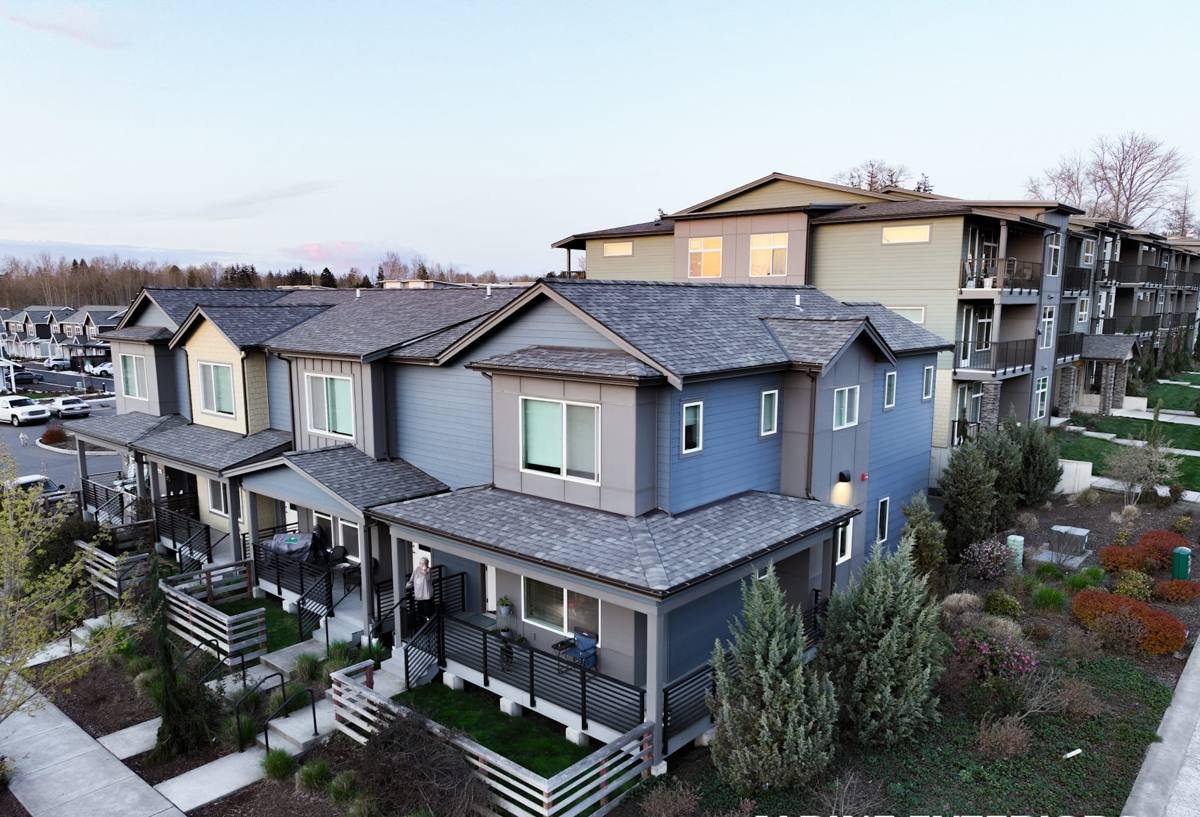
What the Wiser Lake Climate Actually Does to Siding
Shade and Moss, Not Just Weather
Open exposure to sun and wind actually helps siding — it dries fast after rain. Wiser Lake properties often don't get that. Mature trees and lakeside landscaping keep north- and east-facing walls shaded most of the day, which stretches the moss season out for months longer than it runs on a treeless lot in town. Moss and algae aren't just cosmetic. They hold moisture directly against the siding surface, and on materials that aren't built to handle that, prolonged dampness is what eventually causes swelling, delamination, or rot underneath.
Moisture That Has Nowhere to Go
Driving rain off the Salish Sea pushes water sideways into siding, not just down onto it. On a well-ventilated wall in full sun, that moisture evaporates within a day or two. In a shaded, humid pocket near the lake, it can linger far longer, which is exactly the condition that lets water work its way behind panels, into seams, and around fasteners and trim.
Freeze-Thaw Cycling
Whatcom County doesn't get brutal winters, but it does get repeated cold snaps followed by thaw and rain. Any siding that's already holding moisture — behind a hairline crack, a failed caulk joint, or a warped panel — is vulnerable to that freeze-thaw cycle widening the damage a little more each season.
Signs Wiser Lake Homeowners Should Watch For
Most siding damage doesn't announce itself. It shows up as small, easy-to-dismiss changes that are worth a closer look before they become bigger repairs:
- Panels that feel soft, spongy, or flex when you press on them
- Visible cracking, especially near corners, seams, or fastener points
- Persistent moss or dark streaking that comes back within weeks of cleaning
- Paint that's bubbling, peeling, or failing in patches rather than evenly across the wall
- Gaps opening up at butt joints or where siding meets trim, windows, or the foundation
- Visible warping or buckling, particularly on shaded walls
- A musty smell or visible staining on interior walls that back up to exterior siding
Any one of these on its own might be minor. Several showing up in the same area, especially on a shaded or lake-facing wall, usually means moisture has been working on that section for a while.
What a Correct Siding Repair Actually Involves
A repair that just covers the visible damage without checking what's underneath is a repair you'll be paying for again. On Wiser Lake homes especially, we treat every repair as a two-part job: fix what's showing, and confirm what's not.
Checking Behind the Siding, Not Just On It
Damaged siding is often a symptom, not the root problem. Before we replace a section, we check the house wrap or building paper underneath, the flashing at windows, doors, and trim intersections, and the condition of the sheathing itself. If water has been getting behind the siding through a failed seal somewhere, replacing the panel without fixing that entry point just resets the clock on the same failure.
Matching Materials the Right Way
Repaired sections need to match the surrounding siding in profile, exposure, and finish — otherwise you end up with an obvious patch instead of a repair. On homes already sided in James Hardie fiber cement, this is straightforward: we match the plank profile and use the correct ColorPlus finish or field-paint to blend properly. On homes with other siding materials, matching gets harder, and it's worth an honest conversation about whether patching is really the best long-term move.
Sealing and Flashing Details
Most siding failures we see near water and shade trace back to a sealing or flashing detail that was done wrong, or wore out, years before the panel itself failed. Correct repair means redoing those details to code and to manufacturer spec — not just caulking over the gap and moving on.
Repair or Replace? How We Make That Call
Not every damaged section needs a full re-side, and not every problem is solved with a patch. We walk homeowners through the actual factors rather than defaulting to the bigger job:
| Factor | Repair Usually Makes Sense | Replacement Usually Makes More Sense |
|---|---|---|
| Extent of damage | Isolated to a few panels or one wall section | Spread across multiple walls or elevations |
| Underlying moisture | Localized, source identified and fixable | Widespread rot in sheathing or framing |
| Siding material | Same material still available and matchable | Discontinued, faded beyond match, or a material we don't recommend long-term |
| Repair history | First or second repair to this area | Same section has been patched repeatedly |
| Age of siding | Well within expected service life | Near or past the material's realistic lifespan |
We'll always give you the honest read on which column your home falls into, not just the answer that leads to the bigger invoice.
When Repair Leads to a Bigger Conversation About Material
Sometimes a repair call turns into a longer conversation, especially on homes where the siding is vinyl, LP SmartSide, or untreated wood and it's failing in the same shaded, damp spots repeatedly. We're honest about this: we only install James Hardie fiber cement siding on this company's jobs. That's not a sales pitch tacked onto a repair visit — it's because Hardie's engineered-for-climate HZ product line, non-combustible composition, and factory ColorPlus finish hold up better against exactly the conditions Wiser Lake throws at siding: sustained shade, moss, and driving rain. If your existing siding keeps failing in the same area no matter how many times it's patched, that's worth knowing before you spend money on another round of repairs.
Our Process for a Wiser Lake Repair Job
The process is the same whether it's one panel or a full wall section, just scaled to the job:
- Inspection — we look at the damaged area and the surrounding wall, including moisture behind the siding where accessible
- Diagnosis — we identify the actual cause, whether that's a flashing failure, a sealing gap, or straightforward material fatigue
- Written estimate — a clear scope of what's being repaired and why, with repair-versus-replace options laid out honestly
- The work — matched materials, correct flashing and sealing details, and cleanup of moss or debris in the repair area
- Final check — we walk the repair with you before we call the job done
Access on lake and rural lots can be a factor — long driveways, tree cover close to the house, septic or well components near the work area. We plan around that up front instead of discovering it the day of the job.
Why a Crew That Already Works Wiser Lake Matters
A contractor unfamiliar with this area might treat a Wiser Lake repair the same as one in an open, sunny subdivision — same materials, same timeline, same assumptions about how fast things dry. That mismatch is how repairs come back sooner than they should. We know which walls on lake properties tend to hold moisture, how long the moss season really runs here compared to more open parts of Whatcom County, and what a repair needs to survive a full year of shade and rain rather than just look good on installation day. That's the value of hiring a crew that already works this specific area, not just the general region.
Keeping a Repair From Becoming a Repeat Visit
A few habits go a long way toward protecting a repair once it's done, especially on shaded or lake-adjacent walls:
- Trim back branches and vegetation that keep siding in constant shade or hold moisture against the wall
- Rinse moss and algae off before it builds up thick enough to trap water underneath
- Redirect sprinklers or landscape irrigation away from siding surfaces
- Check caulking at trim, windows, and seams once a year, and touch it up before it fails outright
- Have any soft spots or new staining looked at early, before the damage spreads into framing
If you're dealing with damaged, soft, or moss-covered siding on a Wiser Lake home, we're glad to take a look and give you an honest read on what it needs — repair, partial replacement, or something bigger. The estimate is free, there's no pressure, and you'll get a straight answer either way. Use the form below to get started.