 Semiahmoo Exterior
 Asphalt shingle roofing is still the most practical choice for the vast majority of homes in Bellingham and the surrounding Semiahmoo area — but "practical" only holds true when the job accounts for what this stretch of Whatcom County actually throws at a roof. Salt-tinged air off Bellingham Bay, long stretches of driving rain, and a moss season that can run most of the year are not abstract concerns here. They're the reason some shingle roofs make it fifteen years and others make it thirty.
Why Bellingham's Climate Is Hard on Asphalt Shingle Roofs
Three things work against a roof here at the same time, year after year. First is moisture load. Rain doesn't just fall in this part of Washington, it lingers — low clouds, drizzle, and saturated air keep roof surfaces wet for days at a stretch, which matters because asphalt shingles are designed to shed water fast, not sit under it. Second is salt air. Homes closer to the water, including those around Semiahmoo and Bellingham Bay, deal with airborne salt that accelerates corrosion on exposed metal fasteners, flashing, and vent components faster than it would inland. Third is shade and moss. Mature conifers and the marine-influenced humidity here create ideal conditions for moss and algae growth on north-facing slopes and shaded roof planes, and left unchecked, moss holds moisture directly against the shingle mat.
None of these factors alone is unusual for the Pacific Northwest. What makes Bellingham roofs work harder is that all three show up together on the same house, often the same roof plane, for most of the year.
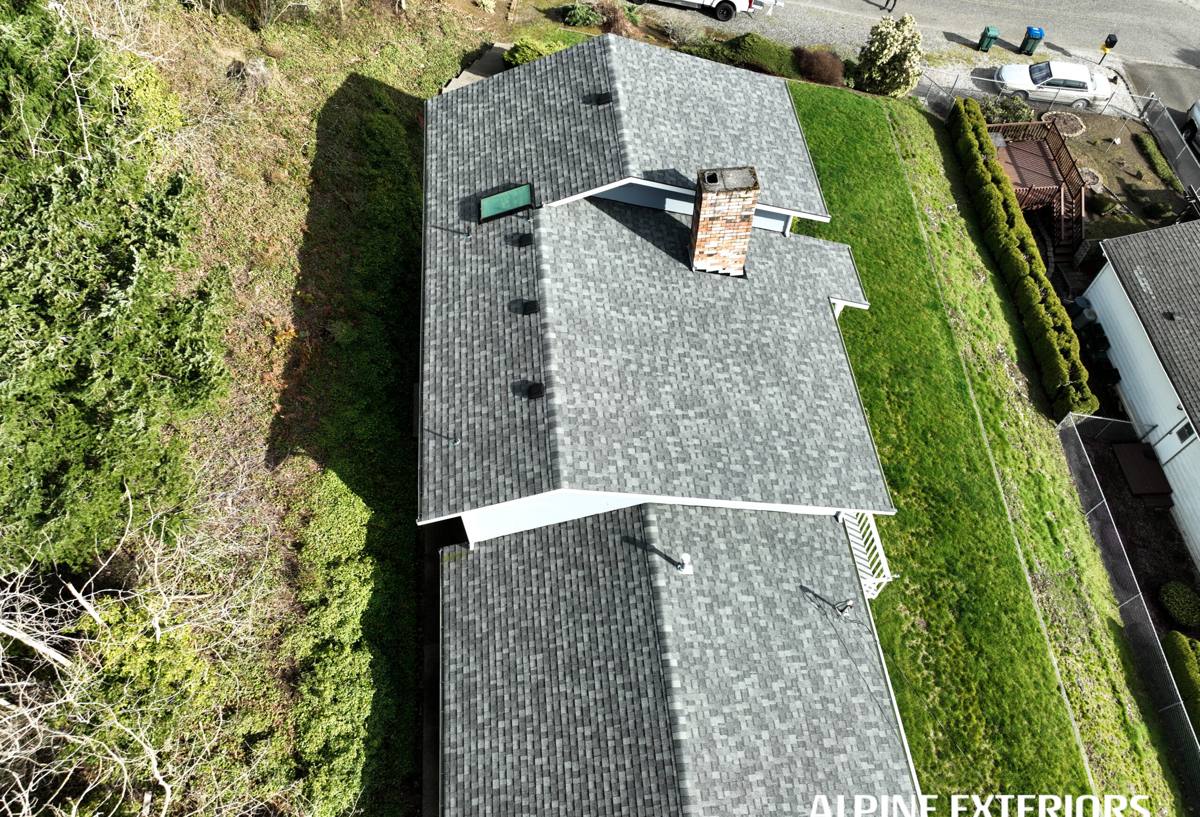
What a Roof Built for This Climate Actually Needs
A correctly built asphalt shingle roof in this area isn't just "shingles nailed to a deck." It's a system, and every layer has a job tied directly to local conditions.
- Ice-and-water shield at eaves and valleys — not primarily for ice here, but for the wind-driven rain that backs up under shingle tabs during winter storms.
- Corrosion-resistant flashing and fasteners — standard galvanized components degrade faster within a few miles of saltwater; stainless or heavier-coated hardware holds up longer.
- Balanced attic ventilation — intake at the eaves and exhaust at the ridge, sized correctly, so moist air isn't trapped against the roof deck from underneath.
- Algae-resistant shingle granules — copper- or zinc-infused granules that actively resist the algae and moss growth this climate encourages.
- Proper nailing pattern and fastener count — every shingle nailed per manufacturer spec, in the nailing zone, not just "close enough," so wind uplift during coastal storms doesn't peel courses back.
Skip any one of these and the roof will likely still look fine for a few years. The failures that show up in this climate are usually slow ones — a soft deck from long-term moisture, rusted flashing that finally lets go during a hard rain, or moss that's been quietly lifting shingle edges for two winters before anyone notices a leak.
Choosing the Right Shingle for a Coastal Whatcom County Home
Not every asphalt shingle product is built the same way, and the difference matters more here than in a drier climate. The table below is a general guide to how the common tiers compare for a home in the Bellingham area — actual product lines and warranties vary by manufacturer.
| Shingle Tier | Typical Lifespan Here | Wind Rating | Best Fit |
|---|---|---|---|
| 3-tab / economy | 12–18 years | Lower | Budget-driven projects, secondary structures |
| Standard architectural (dimensional) | 20–30 years | Moderate to high | Most Bellingham single-family homes |
| Premium/designer architectural | 25–35+ years | High | Homes with high wind exposure or a homeowner prioritizing longevity and appearance |
| Algae-resistant upgrade (any tier) | Adds years to appearance life | Same as base shingle | Shaded lots, north-facing roof planes, homes near mature trees |
For most homes in this area, we steer people toward a standard-to-premium architectural shingle with algae-resistant granules built in. The upcharge over economy 3-tab is modest, and given how much moss and algae exposure a shaded Whatcom County roof gets, it's usually the difference that pays off first.
A Note on Product Selection
We don't install every shingle line on the market. Some lower-tier products have thinner mats and less consistent granule adhesion, which shows up as premature wear once they're exposed to sustained coastal moisture — that's a maintenance and callback burden we'd rather avoid for both the homeowner and the crew. We'll walk through the options that hold up in this specific climate and explain the trade-offs honestly, rather than upselling a tier a home doesn't need.
Moss, Algae, and Shade: The Long-Term Maintenance Reality
If your home sits under or near conifers — common throughout Bellingham and the Semiahmoo area — plan on an ongoing relationship with moss, not a one-time fix. Moss spores are always present in the air here; they just need a shaded, consistently damp surface to take hold, and a north-facing asphalt shingle roof after a wet Pacific Northwest winter is close to ideal.
The goal isn't to eliminate moss risk entirely — that's not realistic in this climate — it's to manage it so it never gets the chance to lift shingles or hold water against the roof deck. That means:
- Zinc or copper strips installed near the ridge on shaded slopes, which release trace metal ions with each rain to inhibit new growth
- Periodic soft washing rather than pressure washing, which can strip granules and shorten shingle life
- Keeping gutters and valleys clear so moss debris doesn't dam water against the shingle courses
- Trimming back overhanging branches where practical, to cut down on shade and organic debris landing on the roof
Our Installation Process
Inspection and Tear-Off
We start by getting on the roof, not just looking at it from the ground. We check deck condition, look for soft spots or rot around valleys and penetrations, and assess how the current roof has actually performed against Bellingham's rain and wind patterns. Full tear-off is standard — we don't recommend layering new shingles over old on this coast, since trapped moisture between layers is exactly the failure mode this climate creates.
Deck Repair and Underlayment
Any damaged sheathing gets replaced before anything else goes down — installing new shingles over a soft or wet deck just hides a problem that will resurface. From there, synthetic underlayment goes down across the field, with self-adhering ice-and-water membrane at eaves, valleys, and around every penetration where wind-driven rain is most likely to find a way in.
Flashing and Ventilation
New flashing goes in at every chimney, wall intersection, and roof-to-roof junction, using corrosion-resistant materials given the coastal air quality in this area. We also check and correct attic ventilation at this stage — undersized or blocked ventilation is one of the more common issues we find on older Bellingham homes, and it quietly shortens shingle life from underneath.
Shingle Installation and Cleanup
Shingles go down per manufacturer specification for nail placement, count, and exposure — details that directly affect the wind warranty. We do a full property cleanup, including a magnetic sweep for stray nails, before calling the job finished.
Signs Your Bellingham Roof Needs Attention
A quick self-check from the ground can catch problems early, before they turn into a full deck repair. Look for:
- Granules collecting in gutters or at downspout outlets
- Dark streaking or green-black patches, especially on shaded or north-facing slopes
- Visible moss growth, even a thin layer, along ridges or in valleys
- Curling, cupping, or lifted shingle edges after a windy storm
- Daylight visible through the attic roof deck, or damp insulation after heavy rain
- Sagging in any roof plane, which can indicate deck-level moisture damage
Any one of these is worth a look. Several together usually mean it's time for a real inspection rather than a wait-and-see approach.
Repair vs. Replacement: Making the Right Call
Not every roof issue in this climate means a full replacement. The right call depends on the roof's age, how widespread the damage is, and what's driving it.
| Factor | Leans Toward Repair | Leans Toward Replacement |
|---|---|---|
| Roof age | Under 15 years | Approaching or past shingle's rated lifespan |
| Damage location | Isolated to one slope or flashing point | Spread across multiple roof planes |
| Deck condition | Solid, dry sheathing | Soft spots or rot found in more than one area |
| Moss/algae history | Recent, surface-level growth | Long-term growth with granule loss underneath |
| Underlying cause | Single storm event or isolated flashing failure | Systemic ventilation or moisture issues throughout |
We'll always tell you honestly which side of that line your roof falls on. A targeted repair is often the right answer, and there's no reason to push a full replacement on a roof that has years of life left.
Why a Local Bellingham Crew Makes a Difference
Roofing crews who don't regularly work this specific stretch of coastline tend to under-spec for it — standard fasteners instead of corrosion-resistant ones, ventilation calculated for a drier region, or a shingle choice that ignores how much shade and moss exposure a given lot actually gets. Working consistently in Bellingham and the broader Semiahmoo area means we're not guessing at how a roof will hold up here — we're building to conditions we see repeatedly, on homes with the same tree cover, the same wind exposure off the water, and the same long wet season.
It also matters for the practical side of a project: knowing which neighborhoods have tree canopy or shoreline considerations that affect job planning, understanding typical lot layouts for material staging and access, and being available quickly if a storm exposes an issue after the job is done.
Warranty and Maintenance After Installation
A new asphalt shingle roof typically carries two layers of coverage: a manufacturer's material warranty and a workmanship warranty from the installing contractor. We'll walk through both in plain terms before work starts, including what voids manufacturer coverage — improper ventilation and non-approved accessory products are common culprits — so there are no surprises later.
After installation, a roof in this climate benefits from a periodic check-in, especially heading into the wetter months. Catching a lifted shingle edge or a clogged valley early is a five-minute fix; ignoring it through a full Bellingham winter often isn't.
If you're weighing a repair, a full replacement, or just want an honest read on where your roof currently stands, we're glad to take a look. Use the form below to request a free, no-pressure estimate.