 Semiahmoo Exterior
 Siding on the Semiahmoo Spit Has a Harder Job Than Siding Anywhere Inland
Semiahmoo Resort sits out on the spit, with water on multiple sides and very little standing between the exterior of a home and Semiahmoo Bay. That location is what makes the resort beautiful, and it's also what makes the siding decision more consequential than it would be for a home a few miles inland in Blaine or elsewhere in Whatcom County. Salt-laden marine air, wind-driven rain off the water, and a long, damp moss season all load stress onto exterior materials here faster than a typical spec sheet accounts for. Siding that performs fine in a sheltered subdivision can fail early on a waterfront spit.
This page is specifically about James Hardie fiber cement siding installed on homes in and around Semiahmoo Resort. We're not going to cover every siding option on the market or repeat generic installation advice — we install Hardie exclusively, and we want to explain what that means for a home in this exact location.
What the Semiahmoo Climate Actually Does to a House
Salt Air
Airborne salt from Semiahmoo Bay settles on every exterior surface, not just the siding facing the water. Over years, salt exposure accelerates corrosion on fasteners, trim hardware, and any metal flashing components, and it can degrade paint films that weren't formulated to resist it. Wood-based siding products are particularly vulnerable because salt holds moisture against the surface longer, which keeps the substrate wet and feeds rot and mold even when the siding "looks" dry on the outside.
Driving Rain
Wind off the water doesn't just drop rain straight down — it pushes it sideways, into laps, seams, and butt joints that would stay dry in a calmer inland setting. Any siding system on a spit-facing or bay-facing elevation has to be detailed as if wind-driven rain is a certainty, not a rare event, because on Semiahmoo Resort it basically is.
Moss Season
Whatcom County's wet season runs long, and the combination of shade, moisture, and mild temperatures gives moss and algae a real head start on north-facing and tree-shaded walls. Moss holds moisture against a wall assembly the same way salt does, which is bad news for any siding material that's sensitive to sustained dampness.
None of these are exotic problems — they're the normal cost of living on the water in the Pacific Northwest. But they mean the siding choice and the installation quality matter more here than they would in a lot of other places.
Why We Install Only James Hardie Fiber Cement
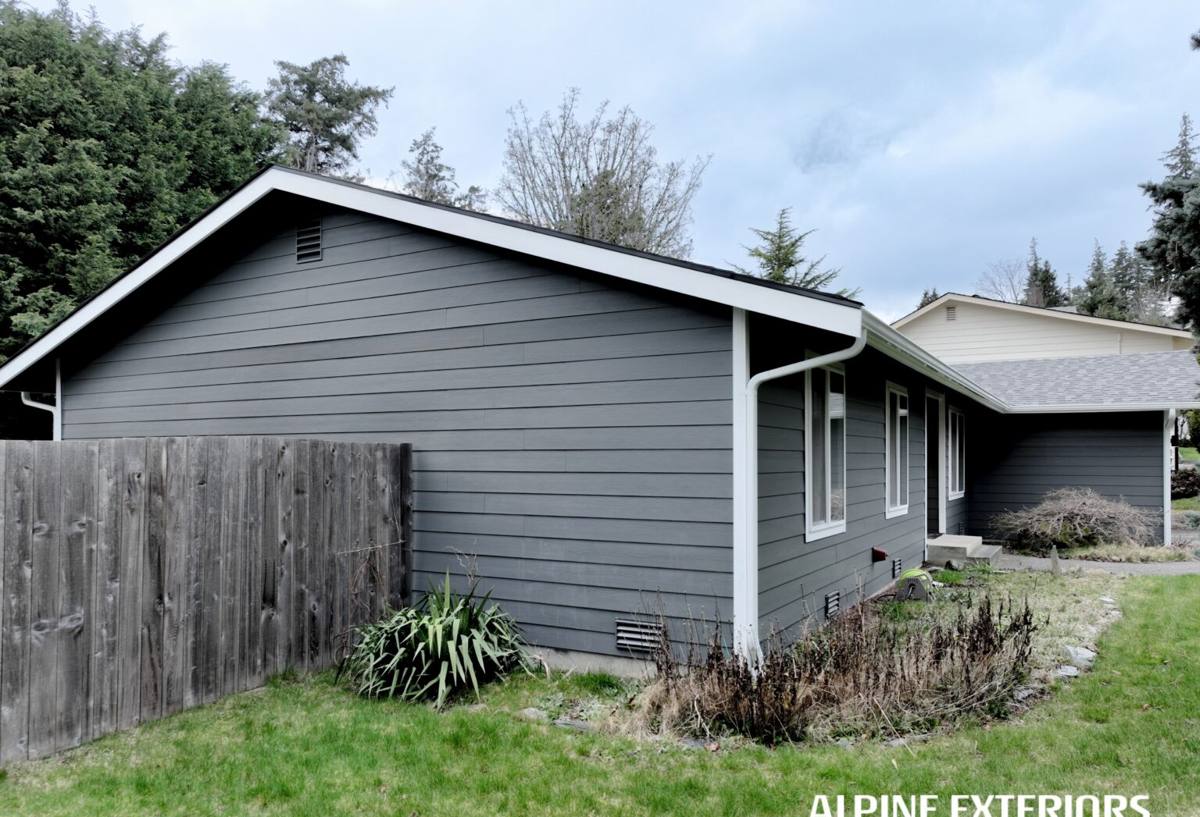
We standardized on James Hardie for every job we take, including work at Semiahmoo Resort, because fiber cement handles this specific combination of stressors better than the alternatives we used to install. It's non-combustible, it doesn't feed mold or rot the way wood-based products can, and it holds its factory finish through repeated wet-dry cycling far longer than field-applied paint systems typically do. We don't install vinyl, LP SmartSide, Cemplank, Allura, primed spruce, or cedar — not because those products don't have a place somewhere, but because on marine-exposed homes we've found the long-term trade-offs (moisture sensitivity, maintenance burden, or finish durability) aren't worth it when a better-suited product exists.
HZ5 Engineering for Marine Exposure
James Hardie engineers its siding by climate zone, and homes in Semiahmoo Resort's marine, high-moisture exposure fall into the HZ5 category — the line built for wet, coastal conditions rather than dry-climate zones. That distinction matters: HZ5 product is manufactured with this exact combination of rain and humidity in mind, not adapted from a product built for a different climate.
ColorPlus Factory Finish
Instead of a field-applied paint job, Hardie's ColorPlus finish is baked on at the factory in a controlled process, which gives it better adhesion and UV/color stability than most site-applied coatings. In a salt-air environment, where paint film integrity determines how long a wall stays protected, that's a meaningful advantage — and it comes backed by its own finish warranty separate from the substrate warranty.
What a Correct Installation Involves Here
Fiber cement siding is only as good as the assembly behind it. On a marine-exposed home, the details below aren't optional extras — they're what separates siding that lasts decades from siding that fails at the seams in five to ten years.
- Rainscreen gap: A drainage gap behind the siding lets any wind-driven moisture that gets past the surface drain and dry out instead of sitting against the wall sheathing.
- Weather-resistive barrier: A correctly lapped and taped water-resistive barrier underneath the siding is the real waterproofing layer — the siding sheds the bulk of the water, the barrier handles what gets through.
- Flashing at every penetration: Windows, doors, hose bibs, vents, and any wall penetration need proper flashing so wind-driven rain can't track behind the cladding.
- Fastener spec: Corrosion-resistant fasteners, installed at the correct spacing and depth, matter more here than inland — the wrong fastener in a salt-air environment corrodes and eventually fails to hold.
- Caulking and gaps: Manufacturer-specified gaps and sealant at butt joints and trim transitions prevent water from wicking into cut edges.
- Painted/sealed cut edges: Any field-cut edge of Hardie board needs to be sealed per manufacturer instructions — an unsealed cut edge is a moisture entry point waiting to happen.
Skipping any one of these doesn't usually show up as a problem in year one. It shows up in year six or seven, as staining, soft trim, or bubbling paint — right around the time a homeowner assumes their siding should still be trouble-free.
Our Process on Semiahmoo Resort Jobs
- On-site assessment: We walk the home, note which elevations take the most wind and rain exposure, check existing moisture damage, and assess trim, flashing, and window conditions.
- Tear-off and inspection: Old siding comes off and we inspect the sheathing underneath for hidden rot or moisture damage before anything new goes up — this is the point where problems that have been building for years finally get found and fixed.
- Weather barrier and rainscreen install: We install the water-resistive barrier and drainage gap correctly the first time, since this layer becomes inaccessible once siding goes on.
- Flashing and trim detailing: Every window, door, and penetration gets flashed before siding closes it in.
- Hardie board installation: Panels or lap siding go up to manufacturer fastening and gapping specifications, matched to the HZ5 product line appropriate for this exposure.
- Final detailing and walkthrough: Caulking, touch-up, cleanup, and a walkthrough so the homeowner understands what was done and what maintenance (if any) to expect.
Cost Factors for a Semiahmoo Resort Home
Every home is different, and we won't quote a number without seeing the property, but these are the factors that most commonly move the price on a Semiahmoo Resort job:
| Factor | Why It Matters Here |
|---|---|
| Home size and wall complexity | More corners, dormers, and roof lines mean more flashing and trim detail work, which is labor-intensive to do right |
| Existing sheathing condition | Waterfront homes sometimes have hidden moisture damage behind old siding that needs repair before new siding goes on |
| Product line (lap, panel, or shingle style) | Different Hardie profiles have different material and install costs |
| Access on the spit | Condo and resort-community sites can have tighter staging areas or access rules that affect scheduling and equipment setup |
| Trim and accessory scope | Corner boards, soffit, fascia, and trim work are often bundled with siding replacement and add to total scope |
Working Inside a Resort Community
Semiahmoo Resort isn't a standard subdivision — it's a mix of condos, townhomes, and single-family properties, often with an HOA or resort management layer involved in exterior work. A crew that's worked in this kind of community understands how to coordinate scheduling, staging, and site access without creating friction with neighbors, shared driveways, or resort operations. That's a practical, unglamorous reason local experience matters as much as product knowledge: the best siding installation in the world still needs a crew that can execute it cleanly on a tight, shared-access site.
Maintenance: What to Expect After Installation
Correctly installed Hardie siding with a ColorPlus finish is low-maintenance, not zero-maintenance. A simple annual routine keeps it performing the way it's designed to in this environment:
- Rinse salt residue off the siding once or twice a year, especially on bay-facing elevations
- Keep gutters clear so roof runoff doesn't sheet down over siding it wasn't designed to handle
- Trim back vegetation and tree cover that keeps walls shaded and damp, which encourages moss growth
- Watch caulked joints and trim transitions for cracking or gaps and have them resealed before water gets behind the assembly
- Address any soft trim, staining, or bubbling paint promptly rather than waiting — small issues caught early are simple, small issues left alone become expensive
Get a Straight Answer About Your Home
If your Semiahmoo Resort home has siding that's aging out, showing moisture damage, or you're planning ahead for a replacement, we're happy to take a look and give you an honest read on condition and options. There's no pressure and no obligation — just a straightforward assessment from a crew that installs one product because we believe in doing it right. Use the form below to request a free estimate.