 Semiahmoo Exterior
 Why Board & Batten Fits Semiahmoo Resort's Waterfront Homes
Board and batten shows up more often on Semiahmoo Resort homes than almost anywhere else in Whatcom County, and there's a reason for it beyond looks. The vertical lines read as clean and modern on the newer builds along the water, and as classic Northwest coastal on the older ones. It pairs well with the mix of shingle, stone, and dark trim you see throughout the neighborhood, and it holds up visually against the open sightlines of the bay in a way that busier siding profiles don't.
But board and batten is also one of the least forgiving siding profiles to install badly. The wide boards and narrow battens create a lot of vertical seams, and every one of those seams is a place water can find its way behind the cladding if the assembly underneath isn't built correctly. On a spit exposed to open water on more than one side, that's not a minor detail — it's the difference between siding that looks good for twenty-five years and siding that's rotting behind the battens in eight.
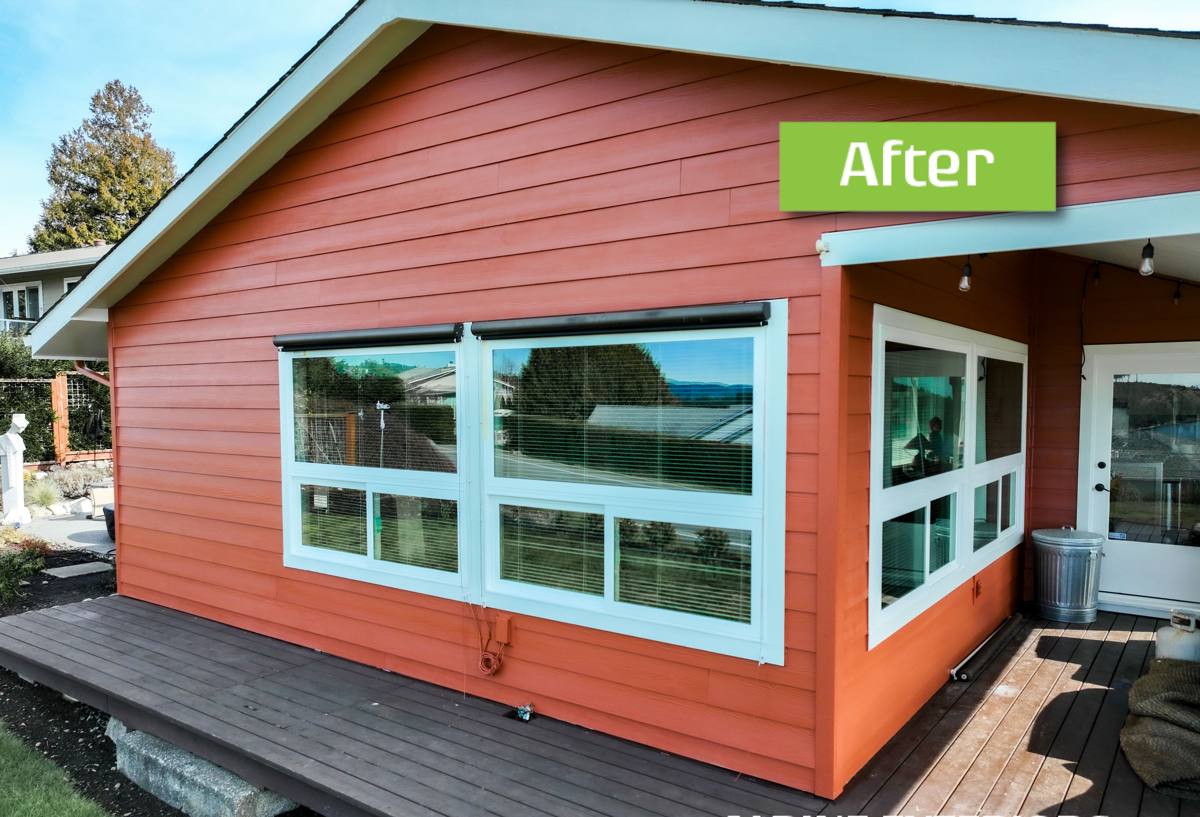
What Semiahmoo's Climate Actually Does to Vertical Siding
Semiahmoo sits out on the water, which means homes here take a combination of exposures that inland Whatcom County properties simply don't deal with to the same degree.
Salt Air
Wind off Semiahmoo Bay carries salt spray onto siding, trim, and fasteners year-round. Salt is corrosive to the wrong fastener and abrasive to finishes that aren't built to take it. Over years, homes on the spit show the difference between materials that were engineered for coastal exposure and materials that weren't — usually first in chalking, fading, or rust bleed at the nail heads.
Driving Rain
Storms off the strait don't fall straight down here — they come in sideways. Board and batten's vertical battens can actually help shed driving rain when they're installed with the right reveal and flashing detail, but the same wind-driven rain will drive straight into a seam that's caulked instead of properly lapped and drained. Caulk is not a water management strategy on a house exposed to this kind of wind.
A Long Moss Season
Whatcom County's damp season runs long, and Semiahmoo's proximity to the water only extends it. North-facing walls, shaded elevations near mature landscaping, and any spot where water sits instead of draining will grow moss and algae faster here than almost anywhere else in the region. Moss holds moisture against the siding surface, and on the wrong material that moisture works its way into the substrate over time.
What a Correct Board & Batten Installation Actually Involves
Board and batten is easy to install badly and only a little harder to install right. The difference is almost entirely in what happens before the first board goes up.
Drainage Behind the Cladding
Every board and batten wall on a home exposed to driving rain needs a drainage plane — a weather-resistant barrier and, ideally, a rainscreen gap — behind the siding, not just under it. This lets any moisture that does get past the battens drain and dry out instead of sitting against the sheathing.
Fastening Into Framing, Not Just Sheathing
Board and batten carries real wind load on an exposed site like the spit. Boards and battens both need to land on and fasten into structural framing at the correct spacing, with corrosion-resistant fasteners rated for the material and the coastal exposure — not whatever was left over from the last job.
Flashing at Every Horizontal Transition
Window heads, water tables, roof-to-wall intersections, and any point where a horizontal surface meets vertical siding needs proper step or drip flashing. This is the detail that gets skipped most often because it's slower work, and it's the detail that causes the most callbacks when it's skipped.
Batten Spacing and Reveal
Battens that are too tight trap moisture between board and batten with no way to dry. Battens spaced and fastened to the manufacturer's specification allow airflow and drainage while still giving the clean, even reveal that makes board and batten look intentional instead of improvised.
Why We Install James Hardie Board & Batten and Nothing Else
We standardized on James Hardie fiber cement for every siding job we do, including board and batten, and Semiahmoo is exactly the kind of site that shows why. Hardie's board and batten panels are engineered fiber cement — non-combustible, dimensionally stable, and built with a factory-applied ColorPlus finish that's formulated to hold color and resist the kind of salt and UV exposure this location sees. That finish matters more here than in a sheltered inland neighborhood, because sun, salt, and moisture are working against the surface finish every single day on the water.
Hardie also engineers specific product lines for different climate exposures. For a site like Semiahmoo, that means specifying the right HZ line and installation detailing for high-moisture, high-wind coastal conditions, rather than treating every job the same regardless of exposure. Fiber cement doesn't rot, doesn't feed moss the way some organic-based sidings can, and doesn't require the recoating cycle that primed wood or some engineered wood products need to keep ahead of moisture. That's a real, honest trade-off in Hardie's favor for this specific site — not a knock on every other product in general, just a reflection of what holds up best where wind carries salt spray onto the wall.
Hardie's transferable limited warranty is also part of why we standardized on it. On a resort community where homes change hands, a warranty that transfers to the next owner is worth more than it looks on paper.
Board & Batten Material Comparison for a Semiahmoo Exposure
| Factor | James Hardie Fiber Cement | Primed Wood / Engineered Wood | Vinyl Board & Batten |
|---|---|---|---|
| Salt air / coastal exposure | Engineered coastal HZ lines, factory ColorPlus finish | Vulnerable without frequent recoating | Can chalk and fade faster in direct salt exposure |
| Moss and moisture resistance | Non-organic, won't feed rot | Organic material, susceptible if finish fails | Won't rot, but seams can trap moisture behind panel |
| Maintenance cycle | Occasional wash, no recoating needed with ColorPlus | Regular repainting/recoating required | Low, but cracks and fades over time |
| Fire resistance | Non-combustible | Combustible | Can warp or melt under heat exposure |
| Warranty structure | Long-term, transferable | Varies, often shorter on finish | Often prorated after early years |
Our Process for a Board & Batten Job at Semiahmoo Resort
- On-site assessment — we walk the exposures on your specific lot, noting which elevations take the most driving rain, which stay shaded and damp, and where existing moisture or moss damage has already started.
- Detail plan before material order — drainage plane, rainscreen approach, flashing points, and fastener spec are decided before we order a single board, not improvised on-site.
- Tear-off and substrate check — old siding comes off and the sheathing underneath gets inspected for hidden moisture damage before anything new goes up.
- Weather barrier and drainage installation — the water-resistive barrier and drainage gap go in correctly the first time, since this layer is invisible once siding is up and impossible to fix cheaply later.
- Board and batten installation to spec — correct fastening pattern, batten spacing, and reveal, following Hardie's installation instructions for this exposure category.
- Flashing and sealant at every transition — windows, trim, and horizontal intersections get flashed properly, with sealant used only where it belongs, not as a substitute for flashing.
- Final walk-through — we go over the finished job with you before we consider it done.
What Drives the Cost of a Board & Batten Job Here
| Cost Factor | Why It Matters at Semiahmoo |
|---|---|
| Existing substrate condition | Homes with hidden moisture damage behind old siding need sheathing repair before new siding goes on |
| Wall height and access | Waterfront homes often have taller elevations or limited access on the water side |
| Amount of trim and window detailing | More window heads, corners, and transitions means more flashing labor |
| Rainscreen vs. direct-applied assembly | A true drainage gap adds material and labor but is worth it on this exposure |
| Color and finish selection | Factory-finished ColorPlus panels cost more up front than field-painted options but eliminate a repaint cycle |
Every job gets a written estimate based on your home's actual condition and elevations — we don't quote board and batten off a square footage number alone, because the substrate and detailing work is what actually drives cost on this kind of site.
Maintaining Board & Batten Siding on the Spit
- Rinse salt residue off siding surfaces periodically, especially on elevations facing open water
- Keep gutters and downspouts clear so water isn't sheeting down wall surfaces
- Trim back landscaping that shades walls and slows drying after rain
- Check caulking at windows and trim annually — it's a maintenance item, not a permanent seal
- Address any soft spots, staining, or moss growth early rather than waiting for a full season
- Have flashing and seams inspected every few years, especially after major windstorms
Why Hiring a Crew That Already Works This Neighborhood Matters
Semiahmoo Resort isn't a typical inland Whatcom County lot. The exposures vary sharply from one elevation to the next on the same house, and a crew that hasn't worked waterfront sites like this one tends to treat every wall the same way. That shows up later as moisture problems on the elevation that actually needed the extra drainage detail or the different fastener spec. A crew that already knows this stretch of the county knows which walls need the closer attention before the first panel goes up, not after a callback.
If you're planning a board and batten project for your home at Semiahmoo Resort, we'd be glad to walk the site with you and put together a straightforward, no-pressure estimate based on what your home actually needs. There's a short form below — reach out whenever it's convenient.