 Semiahmoo Exterior
 Point Roberts Weather Doesn't Play by Normal Rules
Point Roberts sits out on its own point of land, wrapped on three sides by water and exposed to whatever comes off Boundary Bay and the Strait of Georgia. That means salt-laden air working on every exposed metal surface year-round, driving rain that comes in sideways during winter storms, and a moss season that runs longer here than it does a few miles inland. A roof in this location isn't dealing with typical Whatcom County weather — it's dealing with a marine environment layered on top of everything else the Pacific Northwest already throws at a roof.
Asphalt shingles can work here, but they're fighting an uphill battle: granule loss from wind-driven rain, moss taking hold in shaded valleys, and a shorter service life from constant moisture cycling. Metal roofing, done correctly, is built to handle exactly this kind of exposure. The key phrase is "done correctly" — metal is not a material where you can cut corners and expect coastal conditions to forgive you.
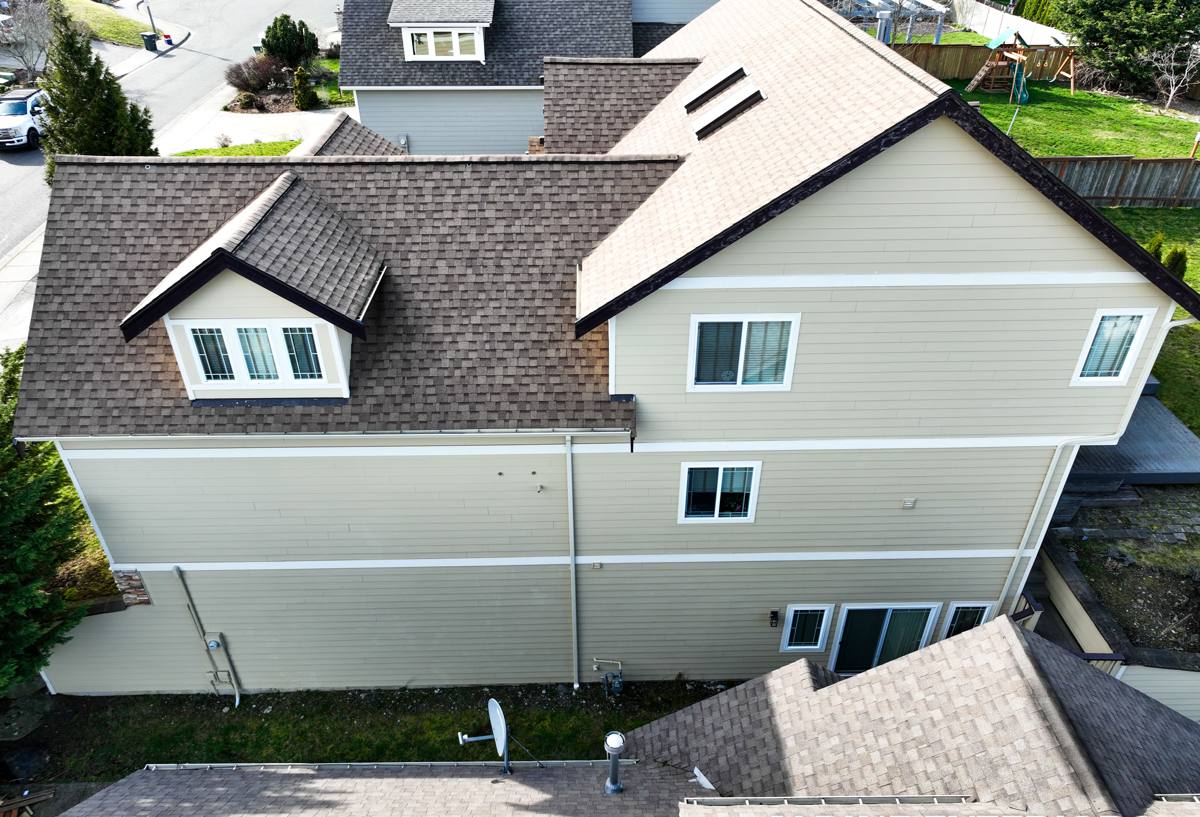
Why Metal Roofing Holds Up Here — When It's Installed Right
Metal roofing has real advantages for a property exposed to salt air and heavy, sustained rain:
- Steep-slope metal sheds water fast, giving driving rain less time to find a weak point
- A smooth, hard surface gives moss and algae far less to grip onto than aged asphalt granules
- Modern coatings are engineered specifically to resist salt-air corrosion over decades, not years
- Lighter weight than many roofing materials, which reduces long-term structural stress
- Non-combustible, which matters as much for insurance conversations as it does for safety
None of that happens automatically just because the material is metal. A poorly installed metal roof in a salt-air environment can corrode at fastener points, trap moisture under panels, or fail at flashing details faster than a well-installed asphalt roof would. The material gives you a strong ceiling on performance — the installation determines whether you ever get close to it.
Choosing a Panel System That Matches This Exposure
Standing Seam vs. Exposed-Fastener Panels
Not all metal roofing is built the same way, and the difference matters more here than it would somewhere drier and inland. The biggest distinction is how the panels attach to the roof deck.
| Panel Type | How It Fastens | Behavior in Salt Air / Driving Rain |
|---|---|---|
| Standing seam | Concealed clips, no exposed fasteners through the panel face | Fasteners are shielded from direct salt exposure and UV; seams interlock to resist wind-driven rain |
| Exposed-fastener panel | Screws driven through the panel face into the deck or purlins | Every screw is a potential entry point; rubber washers degrade faster in salt air and need eventual replacement |
We don't refuse to install exposed-fastener panels — they have a place on outbuildings, shops, and lower-budget projects where the tradeoffs are understood. But for a primary residence exposed to this kind of marine weather, we steer clients toward standing seam as our professional standard. The fastener exposure issue isn't a manufacturer defect — it's simple physics: a screw head sitting in salt-laden, rain-soaked air for years is going to need more attention than a fastener that's never exposed to the elements at all.
What a Correct Installation Involves in a Salt-Air Climate
Underlayment and Water Protection
Every metal roof needs a synthetic or self-adhered underlayment beneath it, but in a driving-rain environment we pay particular attention to valleys, eaves, and any low-slope transitions where wind can force water uphill under the panels. A self-adhered ice-and-water membrane at those vulnerable points isn't optional here — it's the difference between a roof that shrugs off a winter storm and one that develops a slow leak nobody notices until there's damage underneath.
Fasteners, Flashing, and Penetrations
Every screw, clip, and piece of flashing on this roof needs to be rated for the corrosion class it's actually going to face. That means matching fastener metallurgy to the panel material so you don't get galvanic corrosion between dissimilar metals, and using flashing details at chimneys, vents, and wall transitions that are formed and sealed to shed water rather than rely on caulk to do the job long-term. Caulk is a backup, not a strategy.
Ventilation
A well-ventilated attic or roof assembly keeps condensation from forming on the underside of metal panels — a real issue in a humid, marine climate where warm interior air meets a cold metal surface. Proper intake and exhaust venting protects the roof deck itself, which is often overlooked in favor of just talking about the panels.
Moss, Algae, and Drainage Through a Long Moss Season
Point Roberts' moss season stretches longer than drier inland areas because the combination of shade, moisture, and mild temperatures rarely lets up. Moss doesn't just sit on a roof looking bad — it holds moisture against the surface, works into seams and fastener points, and can back up water in valleys and at eave lines. On a metal roof, the smooth surface itself is a real advantage, since moss has a much harder time establishing a foothold compared to textured asphalt shingles. But a few details still matter:
- Valleys need to be sized and detailed to move volume, not just water — needle and leaf debris collects here first
- Overhanging tree limbs should be trimmed back to reduce shade and organic debris landing on the roof
- Gutters and downspouts need to stay clear so water actually leaves the roof instead of backing up under an edge
- Low-slope sections are more vulnerable to standing moisture and need extra attention during design, not just installation
Metal roofing reduces the moss problem significantly compared to shingles, but it doesn't eliminate the need for basic upkeep in a climate this wet.
Our Process for a Point Roberts Metal Roof
The steps themselves aren't unusual, but the order and attention we give each one is shaped by this specific location:
- On-site inspection — we look at existing roof condition, deck integrity, ventilation, and how exposed the roof is to prevailing wind and salt spray off the water
- Measurement and system design — panel profile, gauge, coating, and flashing details are chosen for that specific roof's exposure, not a one-size-fits-all package
- Permitting — pulled through Whatcom County before work begins, so there are no surprises mid-project
- Material and crew logistics — planned around the reality of getting equipment and supplies into Point Roberts
- Tear-off or overlay prep — deck inspected and repaired as needed before a single panel goes down
- Installation — underlayment, flashing, panels, and trim installed to the standard the exposure calls for
- Final walk-through — we go over the finished roof with the homeowner, not just hand over an invoice
Why a Point Roberts-Experienced Crew Matters
Point Roberts is a U.S. exclave — the only practical land route in and out crosses through Canada. That's a fact of geography, not an inconvenience we complain about, but it does mean material deliveries and crew scheduling have to account for a border crossing, not just a drive across town. A contractor who hasn't worked here before can underestimate that reality, which turns into delayed material arrivals, crews sitting idle, or a job that drags on longer than it should have.
A crew that already works this area knows how to plan around that logistics reality, has a working relationship with Whatcom County permitting for this specific location, and understands the exposure conditions firsthand rather than guessing from a spec sheet. That familiarity shows up in fewer surprises, tighter scheduling, and a roof detailed for the actual weather it has to survive — whether the home is a year-round residence or a place you get out to on weekends.
Homeowner Maintenance Checklist
A correctly installed metal roof in this climate is low-maintenance, not no-maintenance. A short annual routine goes a long way:
- Clear leaves, needles, and moss buildup from valleys and gutters, especially heading into fall
- Rinse accumulated salt film off the roof surface periodically, particularly on sides facing open water
- Check sealant and flashing at penetrations — vents, chimneys, skylights — for wear after major storms
- Trim back tree limbs that overhang the roof to reduce shade, debris, and moss pressure
- Walk the roofline visually after any severe wind event to check for lifted panels or dislodged trim
- Have a professional inspection every few years, even if nothing looks obviously wrong
What Drives the Cost
Every roof is different, but the same handful of factors move the price up or down on most metal roofing projects in this area:
| Factor | Why It Matters |
|---|---|
| Panel material (steel, aluminum, zinc) | Aluminum resists salt-air corrosion especially well and is often worth the premium this close to water |
| Panel system (standing seam vs. exposed fastener) | Standing seam costs more upfront but reduces long-term maintenance in this exposure |
| Roof complexity | Valleys, dormers, and multiple roof planes add labor and flashing detail |
| Tear-off vs. overlay | Removing old roofing adds cost but lets us inspect and repair the deck underneath |
| Ventilation upgrades | Adding or correcting attic ventilation during the project is more efficient than doing it later |
Broadly, expect metal roofing to sit above asphalt shingles in upfront cost and below it in lifetime cost, assuming the installation is done right. Exact numbers depend on the roof itself, which is why we walk the property before giving a real figure.
If you're weighing metal roofing for a Point Roberts property, we're glad to come take a look and talk through what your roof actually needs — no pressure, no sales script, just a straight assessment. There's a form below if you'd like to get that scheduled.