 Semiahmoo Exterior
 Metal Roofing on a Blaine Home: What the Climate Actually Demands
Blaine sits at the top corner of Whatcom County, wedged between Semiahmoo Bay, Drayton Harbor, and the Canadian border, and that location shapes what a roof out here has to deal with. Salt-laden air comes off the water on a regular basis, storms push rain sideways instead of straight down, and the mild, damp weather that defines this part of the Pacific Northwest keeps moss and mildew active for most of the year. A roofing material that performs fine in a drier, more sheltered town doesn't automatically perform the same way here.
Metal roofing has real advantages in this kind of climate when it's the right system, the right material, and the right installation. It also has real failure points when any of those three things is wrong — a mismatched fastener, a coating not suited to salt exposure, or flashing that wasn't detailed for wind-driven rain. This page covers what a metal roof needs to hold up in Blaine specifically, what a correct installation actually involves, and how our process works on a metal roofing project in this part of Whatcom County.
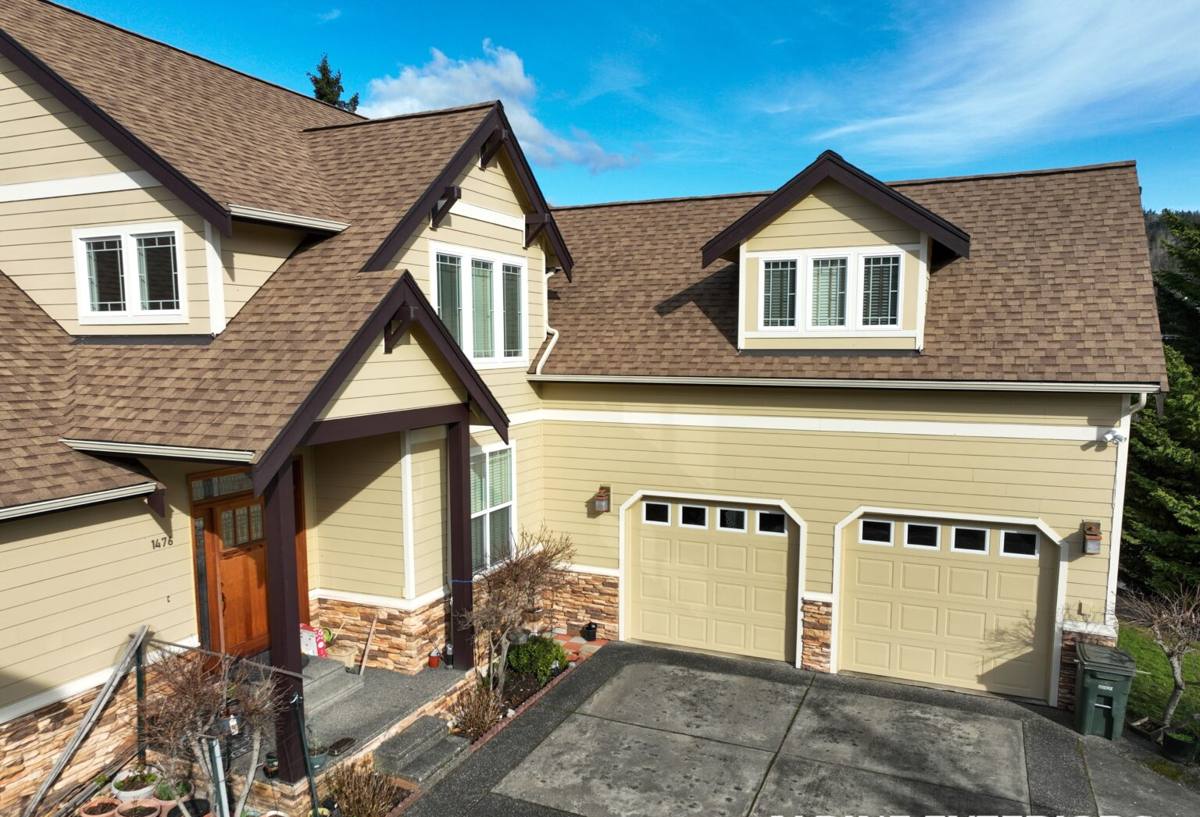
What Blaine's Climate Does to a Roof
Salt Air Off Semiahmoo Bay and Drayton Harbor
Homes in and around Blaine sit close enough to Semiahmoo Bay and Drayton Harbor that salt-laden air reaches most of the town, not just the waterfront lots. Salt accelerates corrosion in exposed metal, and a roof is nothing but exposed metal when it's a metal roof — fasteners, panel seams, flashing, and trim are all in that airstream every day, not just during storms. Corrosion on a roof fastener or flashing joint often starts well before it's visible from the ground, and by the time a stain shows up on the panel below it, the hardware underneath has usually been losing integrity for a while.
Driving Rain and Wind Off the Water
Rain in Blaine doesn't arrive gently. Storms coming off the water push it sideways, driving moisture up under panel laps, into valleys, and against flashing that was only ever designed to shed water falling straight down. A roof detail that sheds water fine in calm conditions can still let water in the moment wind gets involved, and wind is involved here more often than it is a few miles inland. That wind-driven pattern is one of the most common reasons a roof leaks at a transition point rather than through the field of the roof itself.
A Moss Season That Runs Most of the Year
Mild temperatures and near-constant moisture give moss a long growing season across this part of Whatcom County, and a roof is usually the first place it shows up because it holds water and organic debris longer than a vertical wall does. Shaded slopes and north-facing planes are typically hit first. Moss doesn't just look bad — on the wrong roofing material, its root structure and the moisture it holds against the surface can work into seams and fastener penetrations over time.
Why Metal Performs Well Here — When It's Installed Correctly
A properly installed metal roof holds up well against everything described above, which is a large part of why it's a common choice in coastal Whatcom County. The smooth, hard surface of most metal roofing panels gives moss far less to grip onto than a porous shingle surface does, so buildup tends to be lighter and easier to remove. Metal panels also shed wind-driven rain more predictably than a layered shingle system, provided the laps, seams, and flashing are detailed for that exposure rather than a calmer inland site.
None of that is automatic, though. The advantages metal offers over other roofing materials in this climate come from the system as a whole — panel type, metal and coating choice, and installation detail — not from the fact that it's metal. A metal roof installed with the wrong fastener grade or without attention to galvanic compatibility between metals can develop corrosion problems faster than a shingle roof would, which is the opposite of what most homeowners expect when they choose metal.
Choosing the Right Metal Roofing System for This Climate
Standing Seam
Standing seam panels connect through concealed clips along raised, interlocking seams, with no fasteners penetrating the visible panel face. That matters directly in a salt-air environment — there's far less exposed metal hardware for corrosion to take hold on, and the concealed clip system lets panels expand and contract with temperature without stressing a fastener seal. It's the system we recommend most often for full roof replacements on exposed Blaine properties, and it typically costs more than exposed-fastener panels upfront.
Exposed-Fastener Panels
Exposed-fastener panels, sometimes called corrugated or ribbed metal roofing, are screwed directly through the panel face into the framing below, usually with a rubber washer under each screw head. They cost less than standing seam and install faster, but every one of those screw penetrations is a point where the washer gasket will eventually wear, harden, or crack, and where salt air will work on the fastener itself over time. They can be a reasonable choice on outbuildings, shops, or budget-driven projects, but we're upfront that they need more inspection and washer maintenance over the years than standing seam does in this climate.
Stone-Coated Steel
Stone-coated steel panels are formed to resemble shingles or tile with a mineral-coated surface bonded to a steel panel. They combine some of metal's durability with a more traditional roof appearance, and the textured surface can hide minor scuffing better than a smooth panel. The tradeoff is more surface texture for moss and debris to catch on compared to a smooth standing seam panel, so they need somewhat more attention to moss control in a climate like Blaine's.
| System | Salt Air & Corrosion | Moss Resistance | Typical Upkeep |
|---|---|---|---|
| Standing seam | Excellent — minimal exposed fastener hardware | Strong; smooth surface sheds debris | Low; periodic rinsing and inspection |
| Exposed-fastener panels | Moderate — many exposed fastener penetrations | Good on smooth panel profiles | Moderate; washer and fastener checks over time |
| Stone-coated steel | Good — steel core with protective coating | Fair; textured surface holds more debris | Moderate; more attention to moss buildup |
| Asphalt shingle (for reference) | Weak; granule loss accelerates with salt exposure | Poor without regular cleaning | Regular moss treatment and granule monitoring |
Metal and Coating Choices That Matter This Close to Salt Water
The base metal and finish under a roofing panel's paint layer make a real difference in a coastal town like Blaine, and it's a detail that's easy for a homeowner to overlook when comparing quotes on price alone.
- Steel panels are the most common and most affordable metal roofing option, typically coated with a zinc or zinc-aluminum layer (often marketed as Galvalume) to resist rust before the paint finish is applied. That coating performs well in most of Western Washington, but sustained salt exposure can wear on it faster on the most exposed sites.
- Aluminum panels don't rust the way steel can, since aluminum forms its own stable oxide layer rather than corroding structurally. On lots with heavier, more direct salt exposure, aluminum is often worth the added cost over steel for that reason alone.
- Paint finish matters as much as the base metal. A PVDF finish (often sold under the Kynar name) holds color and resists chalking longer under UV and salt exposure than a standard SMP finish, which is a meaningful difference over a 30-plus-year roof life.
- Fastener and flashing metal needs to be compatible with the panel metal. Mixing incompatible metals — aluminum panels with steel fasteners, for example — sets up galvanic corrosion at every contact point, which is a preventable problem that shows up far too often on roofs installed without attention to this detail.
What a Correctly Installed Metal Roof Involves in Blaine
The panels are what a homeowner sees, but the underlayment, flashing, and fastening details underneath are what actually determine whether a metal roof performs the way it's supposed to in this climate. A correct installation here includes:
- Synthetic underlayment rated for the panel system, with self-adhered ice-and-water membrane at eaves, valleys, and any low-slope transitions where wind-driven rain is most likely to back up
- Fastener and flashing metal matched to the panel material to avoid galvanic corrosion between dissimilar metals
- Corrosion-resistant fasteners throughout, sized and spaced to the panel manufacturer's specification rather than a generic fastening pattern
- Properly lapped and sealed flashing at every penetration — vents, chimneys, skylights — and at every roof-to-wall transition, since those are the points most likely to leak under sideways-driven rain
- Panel seams and laps oriented and detailed for this site's prevailing wind and rain direction, not just installed by default convention
- Ventilation that lets the roof deck and attic dry out between storms instead of trapping moisture against the sheathing from underneath
- Panel expansion and contraction accounted for with the correct clip or fastening system, so temperature swings don't stress seams or fasteners over time
Skip any one of those details and the roof can still look correct from the ground for a while. The problems usually show up a few wet seasons later — a leak at a wall transition, a corroding fastener staining the panel below it, or a seam that's started working loose.
How Our Process Works
We start with a site visit to look at the existing roof condition, how close the property sits to the bay or harbor, roof pitch and orientation relative to prevailing wind and rain, and any existing moss or moisture issues. From there we walk through panel system and material options that fit the budget and how exposed the specific roof plane actually is, since a roof facing the water usually calls for a different spec than one that's more sheltered by trees or neighboring structures on the same lot.
Once a system is chosen, tear-off and deck inspection come first, since a metal roof is only as good as the surface it's fastened to. We install underlayment and ice-and-water protection at the vulnerable points, then panels, with flashing detailed for wind-driven rain at every transition rather than a minimum-code approach. We finish with a walkthrough covering what the specific system installed actually needs going forward, since that upkeep differs meaningfully between standing seam, exposed-fastener panels, and stone-coated steel.
What Your Metal Roof Still Needs From You
Even a well-installed metal roof in the right material needs some routine attention in this climate to reach its full lifespan. Worth keeping on a yearly schedule:
- Clear leaves, needles, and organic debris out of valleys and against any roof-to-wall transitions before it holds moisture against the panel
- Rinse accumulated salt residue and grime off the roof surface periodically, especially on the sides facing the bay or harbor
- Check exposed fasteners and washer gaskets once a year if the roof uses an exposed-fastener panel system, particularly heading into the wet season
- Have flashing at chimneys, vents, and skylights inspected periodically for lifted edges or failing sealant
- Address any moss buildup before it accumulates thickly, rather than letting it sit through multiple wet seasons
- Trim back overhanging branches that hold moisture against the roof or drop debris into valleys
Why It Matters That We Already Work Blaine
A crew that mostly works further inland can still put a metal roof together competently, but a Blaine roof has variables that don't come up as often elsewhere in Whatcom County — the corrosion pressure from sustained salt exposure, wind-driven rain patterns tied to open exposure near the bay and harbor, and a moss season that runs longer here than it does in more sheltered towns. Working this area regularly means we're not guessing at those requirements on your roof. We've seen which panel systems, metals, and coatings actually hold up against Blaine's specific combination of salt air, driving rain, and moss, and which fastener and flashing details are worth the extra attention rather than an upsell.
That familiarity also shows up in the smaller judgment calls — how a roof plane facing the harbor gets detailed differently than one tucked behind trees on the same street, or being straightforward about what a metal roof here realistically needs to last versus what's just an extra line item.
Get a Straight Answer About Your Roof
Whether you're replacing an aging roof, comparing metal against other materials, or want an honest read on what a metal roof would take on your Blaine property, we're happy to walk the roof with you and lay out the options plainly. Reach out below for a free, no-pressure estimate.