 Semiahmoo Exterior
 Why Decks in Laurel Wear Out Faster Than People Expect
Homeowners in the Laurel area near Semiahmoo are usually surprised by how much sooner their deck starts failing compared to a deck built somewhere inland and dry. It isn't bad luck. It's the combination of three things working on the wood and hardware year-round: salt-laden air coming off Semiahmoo Bay and the Strait, long stretches of driving rain that gets under fascia and railings, and a moss season that can run from early fall through late spring in Whatcom County. Any one of those is manageable. All three at once, on the same structure, year after year, is what shortens the life of a deck that wasn't built with this climate in mind.
Salt air is corrosive to metal fasteners and connectors long before it does visible damage to the wood itself. Driving rain, especially wind-driven rain that comes in sideways off the water, finds its way into joints and ledger connections that would stay dry in a calmer climate. And moss doesn't just look bad on decking boards — it holds moisture against the wood surface for months at a time, which accelerates rot in ways that a quick summer rinse never fully undoes.
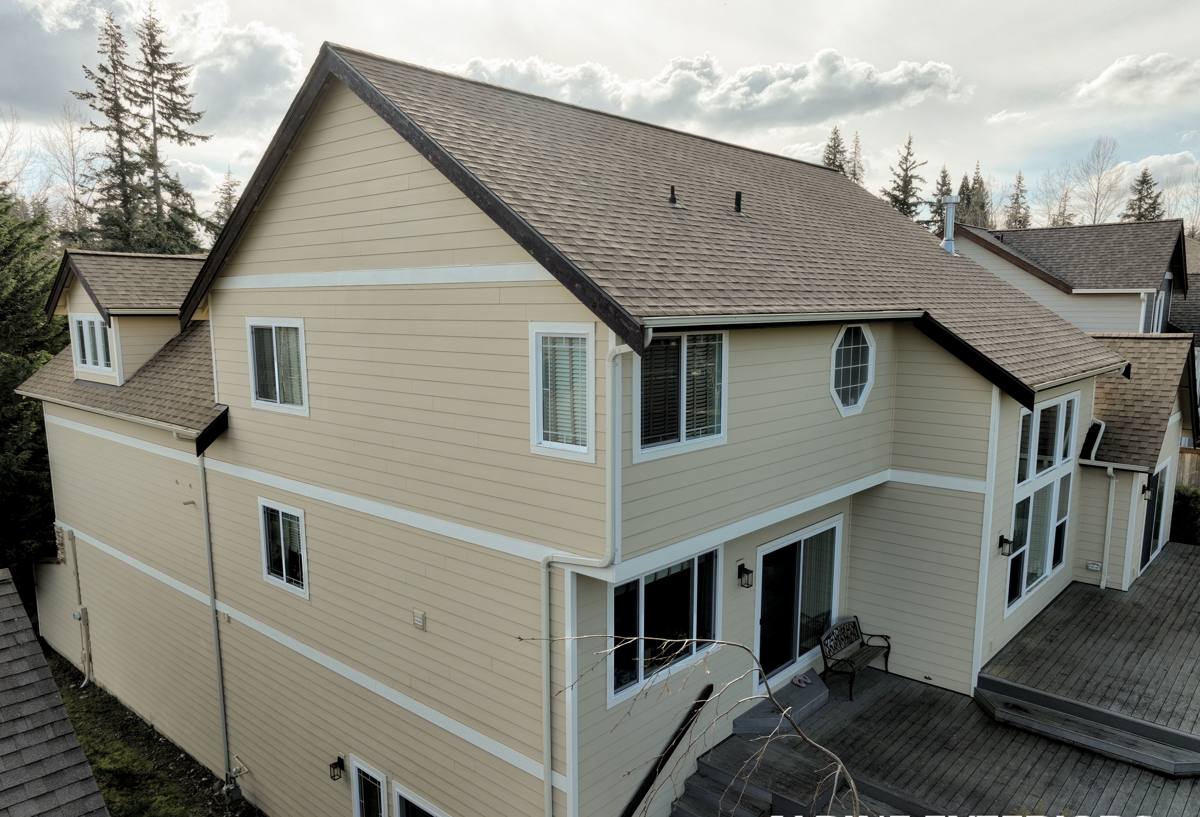
Signs a Laurel Deck Needs Replacement, Not Just Repair
Not every deck problem means starting over. But there's a point where patching individual boards or sistering a joist here and there stops making sense, and a full replacement is the more honest recommendation. Here's how we tell the difference on a typical visit:
- Soft or spongy spots in more than one area of the decking, not just one or two boards
- Rust staining or crumbling around fastener heads, especially where boards meet the ledger or beams
- Persistent moss or black-green staining that comes back within weeks of cleaning
- Visible gaps or movement where the ledger board attaches to the house
- Posts or footings that feel loose or have visible cracking at grade level
- A structure that's more than 15-20 years old with the original untreated fasteners still in place
If we see two or more of these during an inspection, we'll tell you plainly that repair is a short-term patch, not a real fix. We'd rather lose a smaller repair job than have a deck fail on a family a year later because we papered over a structural issue.
What a Correct Deck Replacement Actually Involves
Full Tear-Out and Structural Inspection
A proper replacement starts with removing the decking, railings, and often the fascia down to the framing so we can actually see the structure — not guess at it from the surface. This is where a lot of the real problems in coastal Whatcom County homes show up: hidden rot at the ledger connection, corroded joist hangers, or footings that were undersized or set too shallow to begin with. You can't price or plan a replacement honestly until this step is done.
Ledger Flashing and Water Management
The ledger board — where the deck attaches to the house — is the single most common failure point we find in this region, and it's almost always a water intrusion problem, not a wood quality problem. Correct flashing detail here, including proper step flashing and a water-resistive barrier behind it, is non-negotiable for us. This is exactly where driving rain does its damage over time if it's skipped or done halfway.
Framing, Posts, and Footings
We use decay-resistant lumber for framing and set posts on footings sized and placed for the actual loads and soil conditions on your lot, not a one-size-fits-all approach. In this climate, footing depth and drainage around posts matter more than most homeowners realize — standing water at the base of a post is a slow but steady path to failure.
Fasteners and Hardware
This is where a lot of decks near the water actually fail first, and it's the cheapest thing to get right. Standard galvanized fasteners degrade faster in salt-air environments than most people expect. We spec stainless steel or high-grade coated fasteners and connectors for anything within reach of salt air, which is most of Laurel and the broader Semiahmoo area.
Railings and Code Compliance
Railing height, baluster spacing, and guard requirements are governed by Washington building code and enforced locally. We build to code as a floor, not a ceiling — it's the difference between a railing that passes inspection and one that's actually safe for kids, pets, and anyone leaning on it.
Choosing the Right Decking Material for a Salt-Air, High-Moss Climate
There's no single "best" decking material — there's the material that fits your maintenance appetite, budget, and how close your lot is to the water. We'll walk through the honest trade-offs rather than push whatever's easiest for us to install.
| Material | Moisture & Moss Behavior | Maintenance Burden | Relative Cost |
|---|---|---|---|
| Pressure-treated wood | Absorbs moisture readily; needs sealing to resist moss staining and swelling | Annual cleaning and periodic re-sealing | Lowest upfront |
| Cedar | Naturally decay-resistant but still needs upkeep in wet, mossy conditions | Regular cleaning, occasional oiling to hold color and resist moisture | Mid-range |
| Composite decking | Doesn't rot, but can still grow surface moss or mildew in shaded, damp areas | Occasional washing; no sealing or staining required | Mid-to-higher |
| PVC decking | Fully moisture-resistant, least hospitable surface for moss growth | Lowest — mostly rinsing | Highest upfront |
For homes closer to the water where salt air and moss are heaviest, we tend to recommend composite or PVC for the decking surface even when the budget leans toward wood — the maintenance savings over 10-15 years usually make up the difference. For framing, though, we don't cut corners regardless of what decking goes on top, since that's the part you can't easily inspect or replace later without tearing the deck apart again.
How Our Process Works, Start to Finish
1. On-Site Estimate and Honest Assessment
We come out, look at the existing deck (or the space if it's a new footprint), and give you a straight answer on whether repair or replacement makes sense — along with a written estimate, not a verbal ballpark.
2. Design and Material Selection
We walk through decking material, railing style, and layout with you, factoring in how much sun and shade the deck gets and how exposed it is to weather off the bay — that changes our material recommendation more than most homeowners expect.
3. Permitting
Where a permit is required, we handle the paperwork and inspections so you're not the one tracking down the local building department.
4. Demo and Structural Rebuild
Full tear-out, framing, ledger flashing, and footings come first — this is the part that determines how long the deck actually lasts, long before the decking boards go down.
5. Decking, Railings, and Finish Work
Decking installation, railings, stairs, and any trim or fascia work happen last, followed by a full site cleanup.
6. Final Walkthrough
We walk the finished deck with you before we consider the job done, so any questions about care or maintenance get answered on the spot.
Why a Crew That Already Works Laurel Matters
A contractor who mostly builds decks inland or in a drier climate will often spec the same fasteners, the same flashing detail, and the same footing depth they'd use anywhere else — and it holds up fine there. It doesn't hold up the same way a few hundred yards from Semiahmoo Bay. A crew that already works this specific stretch of Whatcom County knows which details can't be shortcut here: the fastener grade, the ledger flashing, the footing drainage, and how much shade and moss exposure a given lot actually gets based on its orientation to the water and tree cover. That local pattern-matching is the difference between a deck that needs attention again in five years and one that holds up for the long haul.
It also means we're not learning the local permitting process or inspection expectations on your project — we already know how that works in this area, which keeps the schedule realistic instead of guesswork.
Maintaining Your New Deck Through Whatcom County's Moss Season
Even a well-built deck needs some seasonal attention in this climate. Here's the realistic maintenance checklist we give every homeowner after a replacement:
- Sweep or blow off leaves and debris regularly in fall — trapped organic matter is what moss and mildew feed on
- Rinse or lightly scrub decking surfaces at the start and end of the wet season to keep moss from establishing
- Check railings and stair connections once a year for any looseness
- Keep gutters and downspouts clear so runoff isn't draining directly onto or under the deck
- Re-seal or re-stain wood decking on the schedule appropriate to that product — don't wait until it's visibly graying
- Trim back overhanging branches or shrubs that keep sections of the deck shaded and damp longer than the rest
None of this is complicated, but skipping it is exactly how a deck that should last two decades starts failing in one.
Permits and Local Considerations in Whatcom County
Deck replacement projects in Whatcom County, including the Laurel and broader Semiahmoo area, commonly require a building permit depending on the deck's height, size, and whether it's attached to the house — the requirements can vary by exact jurisdiction. Rather than guess, we confirm what's required for your specific property before work starts and handle the application and inspections as part of the project. If your property is close to shoreline or environmentally sensitive areas near the bay, there can also be additional review involved, which we'll flag early rather than let it surprise you mid-project.
Get a Straightforward, No-Pressure Estimate
If your deck is showing soft spots, rust stains, or moss that keeps coming back no matter how often you clean it, it's worth having a local crew take an honest look before you sink money into another round of patch repairs. We'll tell you plainly whether repair or full replacement is the right call for your situation, walk you through material options that actually make sense for a Semiahmoo-area lot, and give you a clear written estimate — no pressure, no obligation. Use the form below to request a free estimate for your Laurel deck replacement.