 Semiahmoo Exterior
 Why Lynden Siding Wears Out Faster Than People Expect
Lynden sits inland from the water compared to towns right on Semiahmoo Bay, but that doesn't spare it from the weather pattern that defines this whole corner of Whatcom County. Marine air moves inland constantly, carrying moisture that settles into wood grain, seams, and fastener holes long before a homeowner notices a problem on the surface. Add driving rain events that come sideways during winter storms, long stretches of overcast days that never let siding fully dry out, and a moss season that can run eight months or more in shaded, north-facing exposures, and you get a climate that is genuinely hard on exterior cladding — even cladding that looks fine from the street.
Winter brings another wrinkle specific to this part of the county: sudden cold snaps when air pushes down from the north, following quickly behind mild, wet weeks. That freeze-thaw cycling is what turns a small crack or a soft spot behind trim into a real problem. Siding that's already saturated from months of damp weather doesn't handle a hard freeze well, whatever it's made of.
None of this means Lynden homes need something exotic. It means they need siding that's dimensionally stable, resists moisture intrusion at the material level (not just at the paint layer), and gets installed with the flashing and drainage details that this climate actually demands. That's the whole job, and it's worth doing right the first time — a siding replacement is not something most homeowners want to repeat in ten or fifteen years.
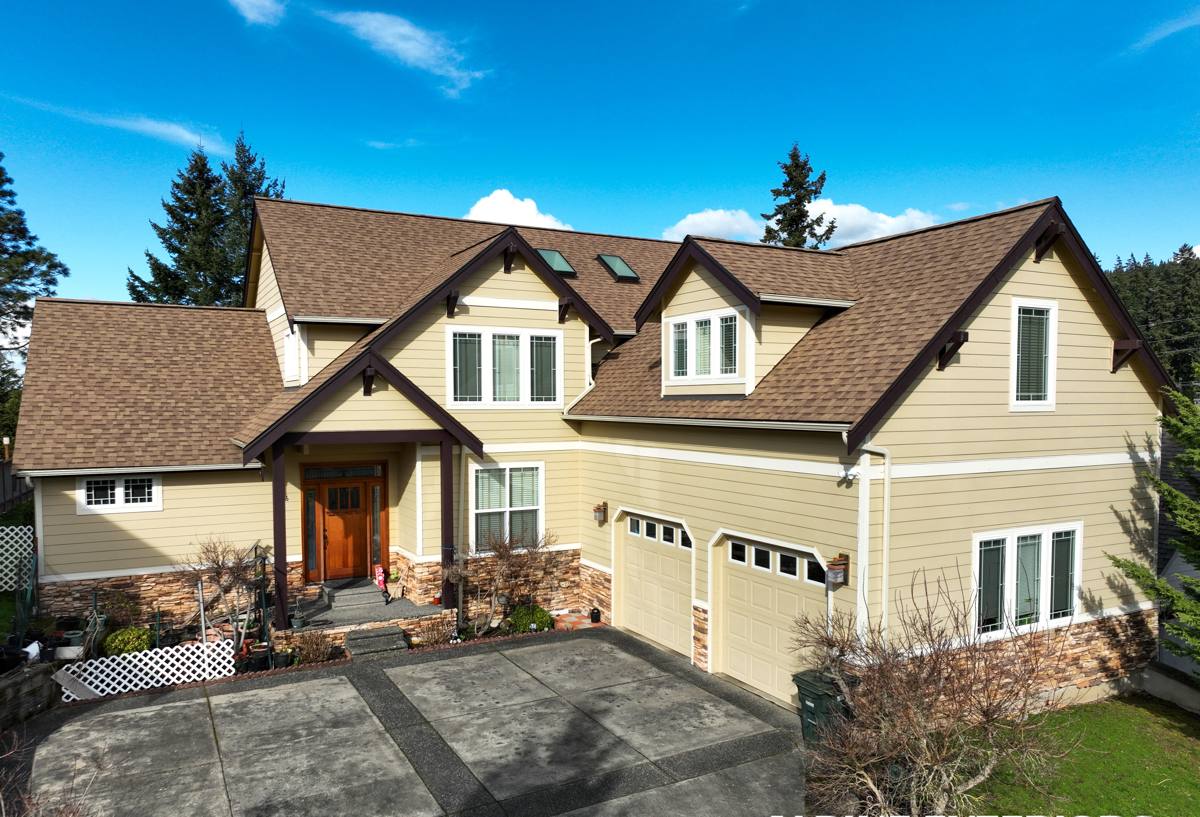
What a Correct Siding Replacement Actually Involves
"Replacement" gets used loosely in this trade. Some contractors mean stripping everything down to the studs; others mean installing new siding over whatever's already there. For a home that's showing real signs of moisture damage, rot, or failed old siding, a proper replacement means:
- Full removal of the existing siding and trim, not overlay installation
- Inspection of the sheathing underneath for rot, delamination, or hidden water damage — and repair or replacement of any compromised sections before anything new goes up
- Installation of a new water-resistive barrier (WRB), correctly lapped so water sheds down and out, never inward
- Proper flashing at every penetration: windows, doors, hose bibs, light fixtures, and anywhere else something punches through the wall plane
- Rain screen or drainage gap detailing where the assembly calls for it, so any moisture that does get behind the cladding has somewhere to go
- Correct fastening — the right fastener type, spacing, and depth for the specific siding product, not a generic nail schedule
Skip the sheathing inspection or the flashing details, and you can put brand-new siding on a wall that's still rotting underneath. That's the part of the job that doesn't show up in a driveway estimate, and it's the part that actually determines whether the new siding lasts.
Why We Install Only James Hardie Fiber Cement
We made a standing decision as a company to install James Hardie fiber cement siding exclusively. We don't install vinyl, LP SmartSide, Cemplank, Allura, primed spruce, or cedar. That's not a marketing position — it's a practical one, built around what actually holds up in Whatcom County's wet, mossy, temperature-swinging climate over decades, not just the first few years.
Fiber cement is cement, sand, and cellulose fiber, not wood and not vinyl. It doesn't feed moss the way wood-based products can, doesn't warp or buckle with moisture cycling the way engineered wood products can under sustained wet conditions, and it doesn't soften, crack, or become brittle with UV and temperature swings the way vinyl does over time. It's also non-combustible, which matters more every year as wildfire smoke seasons extend across the Pacific Northwest, even in areas that don't border forest land directly.
James Hardie backs its siding with a factory-applied ColorPlus finish, engineered specifically to resist fading and chipping better than field-applied paint, plus a strong transferable warranty on both the substrate and the finish. For a homeowner comparing options, the honest summary is this: other products can look identical to Hardie on installation day. The difference shows up eight, twelve, twenty years in — and that's the timeline that actually matters for a full siding replacement.
The Hardie Line We Use for This Climate
James Hardie engineers its products by climate zone (marketed as "HZ" designations), and the Pacific Northwest falls into the zone built for high-moisture, high-humidity conditions. That means the formulation and finish are matched to exactly the kind of weather Lynden and the rest of Whatcom County see most of the year, rather than a one-size-fits-all national product. In practice, most Lynden homes use Hardie lap siding (in a range of exposure widths) for the main field, with Hardie panel or shingle products for accent areas, trimmed out in HardieTrim.
Our Process, Start to Finish
- Walkthrough and assessment — we look at the current siding, check for soft spots, moisture staining, and problem areas around windows, decks, and roof-wall intersections
- Written estimate — scope, product selection, and a clear breakdown of what's included, no vague allowances
- Tear-off — full removal of old siding and trim
- Sheathing inspection and repair — any rot or damage found gets addressed before anything else proceeds, with photos and a conversation before we move forward
- Weather barrier and flashing installation — the part of the job that determines long-term performance, done to manufacturer and code specification
- Hardie siding installation — correct fastening schedule, proper joint treatment, and attention to manufacturer clearances at grade, roof lines, and trim
- Final walkthrough — we go around the house with you before calling the job done
We don't skip steps to hit a lower number on paper. If a homeowner is comparing our estimate to one that's noticeably cheaper, the difference is almost always somewhere in this list.
Cost Factors in a Lynden Siding Replacement
Every home is different, and we won't quote a number without seeing the house, but these are the factors that actually move a siding replacement estimate up or down:
| Factor | Why It Matters |
|---|---|
| Sheathing condition underneath old siding | Rot repair or full sheathing replacement adds material and labor beyond the siding itself |
| House size and wall complexity | More corners, gables, and cutouts mean more trim work and labor hours |
| Siding profile chosen | Lap width, panel vs. lap, and accent shingle areas all price differently |
| Trim scope | Full trim replacement vs. reusing sound existing trim changes the total |
| Access and site conditions | Tight lot lines, landscaping, or multi-story sections affect staging and time |
| Color and finish | Factory ColorPlus finishes vs. field-painted trim carry different costs |
The one factor that shouldn't move the price is corner-cutting on the water-management details. That's the part of the job you can't see once it's closed up, and it's the part that decides whether you're back to this same problem in ten years instead of thirty.
Signs Your Lynden Home Needs Siding Replacement Now
Not every siding problem needs a full replacement — some are repairable. But if you're seeing several of these together, it's worth a real inspection rather than a patch:
- Soft or spongy spots when you press on the siding, especially near the bottom courses or under windows
- Visible warping, buckling, or gaps between boards or panels
- Persistent moss or algae growth that comes right back after cleaning
- Paint that's failing repeatedly in the same spots, even after repainting
- Interior signs — peeling paint, musty smell, or staining on interior walls that back up to exterior siding
- Visible rot or staining at trim boards, corner boards, or around window and door casings
- Siding that's original to a home built more than 25-30 years ago and has never been replaced
If you're only seeing one item on this list and the rest of the wall looks sound, that's often a repair conversation, not a full replacement one. We'll tell you honestly which situation you're in.
Why a Crew That Already Works in Lynden Matters
Siding installation is one of those trades where the manufacturer's spec sheet and the real-world install can drift apart if a crew isn't paying attention. Fastener placement, clearances at grade and roofline, flashing sequencing at windows — these details are learned through repetition, not read once and remembered. A crew that has installed Hardie siding across Whatcom County homes, in this specific rain and moss pattern, has already made and corrected the small mistakes that matter here. That's not something you get from a crew that mostly works in a drier climate or mostly installs a different product.
There's also a practical scheduling reality: siding work in this region has to work around the wet season, and a local crew knows how to sequence tear-off and closure so a house isn't left exposed to a multi-day rain event mid-project. That's a small thing that prevents a large problem.
After Replacement: What Upkeep Actually Looks Like
One of the real advantages of fiber cement in this climate is how little upkeep it demands compared to what most Lynden homeowners are used to. There's no annual caulking-and-recaulking cycle to fight moisture intrusion, no repainting every few years to keep the finish from chalking, and no wood to feed rot or moss the way older siding does. Realistic maintenance is closer to: an occasional gentle rinse to knock down surface dirt or moss buildup, a visual check after major storms, and keeping an eye on caulking at trim joints over the years. That's a manageable list for a homeowner, and it's a big part of why the total cost of ownership on Hardie tends to beat lower-upfront-cost alternatives once you look past year one.
If your Lynden home's siding is showing wear, or you're just planning ahead before it becomes an emergency, we're happy to take a look and give you a straightforward, no-pressure estimate. There's a form below — reach out and we'll get a time on the calendar.