 Semiahmoo Exterior
 Why Siding Takes a Beating in Lynden
Lynden sits inland from Semiahmoo Bay, but "inland" doesn't mean dry. Whatcom County's marine-influenced climate still pushes moist Pacific air across this part of the county most of the year, and Lynden gets its own share of driving rain, heavy dew, and long stretches of overcast humidity. Add in the cold outflow winds that periodically funnel down through the Fraser Valley corridor in winter, and siding here is asked to handle more than a typical dry-climate installation ever would.
The practical result is a long moss and algae season. Anywhere shaded siding stays damp — north-facing walls, areas under eaves, spots blocked from direct sun by trees or neighboring structures — green growth can take hold and stay there for months. Combined with freeze-thaw swings in the coldest weeks of winter, this is a climate that finds every weak point in a siding system: a poorly lapped seam, a missing piece of flashing, a fastener driven too tight. None of that is unique to one street or subdivision in Lynden; it's the baseline condition every exterior wall in this part of Whatcom County has to withstand, year after year.
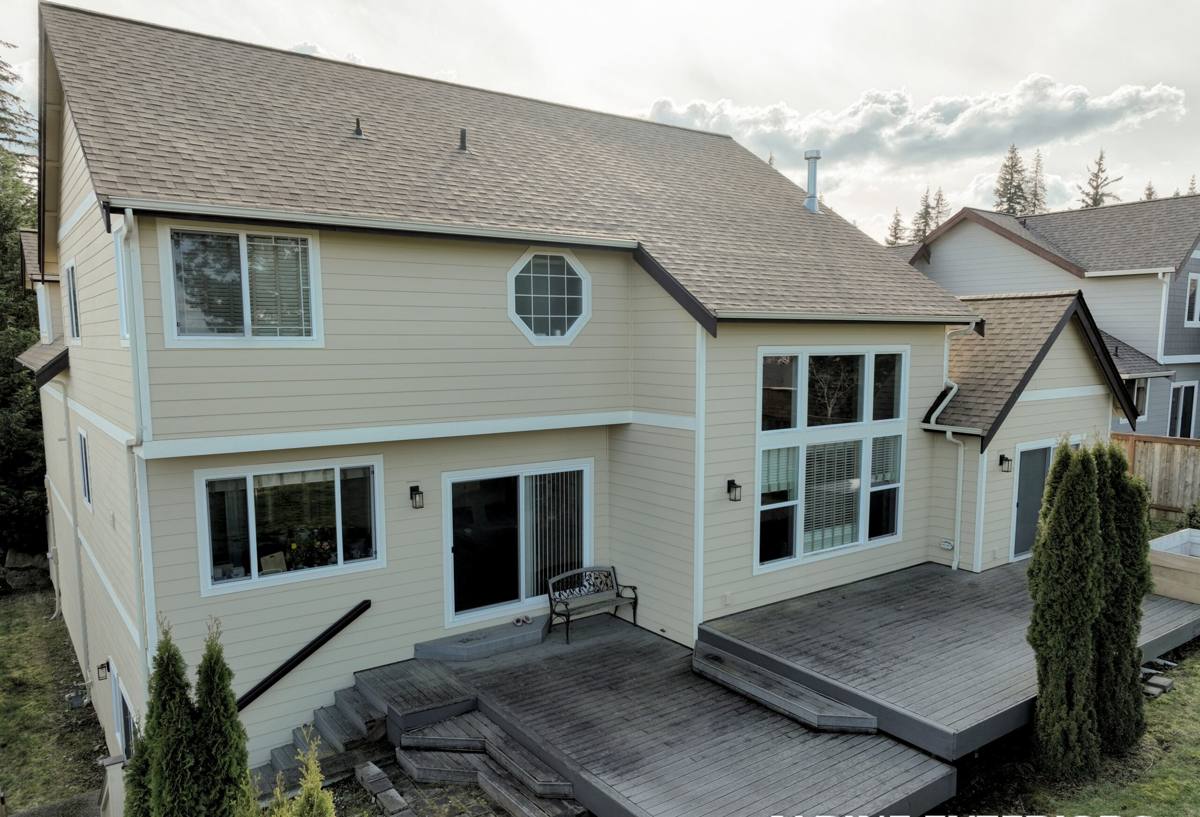
What Chronic Moisture Does to the Wrong Siding
Vinyl
Vinyl siding is inexpensive and low-maintenance in mild climates, but it moves. Wide temperature swings between a cold outflow morning and a mild afternoon cause it to expand and contract, which over years can loosen fastening, distort panel lines, and open small gaps at laps and corners. Those gaps are exactly where Lynden's rain finds a way behind the cladding.
Wood-based and engineered wood products
Products like LP SmartSide use wood strand cores. They perform well when installation and maintenance are followed exactly, but any cut edge, fastener hole, or damaged spot that isn't sealed and maintained becomes an entry point for moisture. In a climate with this much sustained dampness, that maintenance schedule isn't optional — it's the difference between a siding job that lasts and one that starts swelling at the edges within a decade.
We're not saying these products fail on every home. We're saying that in Lynden's climate specifically, the margin for error is thin, and the ongoing upkeep required to keep that margin safe is more than most homeowners want to sign up for. That's our professional read, and it's why we standardized on one product instead.
What a Correct Siding Installation Actually Involves
The weather-resistive barrier
Siding is not the waterproofing — it's the first line of defense over a continuous weather-resistive barrier that does the actual job of keeping bulk water out of the wall assembly. In a high-rainfall climate like this one, that barrier has to be installed without gaps, lapped correctly (upper courses over lower, always shedding water downward), and tied properly into window and door flashing. Skipping or rushing this step is the single most common cause of hidden rot behind siding that looks fine from the yard.
Flashing and trim detail
Every horizontal trim piece, window head, and butt joint is a place water can collect if it isn't flashed correctly. Kick-out flashing at roof-to-wall intersections, head flashing above windows, and proper end-cuts sealed before installation all matter more here than they would in a dry climate, because Lynden gives water more chances to find those weak points over the course of a year.
Fastening and clearances
James Hardie siding has specific fastening patterns, minimum ground clearances, and required gaps at trim and roof lines — all engineered to let the material handle moisture the way it's designed to. Fasteners driven too tight or too loose, siding installed too close to grade or a roof deck, and panels butted with no expansion gap are all common shortcuts that create long-term problems. We install to the manufacturer's published specifications, not to whatever is fastest.
Why We Install Only James Hardie Fiber Cement
Semiahmoo Exterior Company does not install vinyl, LP SmartSide, Cemplank, Allura, primed spruce, or bare cedar. We install James Hardie fiber cement siding, and only that. It's a decision we made after years of seeing what actually holds up in this climate versus what looks good on day one.
- Non-combustible core — fiber cement doesn't feed a fire the way wood-based products can, which matters for insurance and for peace of mind.
- Climate-engineered HZ product lines — Hardie manufactures different formulations for different climate zones, including versions engineered for the freeze-thaw and moisture conditions of the Pacific Northwest.
- ColorPlus factory finish — a baked-on finish applied under controlled conditions, which holds color and resists the fading and peeling that field-applied paint is prone to in a wet climate.
- Dimensional stability — fiber cement doesn't expand and contract with temperature the way vinyl does, so seams and fastening stay tighter over time.
- A strong, transferable warranty — backed by the manufacturer, not just our own labor warranty.
It costs more up front than vinyl and comparable to or more than engineered wood siding. We think that's a fair trade for a product built to handle exactly the conditions Lynden throws at it, installed by a crew that only works with this one system and knows it thoroughly.
Our Installation Process
- Assessment and sheathing check. We inspect the existing siding, look for signs of moisture damage behind it, and evaluate the sheathing underneath before quoting the job.
- Removal and repair. Old siding comes off, and any damaged sheathing, framing, or trim found underneath gets repaired or replaced before anything new goes up. Covering rotten sheathing with new siding is not something we do.
- Weather barrier and flashing. A continuous weather-resistive barrier goes on first, with flashing installed at every window, door, and horizontal trim intersection.
- Hardie installation. Panels or lap siding go on to manufacturer specification — correct fastening pattern, correct clearances, correct overlap.
- Trim, caulking, and finish work. Joints are sealed with the appropriate sealant, trim is fitted and finished, and any factory finish touch-ups are done per ColorPlus guidelines.
- Final walkthrough. We go over the finished job with you before calling it done.
Signs Your Lynden Home May Need New Siding
- Persistent moss, algae, or dark streaking that returns shortly after cleaning
- Soft or spongy spots when you press on the siding, especially near the bottom courses
- Boards or panels that are visibly warped, bowed, or separating at the seams
- Paint that's peeling, bubbling, or won't hold even after repainting
- Widening gaps or cracks around trim, windows, and corners
- A noticeable rise in heating bills with no other explanation
- Visible rot, staining, or discoloration at the lowest few feet of the wall
Any one of these on its own might be minor. Several together, especially on a home that hasn't had its siding inspected in years, usually means moisture has already gotten behind the cladding.
What Affects the Cost of Siding Installation
| Factor | Why It Matters |
|---|---|
| Home size and wall complexity | More corners, dormers, and roof-wall intersections mean more cutting, flashing, and labor time |
| Tear-off vs. new construction | Removing and disposing of old siding, plus repairing any hidden damage, adds cost that a bare-wall install doesn't have |
| Number of stories | Second-story and above work requires staging and scaffolding, which affects both time and safety planning |
| Trim and accessory detail | Corner boards, window trim, and decorative elements add material and labor beyond flat wall coverage |
| Sheathing condition | Rot or damage found once old siding is removed has to be repaired before new siding goes on — this is the most common source of cost surprises |
| Siding profile chosen | Lap siding, panel systems, and shingle-style Hardie products differ in material and installation time |
We walk every home before quoting, because the biggest cost variable — hidden moisture damage — usually isn't visible from the outside.
Why Hire a Crew That Already Works in Lynden
A contractor who regularly works this part of Whatcom County already understands what the climate does to a wall assembly over time, has a working relationship with local building departments, and knows what correct flashing and clearance details actually look like in a house built for this weather. That local familiarity shows up in the details: fewer surprises during permitting, a crew that isn't guessing at how much clearance a foundation needs given local drainage patterns, and a realistic sense of how long a project should take given typical weather windows here.
It also means accountability. A company that installs siding in your area regularly has a reputation to protect with the neighbors, inspectors, and suppliers it works with repeatedly — not just with the one homeowner in front of them today.
If your Lynden home's siding is showing its age, or you're planning ahead of a problem rather than reacting to one, we're happy to take a look and walk you through what we find. There's no cost and no pressure — just a straight assessment of your home's siding and what it would take to do the job right.