 Semiahmoo Exterior
 Marietta's Siding Problem Isn't Really About Style
Homeowners in Marietta usually start looking into new siding because of how something looks — fading paint, a warped board, a streak of green creeping up the north wall. But by the time those symptoms show up, the real damage is often already underneath. Marietta sits close enough to the water around the Semiahmoo Peninsula that salt-laden air, wind-driven rain, and a moss season that can run half the year all work on a house's exterior at the same time, year after year. Siding here isn't just a cosmetic layer. It's the thing standing between your framing and a climate that never really lets up.
That's the lens we bring to every Marietta project: not "what looks good," but "what actually survives here." For us, that answer is James Hardie fiber cement siding, and only James Hardie. This page is about what that means specifically for a Marietta home — the local conditions, what a correct installation looks like, and how we approach the job.
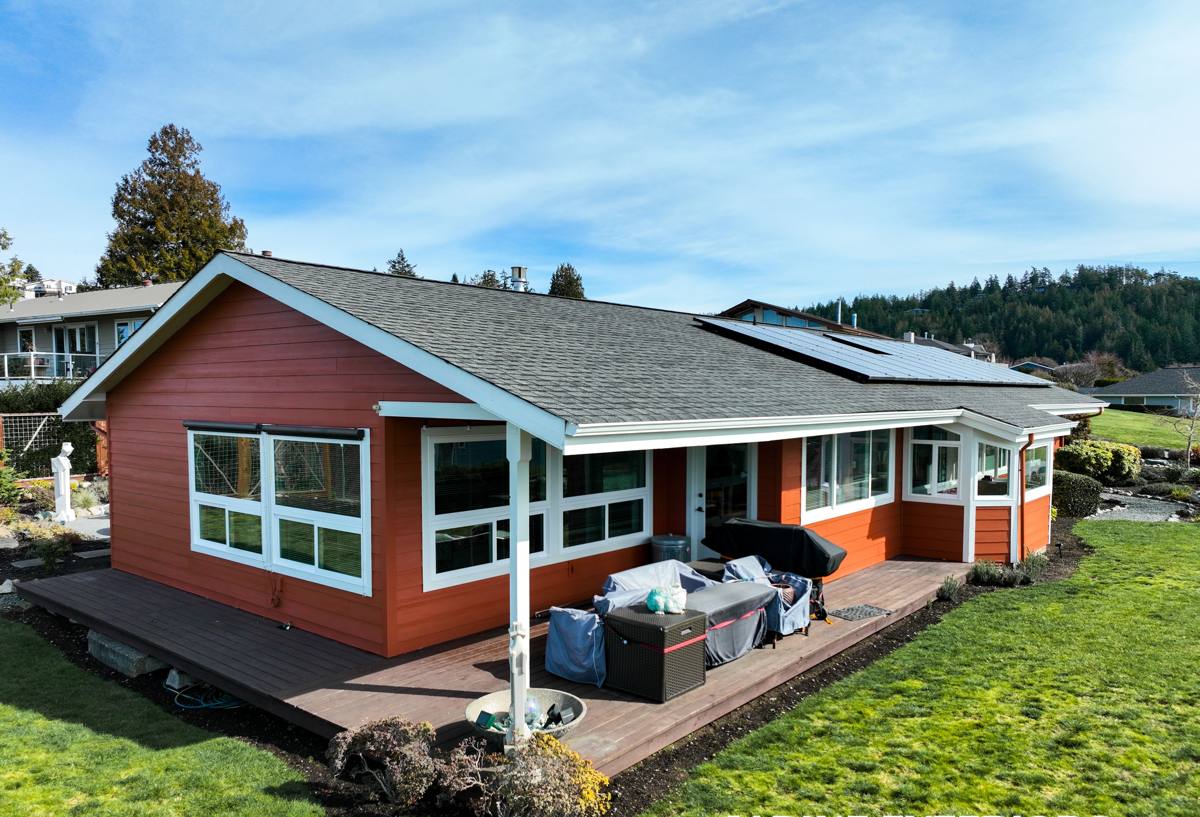
What Whatcom County's Coastal Climate Does to a House
Salt Air and Slow Corrosion
Homes closer to Semiahmoo and the surrounding shoreline get a steady, low-level exposure to salt-carrying air. It's not dramatic — you won't see it happen — but salt is hygroscopic, meaning it pulls moisture out of the air and holds it against whatever surface it lands on. Over years, that means fasteners corrode faster, paint finishes chalk and fail sooner, and any wood-based product that isn't sealed on every cut edge starts absorbing moisture it was never designed to hold.
Driving Rain, Not Just Rain
Whatcom County doesn't just get a lot of rain — it gets a lot of wind-driven rain, pushed sideways off the water during winter storms. That matters more than total rainfall for siding performance, because driving rain gets forced up under laps, into seams, and behind trim in a way that straight-down rain never does. A siding system that isn't detailed for driving rain will eventually let water in at exactly those points, regardless of how good the material itself is.
A Long Moss Season
Cool temperatures, shade from mature trees, and near-constant humidity give moss and algae a long runway in this area — often from fall through spring. Moss holds moisture against a surface far longer than open air would, which accelerates rot in wood products and keeps paint finishes damp for extended stretches. On the north and west-facing walls that get the least sun, this is usually where we see the earliest failure on any siding material that isn't built to resist it.
Why James Hardie Fits This Climate Specifically
James Hardie fiber cement is engineered for regional conditions, and their HZ5 product line is formulated for climates like ours — freeze-thaw cycles, sustained damp, and coastal exposure. A few specific properties matter for Marietta homes:
- Fiber cement is non-combustible and dimensionally stable, so it doesn't swell, cup, or split the way wood-based sidings can when they take on repeated moisture cycles.
- ColorPlus factory-applied finish is baked on under controlled conditions, giving it better UV and moisture resistance than field-applied paint — which matters when a finish is expected to hold up against salt air and near-constant winter dampness.
- The material itself doesn't feed mold or moss growth the way wood fiber can, though any siding will still need surface cleaning in a climate this shaded and damp.
- Hardie's engineered click-fit lap profiles and factory-primed edges reduce the number of vulnerable seams compared to site-cut and site-sealed materials.
None of that replaces good installation. It's the combination of the right material and the right detailing that actually performs here — which is why the next section matters as much as the product choice itself.
What a Correct Installation Actually Involves
A lot of siding failures we get called out to inspect in Marietta aren't material failures at all — they're installation shortcuts that a driving-rain climate eventually exposes. Getting it right means treating water management as the primary job, not an afterthought.
The Drainage Plane Comes First
Before a single piece of siding goes up, there needs to be a functioning water-resistive barrier and, in most cases, a drainage gap behind the siding so any moisture that does get past the cladding has somewhere to go besides your sheathing. Skipping or shortcutting this step is invisible on installation day and expensive five years later.
Flashing at Every Penetration
Windows, doors, hose bibs, light fixtures, deck ledgers — every point where something interrupts the siding plane needs proper flashing detail, lapped correctly so water sheds outward and down, never inward. In a wind-driven rain climate, these details do most of the work of keeping a wall dry.
Fastener and Gap Spec, Followed Exactly
James Hardie publishes specific fastener types, spacing, and clearance requirements — including gaps at butt joints and around trim to allow for expansion and to prevent capillary draw of water into seams. These specs exist because the manufacturer has engineered them for exactly the kind of weather Whatcom County sees. Following them isn't optional detail work; it's what keeps the warranty valid and the wall dry.
Caulking Only Where It Belongs
Correctly detailed Hardie siding needs caulk in far fewer places than most installers assume — over-caulking can actually trap moisture behind the siding instead of letting it drain. Knowing where caulk helps and where it hurts is a judgment call that comes from installation experience, not a generic checklist.
How Our Process Works on a Marietta Home
Every project starts with a walk-around assessment of the specific exposures on your lot — which walls take the brunt of winter wind, where moss and shade are already a problem, where the existing siding shows early failure. That assessment shapes decisions on product line, trim detail, and drainage approach before we ever quote the job.
- On-site evaluation — we look at existing siding condition, sheathing moisture where accessible, roofline and gutter drainage, and sun/shade exposure per wall.
- Product and color selection — matching the right Hardie plank, shingle, or panel profile and ColorPlus finish to your home's style and this climate's demands.
- Tear-off and sheathing check — removing old siding gives us a direct look at the wall assembly underneath, which is often the first real inspection a house has had in years.
- Weather barrier and drainage plane installation — done to current best practice for a marine climate, not just code minimum.
- Hardie installation to manufacturer spec — fastener pattern, gaps, and flashing sequence followed exactly, not approximated.
- Final detail and walk-through — trim, caulk points, and touch-up finish checked before we call the job done.
James Hardie Compared to Other Common Siding Choices
Homeowners in Marietta often come to us already having looked at vinyl or engineered wood siding, usually on price. Here's how those options stack up against James Hardie fiber cement on the factors that actually matter in this climate:
| Factor | James Hardie Fiber Cement | Vinyl Siding | Engineered Wood (e.g. LP SmartSide) |
|---|---|---|---|
| Moisture behavior over time | Dimensionally stable; doesn't swell or rot when installed correctly | Doesn't rot, but can warp/buckle in heat and gaps let water track behind panels | Wood-based core is vulnerable to swelling and edge failure if moisture reaches it |
| Salt air / coastal exposure | Formulated HZ5 line for coastal and freeze-thaw regions | Can become brittle over years of coastal UV and salt exposure | Coatings and edge seals are the weak point in salt air over time |
| Fire resistance | Non-combustible | Combustible, can melt or deform near heat sources | Combustible |
| Finish longevity | Factory-baked ColorPlus finish, long warranty on color and substrate | Color is through-body but can fade and chalk; can't be easily repainted well | Field or factory paint, typically shorter repaint cycle |
| Upfront cost | Higher material and install cost | Lowest upfront cost | Mid-range, often close to fiber cement once installed correctly |
| Long-term cost of ownership | Lower — less repainting, fewer moisture repairs when installed to spec | Low maintenance but limited lifespan in harsh coastal conditions | Maintenance and edge-sealing costs add up over the product's life |
We don't install vinyl or engineered wood products, including LP SmartSide, on any home — not because they can't work anywhere, but because we've made James Hardie our standard for the specific conditions Whatcom County homes deal with, and we'd rather stand behind one system we know performs here than offer several we'd have reservations about.
Living With Hardie Siding in a Moss-Prone Climate
No siding material is maintenance-free in a climate this damp and shaded — but the maintenance James Hardie needs is straightforward and infrequent compared to wood-based alternatives. A simple annual routine goes a long way:
- Rinse siding with a garden hose or low-pressure wash once a year, focusing on north and west walls where moss and algae build up fastest.
- Keep gutters clear and downspouts directed away from the foundation so water isn't sheeting down onto lower siding courses.
- Trim back vegetation and tree limbs that keep siding shaded and damp longer than the rest of the house.
- Check caulking at trim and penetration points every couple of years and have any cracked or missing sections redone.
- Watch for any soft spots, staining, or bubbling at the bottom edge of siding near grade, which can indicate a drainage issue rather than a siding problem.
Because ColorPlus finish is factory-cured, you're generally not repainting Hardie siding on the schedule you'd repaint wood or touch up vinyl — which matters in a climate where scaffolding and exterior work have a narrow dry-weather window each year.
Why a Crew That Already Works Marietta Matters
Siding installation standards are the same on paper everywhere, but the judgment calls — how tight to run a drainage gap on a wall that takes direct winter wind, where an extra flashing detail is worth the labor, which walls in a given lot will actually see moss first — come from having done this work repeatedly in this specific area. A crew that's used to installing in a drier inland climate can follow the same written spec and still miss the details that matter most here, because they haven't seen what five Whatcom County winters do to a wall that wasn't detailed for driving rain.
There's also a practical scheduling side to this: exterior work in this region has a real weather window, and a crew that knows the local pattern plans around it instead of getting caught mid-project when a wet system moves in off the water.
Ready to Talk About Your Marietta Home
If your current siding is showing moss staining, chalking paint, soft spots, or you're just planning ahead before a small problem becomes a bigger one, we're happy to take a look. We'll walk your home, talk through what your specific exposures call for, and give you a straightforward, no-pressure estimate for a James Hardie installation done right for this climate. Use the form below to get started.