 Semiahmoo Exterior
 Living With Drayton Harbor's Marine Climate
Homes around Drayton Harbor sit close enough to the water that the roof over your head is doing a different job than a roof twenty miles inland. Salt-laden air drifts off the harbor and settles on every exposed surface, wind-driven rain finds its way under poorly lapped materials, and the shaded, damp stretches of fall through spring give moss and algae months to take hold. None of this is unique to any one house — it's the baseline for anything built near Semiahmoo Bay and the harbor. A roofing material and installation method that would be perfectly fine in a drier part of Whatcom County can fall short here simply because the conditions are more demanding, year in and year out.
That's the lens we use when we talk to homeowners in this area about metal roofing. It's not a trend or an upsell — for a lot of harbor-adjacent homes, it's the material that best matches what the climate actually does to a roof over time.
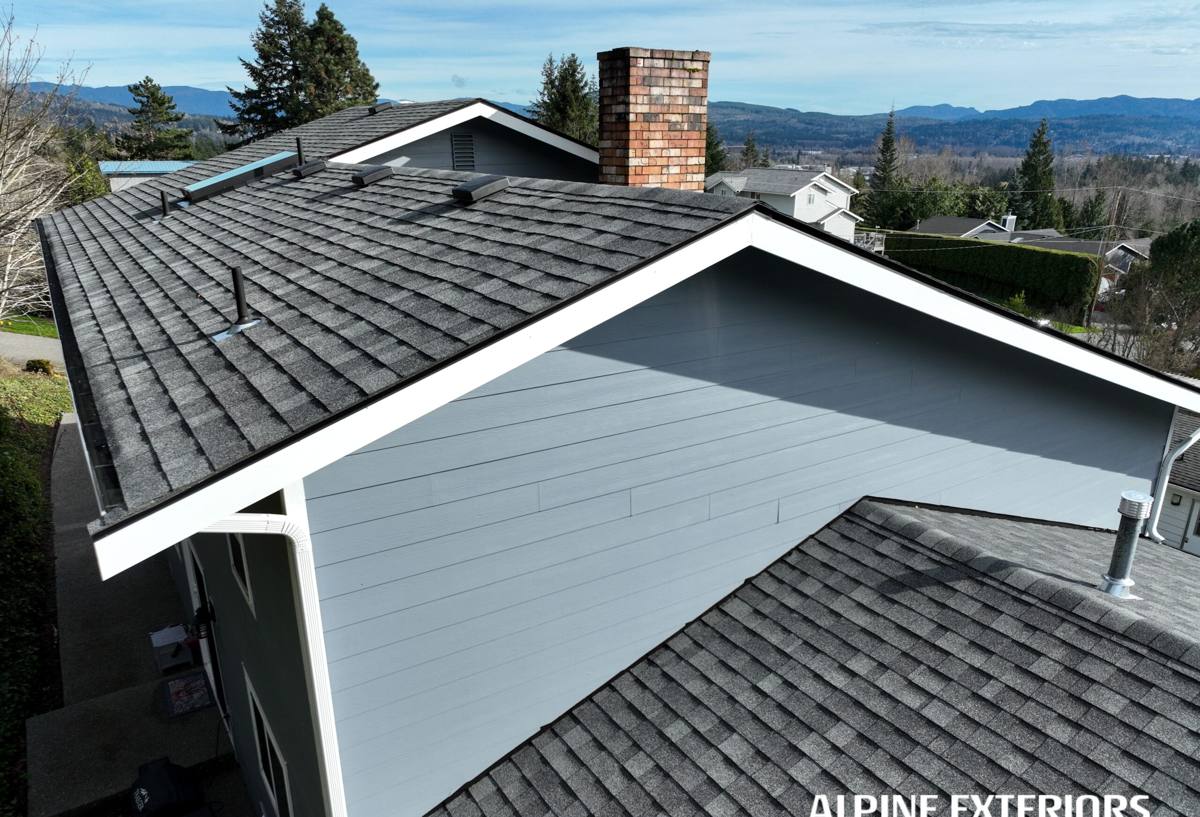
Why Metal Roofing Makes Sense Here
Metal roofing earns its reputation in coastal and marine environments for a few concrete reasons. It sheds water fast, which matters when driving rain comes in sideways off the harbor. It doesn't provide the organic surface that moss and algae need to gain a foothold, unlike asphalt shingles, which trap grit and moisture in their granules and give moss something to root into. And a properly coated steel or aluminum panel resists the slow surface breakdown that salt air causes to lesser-protected materials.
It's also a long-service-life product, which counts for more near the water than it does elsewhere, because reroofing a harbor-exposed house is more disruptive and the climate is less forgiving of shortcuts the second time around.
Standing Seam vs. Exposed-Fastener Panels
Not all metal roofing is built the same way, and the difference matters most in exactly this kind of environment.
- Standing seam panels use concealed, mechanically or hydraulically seamed connections with no exposed screws through the panel face. Nothing on the roof surface is relying on a rubber washer to stay watertight for the next twenty years.
- Exposed-fastener panels are less expensive up front but depend on screw gaskets that harden and shrink with age, sun exposure, and salt exposure. In a salt-air environment, those gaskets are the first thing to fail, and once they do, water finds its way in at hundreds of small points across the roof instead of a handful of large seams.
We don't refuse to install exposed-fastener systems, but we're honest with harbor-area homeowners about the tradeoff: it's a lower material cost against a shorter maintenance-free lifespan and a higher long-term chance of fastener-related leaks.
What a Correct Installation Looks Like on a Harbor-Adjacent Home
Metal roofing is only as good as the details underneath it. A panel that's rated for decades of coastal exposure can still leak in three years if the underlayment, flashing, and fastening weren't matched to the site.
Fasteners, Flashing, and Underlayment
For homes this close to Drayton Harbor, we treat a few line items as non-negotiable rather than upgrades:
- Stainless steel or otherwise corrosion-rated fasteners — mild steel screws in a salt-air zone will rust and stain long before the panels themselves show wear.
- Self-adhered, high-temperature underlayment at eaves, valleys, and any low-slope transition, so wind-driven rain that gets under a panel edge still has a second line of defense.
- Metal-specific flashing details at every penetration — vents, chimneys, skylights — sized and lapped for the direction prevailing wind and rain actually come from on this site, not a generic layout.
- Dissimilar-metal separation where the panel material meets fasteners, flashing, or gutters, so galvanic corrosion doesn't quietly eat away at the roof from a contact point you'd never think to check.
Ventilation and Moisture Control
A metal roof that's sealed tight but poorly ventilated can trap moisture in the attic, which in a humid, marine climate is its own slow problem — condensation, wood rot in the decking, and conditions that favor mold rather than moss. Ridge and soffit ventilation sized correctly for the home, and installed so it doesn't become a rain-entry point itself, is part of a correct metal roof job, not an afterthought.
Comparing Metal Roofing Options for Drayton Harbor Homes
There's no single "best" metal roof for every house on the harbor — the right choice depends on your budget, your home's exposure to wind and salt spray, and how long you plan to own the property. Here's how the common options stack up in this specific climate:
| Option | Coastal Durability | Maintenance | Best Fit |
|---|---|---|---|
| Standing seam steel | Very strong when properly coated; concealed fasteners avoid the weak point of exposed screws | Low — occasional rinse to clear salt film | Direct harbor exposure, long-term ownership |
| Standing seam aluminum | Naturally corrosion-resistant, doesn't rely on coating alone to resist rust | Low | Homes with the heaviest salt exposure or wind-driven spray |
| Exposed-fastener steel panel | Adequate short-to-mid-term; gaskets are the limiting factor | Moderate — fastener and gasket checks every few years | Budget-conscious projects, secondary structures |
| Stone-coated steel | Good; coating adds abrasion resistance but seams still matter | Low to moderate | Homeowners who want a shingle-like appearance with metal's durability |
Finish quality matters as much as panel type. A high-performance PVDF-type coating holds its color and chalk-resistance far longer in salt air than a basic polyester paint system, which is worth the modest upcharge on a house this close to the water.
Our Process, Start to Finish
We keep the process straightforward, but we don't skip steps just because a homeowner doesn't ask about them.
- On-site inspection. We look at your existing roof deck, ventilation, and how the home is actually exposed to wind and rain off the harbor — not just a generic checklist.
- Material and panel selection. We walk through standing seam versus exposed-fastener, steel versus aluminum, and finish options, with honest pros and cons for your specific site rather than a default recommendation.
- Deck prep and underlayment. Any soft or damaged decking gets addressed before a single panel goes down — covering over a problem doesn't make it go away.
- Installation. Panels, flashing, and fasteners installed to the tolerances the manufacturer and the site actually require, not just "close enough."
- Final walk-through. We review the finished roof with you, including what maintenance to expect and when.
Living With a Metal Roof: Maintenance in Salt Air and Moss Season
A correctly installed metal roof in this climate is low-maintenance, not no-maintenance. A little attention goes a long way toward getting the full service life out of it.
- Rinse accumulated salt film off the roof surface once or twice a year, especially on sides facing the harbor.
- Keep gutters and valleys clear of needles, leaves, and moss debris so water has a clear path off the roof.
- Trim back overhanging branches that keep sections of roof shaded and damp longer than the rest.
- After major wind events, do a visual check for lifted flashing or debris impact rather than waiting for a leak to show up inside.
- Have fastener and sealant points checked periodically if your roof uses an exposed-fastener system.
- Watch for any dulling, chalking, or color change in the finish, which can be an early sign the coating is wearing thin.
Why Hire a Crew That Already Works Drayton Harbor
Metal roofing done wrong doesn't usually fail on day one — it fails two, five, or ten years in, when a flashing detail that looked fine at installation finally gives up to a climate it wasn't really built for. A crew that regularly works homes around Drayton Harbor and Semiahmoo has already seen where that failure shows up first on this coastline: which flashing laps actually hold up to wind-driven rain here, which fastener grades hold up to the salt air, and which roof orientations need extra attention for moss. That's knowledge you don't get from a spec sheet — it comes from working this specific stretch of Whatcom County, house after house.
It also matters for something less visible: knowing how local building requirements and inspection expectations apply to a reroof in this area, so the job doesn't hit delays or rework because of a step that got missed.
Signs It's Time to Talk About a New Roof
You don't need to wait for an active leak to start the conversation. Some common signs a harbor-area roof is due for a closer look:
- Heavy moss growth that keeps returning within a season or two of cleaning
- Visible rust streaking, especially around fasteners or flashing on an existing metal or metal-flashed roof
- Curling, cracking, or granule loss on an aging asphalt roof
- Soft spots, sagging, or staining on interior ceilings near exterior walls
- A roof that's approaching or past its expected service life for its material and exposure
If you're seeing any of that, it's worth having someone take an honest look before it becomes a bigger repair.
If you're weighing options for a metal roof on a home near Drayton Harbor, we're happy to take a look and walk you through what your specific house needs — no pressure, no obligation. Use the form below to request a free estimate.