 Semiahmoo Exterior
 Why Decks Near Drayton Harbor Wear Out Faster
Homes around Drayton Harbor sit in one of the more demanding microclimates in Whatcom County for exterior wood structures. The combination of salt-laden air off the harbor, near-constant winter rain, and long stretches of shade and dampness through fall and spring creates conditions that push decks toward failure years before a homeowner expects it. A deck built the same way you'd build one twenty miles inland simply doesn't hold up the same way out here.
Salt air accelerates corrosion in fasteners, brackets, and any exposed metal hardware. Driving rain off the water finds its way into ledger connections, end grain, and any spot where two boards meet without proper drainage. And the moss and algae that thrive in this region's mild, wet winters don't just look bad on a deck surface — they hold moisture against wood and coatings, which speeds up rot in ways that are easy to miss until the damage is structural.
None of this means a deck near Drayton Harbor can't last for decades. It means the materials, fasteners, and construction details have to be chosen with this specific environment in mind, not a generic building-supply default.
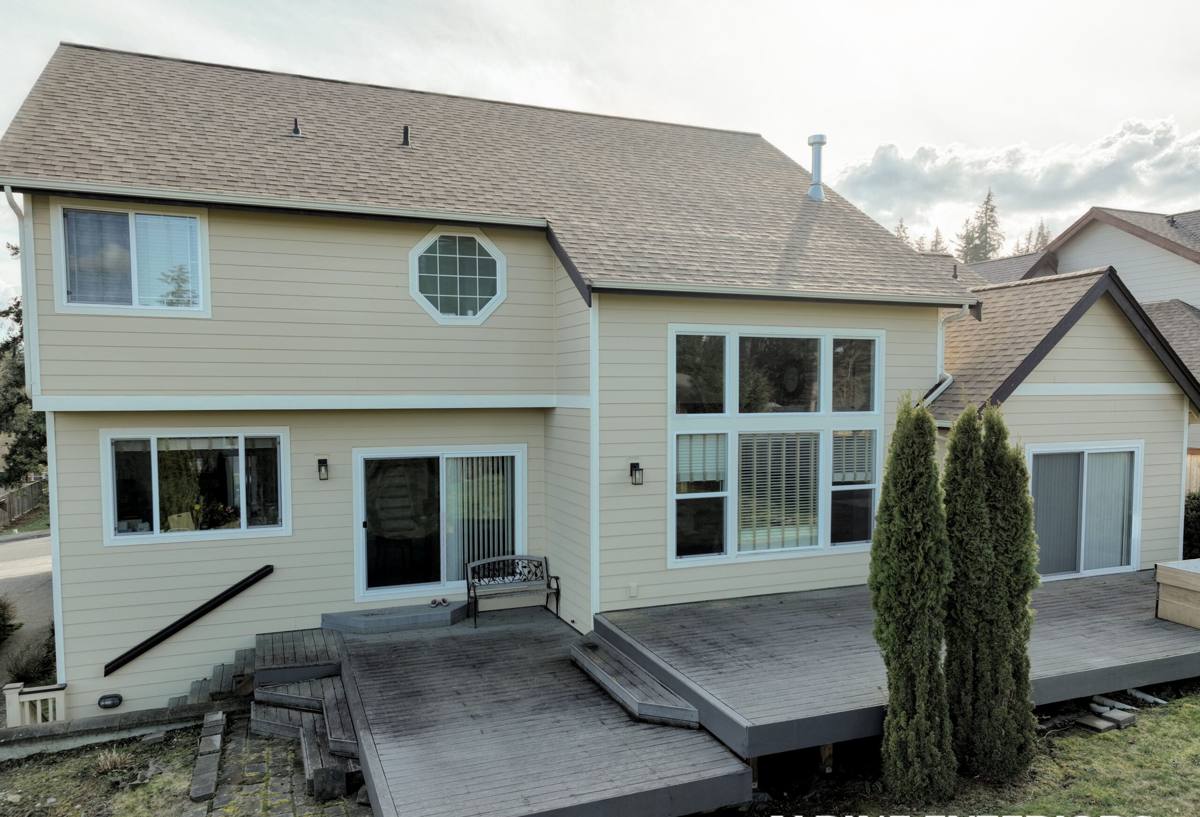
Signs Your Deck Needs Replacement, Not Repair
Not every tired-looking deck needs to be torn out. But there's a point where patching boards or re-staining stops being a real fix and starts being a way to delay an inevitable, more expensive job. Here's how we tell the difference on site visits around Semiahmoo and the harbor.
- Soft or spongy spots underfoot, especially near the house or along the perimeter — usually a sign of rot in the joists or ledger, not just the surface boards
- Fasteners that are rusted, bleeding stains onto the decking, or backing out on their own
- Visible gaps or separation where the deck ledger meets the house siding or rim joist
- Persistent moss or black staining that comes back within weeks of cleaning, even in summer
- Railings or stair stringers that flex or feel loose when you put weight on them
- A deck more than 15-20 years old that has never had its structural framing inspected
If you're seeing surface wear — graying, minor splintering, a few loose screws — repair or refinishing may still make sense. Once the framing, ledger connection, or footings are compromised, replacement is almost always the more honest recommendation, because rebuilding on a failing structure just moves the problem down the road.
What a Correct Deck Replacement Actually Involves
A deck replacement is more than swapping old boards for new ones. Done right, it's a structural project with several parts that matter more than the visible decking surface.
The Ledger and Flashing
The ledger board — where the deck attaches to the house — is the single most common failure point on decks in wet climates like ours. Water that gets behind the ledger without proper flashing will rot the rim joist and, eventually, the framing inside the wall. Every replacement we do treats ledger flashing as non-negotiable, not an upgrade.
Joists, Beams, and Footings
We check footing depth and condition, beam sizing, and joist spacing against current span tables rather than just matching what was there before. Older decks around Drayton Harbor were sometimes built to standards that have since been tightened, particularly around footing frost depth and joist hangers.
Drainage and Airflow Underneath
Decks built low to the ground or over damp, shaded soil near the harbor need real attention to airflow and drainage underneath. Trapped moisture under a deck is one of the biggest drivers of premature joist rot in this area, and it's invisible until you're looking up from underneath.
Stairs and Railings
Stair stringers and railing posts take more structural stress than most homeowners realize, and they're often the first thing to loosen on an aging deck. We rebuild these to current code requirements for baluster spacing and rail height, not just to match what was there.
Decking Material Options for Salt Air and Moss Conditions
There's no single "best" decking material — there's a best material for your budget, your maintenance appetite, and how exposed your specific lot is to harbor wind and rain. Here's how the common options actually perform in this climate.
| Material | Performance Near Salt Air & Moisture | Maintenance | Relative Cost |
|---|---|---|---|
| Pressure-treated fir/hem-fir | Decent if properly sealed and re-coated regularly; end grain is a weak point | Annual cleaning and re-staining recommended | Lowest |
| Cedar | Naturally rot- and insect-resistant, handles moisture well, but softens fasteners' grip over time | Periodic sealing to preserve color and resist moss | Moderate |
| Composite decking | Very stable in wet, shaded conditions; won't rot or splinter | Occasional washing; some products can still grow surface algae in shade | Higher |
| PVC/capped composite | Best moisture and moss resistance of the group; fully sealed surface | Lowest ongoing maintenance | Highest |
For lots with direct harbor exposure and heavy shade, we generally steer homeowners toward composite or capped PVC for the decking surface specifically because moss and algae get a foothold faster on wood in those spots. That's a maintenance and moisture-behavior tradeoff we're happy to walk through, not a claim that wood decking is a bad product — plenty of well-maintained cedar decks in this area still look great after many years.
Fasteners and Hardware: The Detail That Fails First
On a lot near saltwater, hardware quality matters as much as the decking itself. Standard galvanized fasteners can corrode faster near Drayton Harbor than they would even a few miles inland, and once a fastener starts bleeding rust into the board around it, that's a sign the connection is weakening too.
We use stainless steel or high-corrosion-rated hardware for structural connections, hidden fastener systems where the decking product supports it, and joist hangers and structural screws rated for exterior, coastal-adjacent exposure. It costs more upfront than standard hardware. It also stops you from having a beautiful new deck surface held together by fasteners that are already rusting three years in.
Our Process for Drayton Harbor Deck Replacements
- On-site evaluation. We inspect the existing structure from underneath as well as the surface, checking ledger, footings, joists, and drainage before recommending replacement over repair.
- Honest scope and material discussion. We walk through decking and hardware options based on your lot's actual sun, shade, and wind exposure — not a one-size-fits-all package.
- Permitting and planning. Structural deck work typically requires permitting through the local building department; we handle that process as part of the job.
- Demolition and structural rebuild. Old decking and framing are removed, ledger flashing is corrected, and framing is brought up to current span and connection standards.
- Decking, railing, and stairs. Surface materials and railings are installed with corrosion-rated fasteners throughout.
- Final walkthrough. We go over the finished deck with you, including what maintenance it does and doesn't need going forward.
Permits and Site Access Near the Harbor
Deck replacement projects on or near Drayton Harbor can involve additional considerations beyond a standard inland build — proximity to water sometimes brings setback rules or additional review depending on your specific parcel and its location relative to the shoreline. We check the requirements for your address as part of planning the job rather than assuming a blanket answer applies to every lot in the area.
Site access is also worth planning for early. Some waterfront and near-harbor properties have limited equipment access, tighter side yards, or grade changes down toward the water, all of which affect how material staging and demolition debris removal are handled. We plan this out before the crew shows up, not on day one.
Maintaining Your New Deck in This Climate
Even the best-built deck needs some ongoing attention in a climate like Semiahmoo's. A little seasonal upkeep goes a long way toward getting the full lifespan out of the materials and hardware you paid for.
- Sweep debris and standing leaves off the surface regularly, especially in fall when moss growth accelerates
- Rinse off salt spray and grime a few times a year if your deck faces the harbor directly
- Check railings and stair connections once a year for any looseness
- Keep gutters and downspouts near the deck clear so runoff isn't draining onto or under it
- For wood decking, plan on re-sealing or re-staining on the schedule your specific product recommends — don't wait until it's visibly gray
- Look underneath the deck once a year for any signs of moisture pooling or new moss growth on framing
Why a Crew That Already Works Drayton Harbor Matters
A deck replacement done by a contractor unfamiliar with harbor-adjacent conditions can look fine on the day it's finished and still fail early — wrong fastener grade, missed ledger flashing detail, decking chosen without accounting for shade and moss exposure. We work throughout Semiahmoo and the surrounding Whatcom County waterfront regularly, which means we're not guessing about how salt air, rain patterns, and moss behave on decks in this specific area — we're building around what we've already seen hold up and what doesn't.
That local familiarity also means straighter answers. When we tell you a certain decking material or hardware upgrade matters for your specific lot, it's based on how that lot's exposure compares to others we've worked on nearby, not a generic sales script.
If your deck near Drayton Harbor is showing its age, or you just want an honest opinion on repair versus replacement, we're glad to take a look. Use the form below to request a free, no-pressure estimate — there's no obligation, and no pushy follow-up.