 Semiahmoo Exterior
 Building Decks in a Harbor Climate
Drayton Harbor sits right on the water at the edge of Semiahmoo, and that location shapes everything about how a deck should be built here. Homes close to the harbor deal with a combination most inland Whatcom County properties don't: salt-laden air off the water, long stretches of driving rain through fall and winter, and a moss season that can run from October well into spring. A deck built with generic, one-size-fits-all methods might look fine the first summer. By year three or four, the difference between a deck built for this specific environment and one that wasn't becomes obvious — in the hardware, in the boards, and in the framing underneath that nobody sees until something fails.
This page covers what deck building actually requires for homes in and around Drayton Harbor, what we do differently because of it, and why working with a crew that already builds decks in this exact environment matters more here than in a lot of other places.
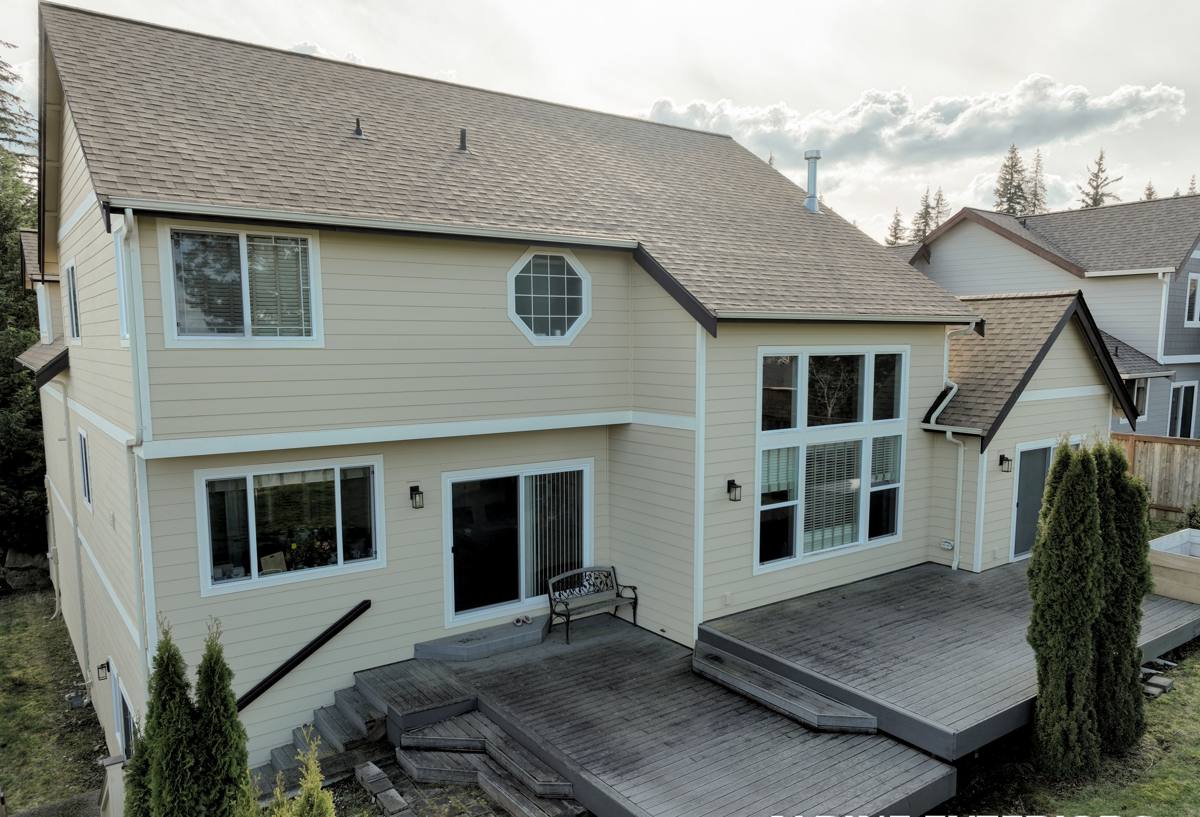
What Salt Air, Rain, and Moss Actually Do to a Deck
Fasteners and Hardware
Salt air accelerates corrosion on anything metal, and a deck has a lot of metal in it — joist hangers, structural screws, post bases, ledger bolts. Standard coated fasteners that hold up fine forty miles inland can start showing rust streaks and pitting within a few years this close to saltwater. Once a fastener corrodes, it loses holding strength long before it looks obviously "broken," which is part of why hardware choice matters more here than the decking material itself.
Decking Material Breakdown
Constant moisture cycling — wet from rain, then dry, then wet again — is hard on wood fibers and on lower-grade composite cores alike. Untreated or poorly sealed wood decking will cup, check, and gray unevenly. Composite boards that aren't rated for high-moisture exposure can absorb water at the cut ends and swell over time. None of this happens overnight; it shows up as a slow decline that's easy to miss until a board is soft underfoot.
Moss, Algae, and the Framing Underneath
A long moss season means organic growth doesn't just sit on the surface of the boards — it holds moisture against the deck longer than rain alone would. On boards, that's mostly a slip hazard and a cosmetic problem. On the framing underneath, especially at the ledger board where the deck attaches to the house, trapped moisture is what leads to rot. That's the failure that matters most, because it's structural and it's hidden.
Choosing a Decking Material for This Environment
There's no single "best" decking material for every budget and every home near the harbor — each option handles salt air and moisture differently, and each comes with real trade-offs. Here's how the common choices compare for a property like this:
| Material | How it handles salt air & moisture | Maintenance | Typical lifespan here |
|---|---|---|---|
| Pressure-treated wood | Handles moisture well when properly sealed; end cuts and fastener holes need attention | Annual cleaning and re-sealing recommended | Shorter than composite if maintenance lapses |
| Cedar or other naturally durable wood | Naturally moisture- and insect-resistant, but still needs sealing near saltwater | Regular sealing to maintain color and protection | Solid if maintained consistently |
| Capped composite | Fully encapsulated boards resist moisture absorption well; better at cut ends than uncapped composite | Occasional washing, no sealing or staining | Long-term option with the least upkeep |
| Uncapped composite | More prone to moisture uptake at exposed fibers; can perform inconsistently in wet, salty conditions | Low, but cut ends need sealing at install | Variable — depends heavily on the specific product |
Our standard is to walk through these trade-offs honestly rather than push whatever has the best margin. A wood deck that's sealed and maintained on schedule can perform very well here. A composite deck saves ongoing labor but costs more upfront. Neither is wrong — the mistake is picking a material without accounting for how much upkeep the homeowner actually wants to do.
What a Correctly Built Deck Involves Near the Harbor
The parts of a deck that determine whether it lasts are mostly the parts you can't see once it's finished. For homes in this area, a few details matter more than they would somewhere drier and further from saltwater:
- Ledger flashing: The connection between deck and house needs proper flashing and a moisture barrier — this is the single most common source of hidden rot on older decks we've replaced or repaired.
- Corrosion-resistant hardware: Structural screws, hangers, and post bases rated for coastal or high-moisture exposure, not standard interior-grade coatings.
- Joist protection: Tape or sealant on joist tops before decking goes down, so fastener penetrations don't become entry points for water.
- Drainage and slope: A slight, consistent slope away from the house so water sheds instead of pooling, plus gapping between boards that accounts for wood movement.
- Footings sized for local soil: Soil conditions near the water can vary from typical inland lots, and footing depth and bearing need to match what's actually under the deck, not a generic assumption.
- Ventilation underneath: Airflow below the deck surface helps framing dry out between rain events instead of staying damp for days.
Skip any one of these and the deck can still look good going up. The problems show up later, and they're almost always more expensive to fix after the fact than to build correctly the first time.
Our Process, Start to Finish
- On-site walkthrough. We look at the specific spot the deck will sit — sun and wind exposure, proximity to the water, existing drainage patterns, and the condition of the house wall where a ledger would attach.
- Honest material conversation. We go over wood versus composite options for this exact location and budget, without steering toward whatever's most profitable for us.
- Permitting. We handle the permit application and, where the property's location requires it, coordinate with the county on any additional shoreline-related review.
- Demolition and site prep, if needed. Removing an existing deck the right way, including checking the ledger and framing behind it for rot before anything new goes up.
- Framing and structural work. Footings, posts, beams, joists, ledger flashing, and hardware — all built to the standard described above, not a shortcut version of it.
- Decking, railing, and finish work. Board installation, fastening, railing systems, stairs, and any sealing or finishing the material requires.
- Final walkthrough. We go over the finished deck together, including what maintenance schedule makes sense for the material chosen.
Maintenance Between Visits
A well-built deck near the harbor still needs some ongoing attention — the climate doesn't let anything sit maintenance-free indefinitely. A simple seasonal routine goes a long way:
- Sweep debris and standing moss off boards regularly, especially through fall and winter when growth is fastest.
- Rinse salt residue off the surface and railings periodically, particularly after storms with wind off the water.
- Check fastener heads once or twice a year for early signs of rust or backing out.
- Re-seal or re-stain wood decking on the schedule the product calls for — don't wait until graying is obvious.
- Keep gutters and downspouts near the deck clear so roof runoff isn't dumping extra water onto or under the structure.
- Look underneath once a year at the ledger connection and framing for any soft spots, staining, or organic growth.
Why a Crew That Already Works Drayton Harbor Matters
Deck building isn't unique to this neighborhood — the fundamentals of good framing and fastening are the same everywhere. What's different is knowing, from repeat experience, exactly how fast salt air corrodes a given hardware grade here, how a moss season this long actually behaves on north-facing sections of a deck, and which parts of a harbor-adjacent lot tend to hold water after a storm. That kind of knowledge comes from building and repairing decks in this specific area repeatedly, not from a general contracting background applied to a new zip code.
There's also a practical side: a crew already familiar with Whatcom County's permitting process and any shoreline-related requirements that apply to a given lot can move a project through approval more smoothly than one encountering it for the first time. That familiarity doesn't cut corners on the review — it just means fewer surprises and delays for the homeowner.
Cost Factors Specific to This Area
Deck pricing depends on size, material, and complexity everywhere, but a few factors specific to Drayton Harbor properties tend to move the number more than homeowners expect:
| Factor | Why it affects cost here |
|---|---|
| Hardware grade | Corrosion-resistant fasteners and connectors cost more than standard grade, but skipping them shortens the deck's life considerably |
| Ledger and framing condition | Rebuilds on older homes sometimes uncover rot at the ledger that needs repair before new framing can go up |
| Site access and soil conditions | Waterfront and near-shore lots can have soil or access conditions that affect footing work |
| Permitting scope | Some lots require additional shoreline-related review depending on proximity to the water, which can add time though usually not major cost |
| Material choice | Composite costs more upfront than wood but reduces long-term maintenance spending |
We price every project after seeing the actual site rather than off a generic per-square-foot number, because these local factors genuinely change what a given deck needs.
Get a Straight Answer for Your Property
If you're weighing a new deck or wondering whether an existing one near Drayton Harbor is holding up the way it should, we're happy to take a look and give you an honest read — no pressure, no upsell. Fill out the form below for a free estimate and we'll walk the site with the local climate in mind from the very first conversation.