 Semiahmoo Exterior
 Marietta's Roofs Work Harder Than Most
Marietta sits close to the water in Whatcom County, and that location shapes everything about how a roof ages here. Salt-laden air moves inland off the Salish Sea and settles on exposed metal, fasteners, and flashing. Winter and fall storms bring driving rain that comes in sideways as much as it comes down. And the shade from mature evergreens combined with damp, mild winters gives moss more months to establish itself than almost anywhere else in the state. None of that means a roof in Marietta can't last as long as one anywhere else — it means the installation has to account for these conditions from the start, not patch around them later.
A roof that was installed correctly for a drier inland climate, or installed with shortcuts that don't show up for a few years, tends to fail here first at the details: the flashing around a chimney, the fasteners along a ridge, the underlayment lap at a valley. Those are exactly the places we focus on.
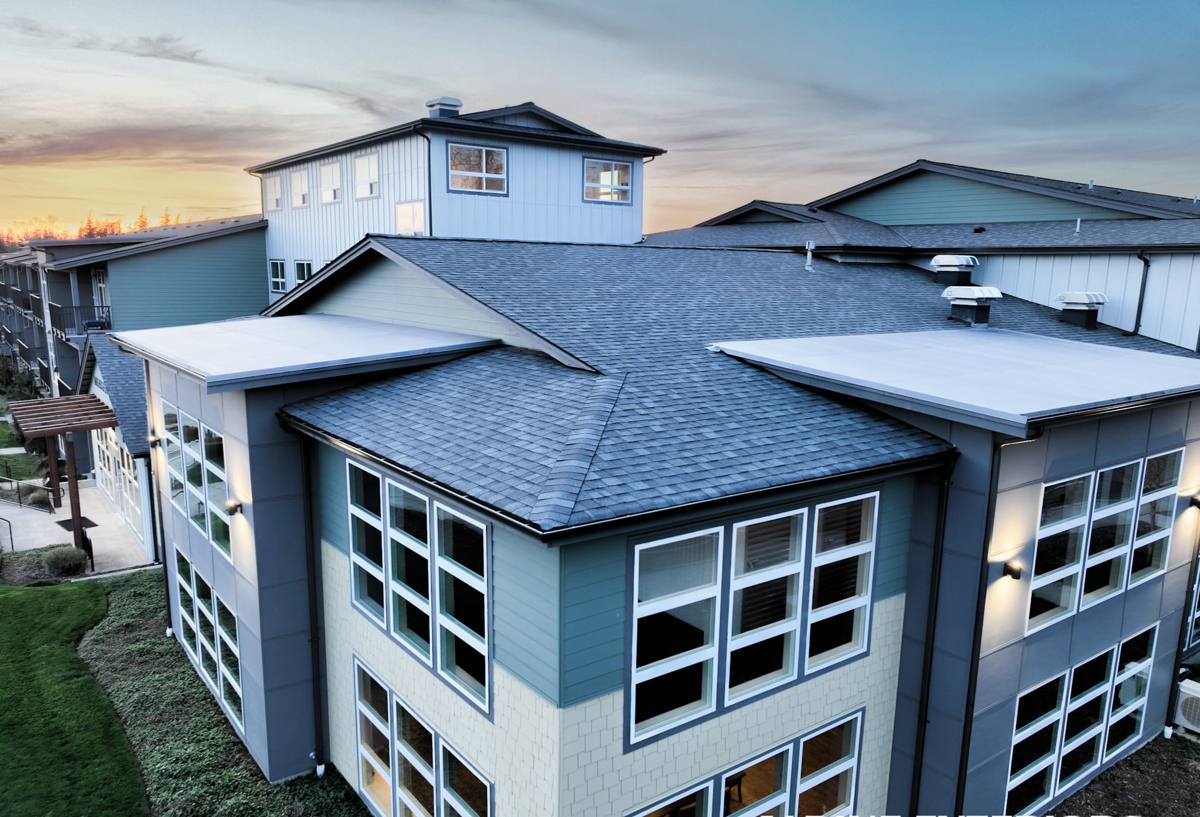
Signs a Marietta Home Needs a New Roof, Not Another Repair
Not every roofing problem calls for full replacement, and we won't tell a homeowner they need a new roof when a repair will do the job. But there's a point where patching stops making financial sense. Some signs worth a real inspection:
- Granule loss heavy enough that you're finding grit in gutters and downspouts every season
- Shingles that are cupping, curling, or cracking, especially on south- and west-facing slopes
- Moss that keeps returning within a year or two of cleaning, even after treatment
- Soft spots in the decking you can feel when walking the roof, or sagging visible from the ground
- Flashing that's rusted, lifted, or was never properly stepped and counter-flashed to begin with
- Daylight visible through the roof deck from inside the attic, or damp insulation after storms
- A roof approaching or past the 20-25 year mark for asphalt shingle products in a coastal-influenced climate
If a roof is showing two or three of these at once, replacement is usually the more honest recommendation than another round of spot repairs.
What a Correct New Roof Installation Actually Involves
Tear-Off and Deck Inspection
We don't install new roofing over old. A full tear-off lets us see the deck itself, which is where a lot of coastal moisture problems actually live. Any rotted or delaminated sheathing gets replaced before anything new goes down — covering over a compromised deck just guarantees a shorter lifespan for the new roof, no matter how good the shingles are.
Underlayment
Given how much driving rain Marietta sees, we treat underlayment as a real second layer of protection, not a formality. Synthetic underlayment handles wind-driven moisture better than older felt products, and we pay particular attention to ice-and-water shield at eaves, valleys, and any roof-to-wall transition — the places wind-driven rain is most likely to find a way in.
Flashing
Flashing failure is the single most common cause of leaks we find on older Marietta roofs, more than shingle wear itself. Salt air accelerates corrosion on lower-grade or aging metal flashing, so we install new flashing at every penetration, chimney, and sidewall rather than reusing what's there. Step flashing and counter-flashing get layered correctly, not caulked together as a substitute for proper installation.
Ventilation
A roof needs balanced intake and exhaust ventilation to manage moisture and temperature in the attic. In a marine climate, poor ventilation traps humid air against the underside of the deck, which shortens the life of the decking and can encourage the same kind of moss and algae growth you're trying to avoid on the outside of the roof. We check and correct ventilation as part of every new installation, not as an upsell afterward.
Fasteners
We use corrosion-resistant fasteners throughout. Salt air is hard on standard-grade nails and screws over time, and fastener failure is a slow, invisible problem until shingles start lifting in wind. It costs more upfront and is not visible once the roof is finished, which is exactly why it's worth asking a contractor about directly.
Choosing Materials for a Coastal-Influenced Climate
There's no single "best" roofing material for every home — it depends on the roof's pitch, the amount of shade, the home's structure, and the owner's budget and maintenance preferences. Here's how the common options stack up for Marietta's conditions specifically:
| Material | Moss Resistance | Salt Air Durability | Typical Lifespan | Maintenance |
|---|---|---|---|---|
| Architectural asphalt shingle | Moderate — improves with algae-resistant granules | Good with corrosion-resistant fasteners and flashing | 20-30 years | Periodic moss/debris removal |
| Standing seam metal | Very good — steep profile sheds debris | Depends on coating and fastener grade; needs quality materials near salt air | 40-60 years | Low; occasional fastener/seam checks |
| Synthetic/composite shingle | Good | Good — resists corrosion inherently | 30-50 years | Low to moderate |
| Wood shake | Poor without diligent upkeep | Moderate — needs regular treatment | 20-30 years with upkeep | High |
For most Marietta homes, architectural asphalt with algae-resistant granules or a synthetic composite gives the best balance of upfront cost and low-maintenance performance. Metal is worth serious consideration on lower-pitch sections or homes under heavy tree cover where moss is a persistent fight, but it's a bigger investment and only pays off when installed with proper coatings and fasteners suited to salt exposure.
How Our Installation Process Works
- On-site inspection — we walk the roof and attic, check the deck, ventilation, and existing flashing, and take real measurements rather than estimating from the ground or a photo.
- Written proposal — a clear scope of work and material selection, so you know exactly what's being installed and why, before any work starts.
- Scheduling around weather — we watch the forecast closely and plan tear-off days to avoid leaving a deck exposed when rain is likely.
- Tear-off and deck repair — old roofing removed, deck inspected, and any damaged sheathing replaced.
- Underlayment and flashing — installed to the standards described above, with extra attention at valleys, penetrations, and wall transitions.
- Roofing material installation — installed to manufacturer specifications, which matters for both performance and warranty validity.
- Final walkthrough — we inspect the completed roof with you, and clean up the site, including a magnetic sweep for stray fasteners.
Moss Season and Long-Term Roof Care
A new roof buys you time, but moss season doesn't go away because the roof is new. Whatcom County's damp, mild winters mean moss spores are active for much of the year, and shaded or north-facing sections of roof are especially vulnerable. A few habits make a real difference in how long a new roof performs well:
- Keep overhanging branches trimmed back to reduce shade and debris buildup on the roof
- Clean gutters and valleys before the fall rains start, and again mid-winter if trees drop heavily
- Address small moss patches early with a gentle treatment rather than pressure washing, which can strip granules
- Schedule a visual roof check after major windstorms, since that's when flashing and fastener issues tend to surface
What a New Roof Typically Costs — and What Drives the Price
We're not going to quote a price without seeing the roof, since pitch, access, tear-off complexity, and material choice all move the number significantly. But it's fair to explain what actually drives cost so a homeowner isn't surprised:
| Cost Factor | Why It Matters |
|---|---|
| Roof size and pitch | Steeper roofs take longer to work safely and require more fall protection |
| Number of layers to remove | Tearing off two layers of old roofing costs more than one |
| Deck condition | Rotted sheathing found during tear-off adds material and labor |
| Material selected | Asphalt, synthetic, and metal carry different material and labor costs |
| Roof complexity | Valleys, dormers, chimneys, and skylights all add flashing work |
| Access | Tight lots or difficult truck access can add setup time |
Broadly, a straightforward asphalt shingle replacement on an average home tends to run in the mid-five-figure range, with metal roofing and complex rooflines pushing higher. An accurate number only comes from an actual on-site look at your roof.
Why It Matters That We Already Work in Marietta
A roofing crew that mostly works inland doesn't always think about salt air corrosion on fasteners or flashing, because it isn't a problem they deal with regularly. Working in and around Semiahmoo and the surrounding Whatcom County coastline means we're used to specifying corrosion-resistant hardware as a default, not an upgrade, and we've seen firsthand how differently a roof ages here compared to a few miles inland. That local pattern recognition — knowing which slopes hold moss longest, which flashing details fail first in driving rain — shapes how we bid and install every roof, not just the ones with obvious problems already visible.
Get a Free, No-Pressure Estimate
If your Marietta home's roof is showing its age, or you just want an honest read on how many years it has left, we're happy to take a look. There's no cost and no pressure to move forward — just a straightforward inspection and a clear explanation of what we find. Use the form below to request your free estimate.