 Semiahmoo Exterior
 Why Bellingham Decks Take More Punishment Than the Brochure Suggests
Bellingham sits close enough to the water that salt-laden air reaches decks, railings, and fasteners year-round, not just on stormy days. Add in Whatcom County's long stretch of driving rain from fall through spring, plus a shoulder season where surfaces rarely get a full day of direct sun to dry out, and you have a climate that's genuinely tougher on outdoor structures than most manufacturer literature accounts for. On top of moisture and salt, this area grows moss aggressively on anything that stays damp and shaded for more than a few days, which includes the north side of most decks and the gaps between boards if they're not built to drain.
None of this means composite decking is a bad choice here — it's usually the opposite. But it does mean the difference between a deck that looks good for two years and one that performs for twenty comes down to build details that have nothing to do with the composite board itself: framing, fastening, airflow, and drainage. That's the part of the job that gets rushed on a lot of decks we're asked to look at after the fact.
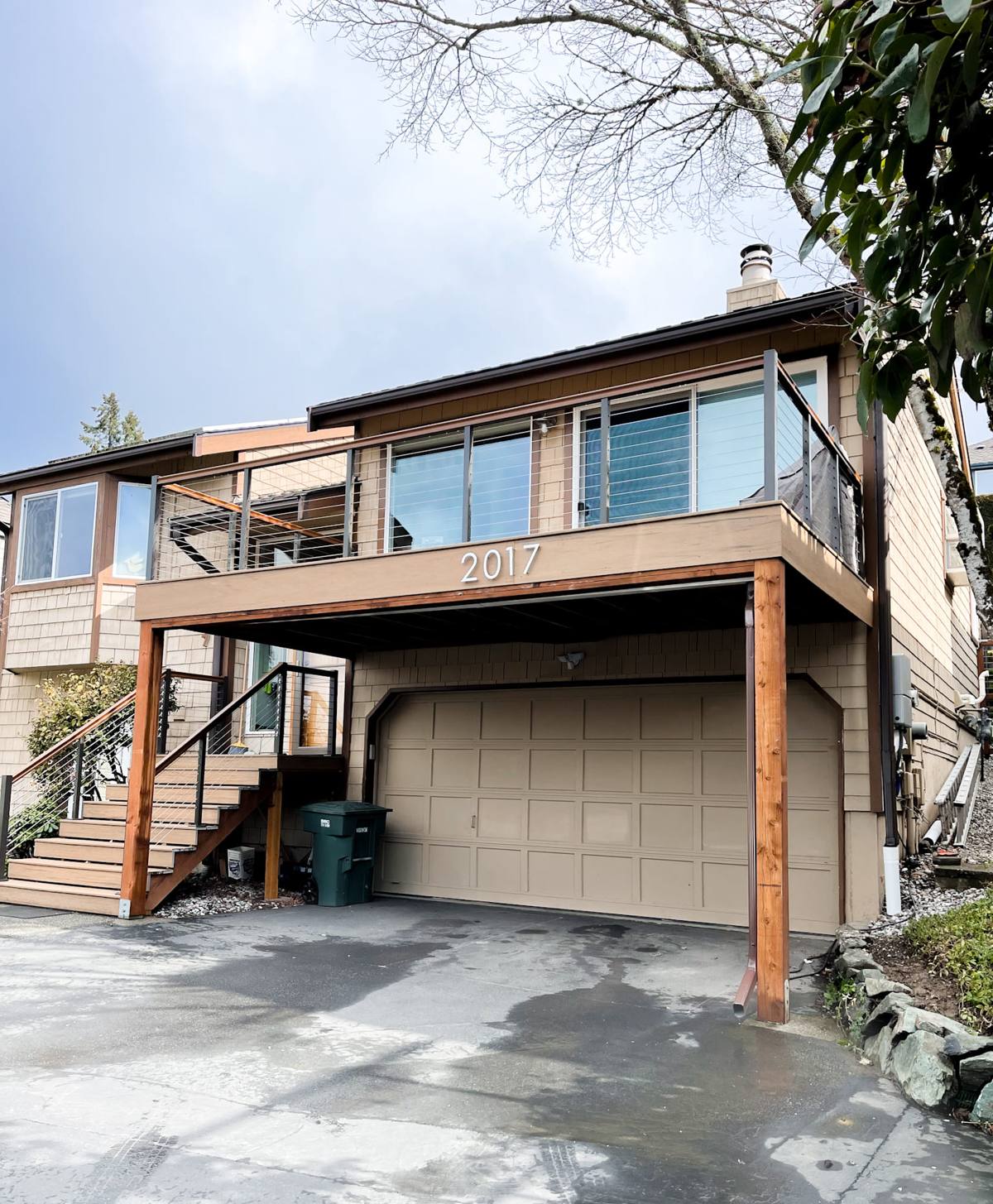
What Composite Decking Actually Needs to Hold Up Here
Moisture Management, Not Just Moisture Resistance
Composite boards resist rot the way wood never will, but "resists rot" is not the same as "handles standing water indefinitely." Capped composite boards shed surface water well, but the substructure underneath — joists, beams, ledger connections — is still wood or wood-adjacent in most builds, and that's where Bellingham's rain volume actually causes damage if it's not planned for.
Airflow Underneath the Deck
A deck built low to the ground with poor ventilation underneath will trap moisture and grow moss and mildew on the underside of the boards even if the top surface stays clean. Adequate clearance, and in some cases venting or gravel/drainage treatment below, matters more here than in drier climates.
Fastener and Hardware Selection
Salt air corrodes standard fasteners and hardware faster than most homeowners expect, especially within a few miles of the water. Using hot-dip galvanized or stainless structural hardware, and fasteners rated for coastal exposure, isn't an upsell — it's what keeps a deck from developing rust streaks and loosening connections within a handful of years.
Composite, Wood, and PVC — How They Compare for This Climate
| Factor | Composite | Pressure-Treated Wood | PVC/Capped Polymer |
|---|---|---|---|
| Moisture behavior | Stable, low absorption when capped | Absorbs and releases moisture, prone to cupping/splitting | Essentially non-absorbent |
| Moss/mildew resistance | Good on capped surfaces, needs airflow underneath | Poor — grain holds moisture and organic growth | Very good on the surface |
| Salt air/corrosion impact | Board itself unaffected; hardware still matters | Fasteners and connectors corrode; wood checks around them | Board itself unaffected; hardware still matters |
| Maintenance | Periodic cleaning, no staining/sealing | Annual sealing/staining to keep ahead of weather | Low, similar to composite |
| Upfront cost | Mid-range | Lowest | Highest |
| Long-term cost | Lower — fewer redo cycles | Higher over time from recoating and repairs | Comparable to composite, sometimes higher |
We install composite most often in this area because it holds a good middle ground: it handles the wet climate far better than untreated or even pressure-treated wood without the premium price of full PVC systems. That said, honest tradeoffs exist — composite can run warmer underfoot in direct summer sun and, like any capped product, is only as good as the substructure and installation underneath it.
How We Approach a Bellingham Composite Deck Build
- Site walk and assessment. We look at drainage patterns, sun/shade exposure, existing structure condition, and how close the deck sits to salt-air exposure or standing moisture.
- Framing and substructure plan. Joist spacing, ledger flashing, and clearance are sized for composite board specs and for this region's rain volume, not just minimum code.
- Material selection walkthrough. We go over board profiles, hidden vs. face-fastening systems, and hardware grade so you know what you're paying for and why.
- Installation. Proper gapping for drainage and thermal movement, corrosion-resistant fasteners throughout, and flashing details at the house connection.
- Final walkthrough. We check board alignment, fastener seating, railing security, and drainage before calling the job done.
Substructure and Fastening Details That Matter Most Locally
Most composite deck failures we're called out to inspect trace back to the substructure, not the decking material. Ledger boards attached to the house without proper flashing let water track behind the siding and into the framing — a slow problem that isn't visible until it's significant. Undersized or improperly spaced joists let composite boards flex and sag over time, which is a manufacturer warranty issue as much as a comfort one.
In a coastal-influenced climate like Semiahmoo and Bellingham, we also pay close attention to:
- Post base connections — kept off grade and away from standing water
- Joist tape or flashing on top of framing lumber to protect it under the decking
- Corrosion-rated screws, clips, and structural hardware throughout, not just at visible points
- Consistent board gapping so water drains instead of pooling between boards
- Clearance underneath the deck for airflow, sized to the deck's height and site conditions
Moss, Mildew, and Realistic Long-Term Maintenance
Composite decking cuts maintenance significantly compared to wood, but "low maintenance" isn't "no maintenance" in a climate that grows moss on driveways and roofs, let alone shaded decking. Debris that collects in board gaps or against railing posts holds moisture and gives moss a place to start, especially on north- or east-facing decks that don't get much direct sun. A periodic rinse and sweep, keeping gutters and nearby drainage clear so water isn't dumping onto the deck, and addressing shaded, damp corners before moss establishes itself will keep a well-built composite deck looking clean for years with minimal effort.
What composite decking doesn't need — and what we won't recommend — is annual sealing, staining, or the kind of upkeep cycle that pressure-treated wood requires to keep ahead of Whatcom County's wet season. That maintenance gap is a big part of why composite has become the practical default for decks in this area.
Common Problems We See on Existing Decks in the Area
When we're called to inspect an older deck — whether for repair, a partial rebuild, or full replacement — a handful of issues show up repeatedly around Bellingham and Semiahmoo:
- Rusted or corroding fasteners causing loose boards or railing wobble
- Moss buildup in board gaps that were never spaced for drainage
- Soft or damaged framing near the house where ledger flashing was missing or failed
- Boards installed too close to grade with no airflow underneath
- Mixed hardware grades where some connectors were coastal-rated and others weren't
Most of these are avoidable with correct installation up front, which is a large part of why we treat the substructure and fastening details as seriously as the visible decking material.
What to Ask Before Hiring a Decking Contractor Here
Composite decking is a forgiving enough product that a poor installation can still look fine for the first year or two — which makes it easy to hire the wrong crew without knowing it until problems show up later. Before signing anything, it's worth asking:
- What fastener and hardware grade do you use, and is it rated for coastal/salt-air exposure?
- How do you handle ledger board flashing at the house connection?
- What joist spacing do you build to relative to the composite manufacturer's requirements?
- How much clearance and airflow will the finished deck have underneath?
- Do you carry manufacturer certification for the composite brand you're installing?
- What does your warranty cover on labor, separate from the manufacturer's material warranty?
Why Hiring a Crew That Already Works Bellingham Matters
A lot of the details above aren't things you'd know to ask about unless you'd already seen what fails in this specific climate. A crew that builds decks mainly in drier or inland regions may not default to coastal-rated hardware, may not think twice about airflow clearance, and may not catch ledger flashing issues that only become obvious after a wet Whatcom County winter. We work in Semiahmoo and the surrounding Bellingham area regularly enough that these aren't special requests — they're just how we build a deck meant to hold up here.
If you're planning a new composite deck or replacing one that hasn't held up the way it should, we're happy to take a look and talk through what your site actually needs. Reach out for a free, no-pressure estimate using the form below.