 Semiahmoo Exterior
 California Creek's Siding Climate: Salt Air, Rain, and Moss
Homes near California Creek sit close enough to Semiahmoo Bay and the Salish Sea that salt-laden air is part of daily life, not an occasional event. That air carries fine salt particles that settle on exterior surfaces, work into seams and fastener heads, and accelerate corrosion on anything not built to resist it. Add Whatcom County's long wet season — driving rain that comes in sideways off the water during winter storms — and siding here takes on moisture loads that inland Washington siding never sees.
Then there's moss. The combination of shade from mature trees, high humidity, and mild temperatures year-round gives moss and algae a long growing season on this stretch of coastline — often eight months or more on north-facing walls that stay damp. Moss doesn't just look bad; it holds moisture against the wall surface, and over years that moisture finds its way into any gap, crack, or failed caulk joint in the siding system.
None of this is unique to one house — it's the baseline condition for exterior work in this part of Semiahmoo. Siding that isn't specifically suited to salt, standing moisture, and prolonged organic growth will show it early: chalking paint, swelling edges, soft trim, and rot starting from the inside out before it's visible from the street.
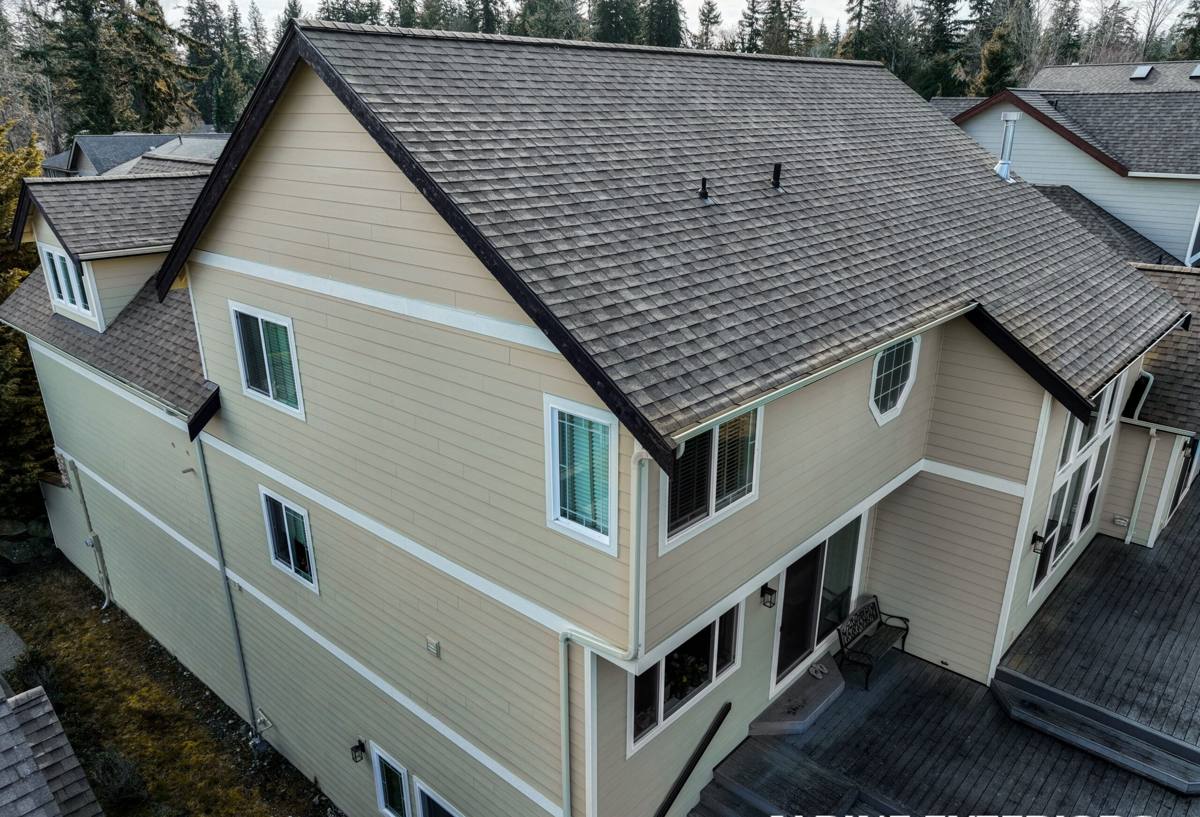
Why We Only Install James Hardie in This Kind of Exposure
We install James Hardie fiber cement siding exclusively — not as a marketing position, but because after years of seeing what salt air and coastal rain do to other siding materials, it's the product we're willing to put our name behind here. We don't install vinyl, LP SmartSide, cedar, primed spruce, or comparable fiber cement alternatives like Allura or Cemplank. Each of those has legitimate uses somewhere; on a California Creek home facing this climate, we don't think they hold up as well over the long run.
Engineered for Pacific Northwest Moisture
James Hardie makes climate-specific product formulations, and its HZ5 engineering is built for regions with the kind of moisture cycling Whatcom County sees — wet winters, humid shoulder seasons, and repeated wet-dry cycling that stresses lesser materials. Fiber cement itself is non-combustible and dimensionally stable; it doesn't swell, warp, or delaminate the way wood-based or wood-composite siding can when it stays damp for weeks at a time, which is exactly what happens behind moss on a shaded wall.
ColorPlus Factory Finish vs. Field-Painted Siding
Most Hardie siding we install uses the ColorPlus finish — baked on in a controlled factory environment rather than sprayed or brushed on site. That finish is formulated to resist fading and holds up better against the UV and salt exposure this area gets than a field-applied paint job, and it comes with its own finish warranty separate from the substrate warranty. For homeowners tired of repainting every few years because coastal weather chalks and fades standard paint fast, that's a real, measurable difference — not a marketing detail.
What a Correct James Hardie Installation Involves
Fiber cement siding is only as good as the installation behind it. Hardie's own installation instructions are specific for a reason: skip a step and you can end up with moisture problems on a product that's otherwise built to prevent them. A correct job on a California Creek home includes the following.
Flashing and Drainage Plane
Every wall needs a continuous water-resistive barrier and correctly lapped flashing at windows, doors, and horizontal transitions — installed so that any water that gets behind the cladding drains back out rather than pooling against sheathing. With this much annual rainfall, a compromised drainage plane is one of the fastest ways to turn a cosmetic siding job into a structural repair a few years later.
Fastening and Gaps
Hardie specifies fastener type, placement, and minimum gaps at butt joints, corners, and penetrations for a reason — those gaps allow for the board's normal expansion and contraction and give caulk somewhere stable to do its job. Fastening too tight, too loose, or in the wrong location is one of the most common shortcuts we see undoing an otherwise good product.
Trim and Caulking Details
Salt air degrades cheap or improperly applied sealants faster than inland climates do. We use sealants rated for the exposure and detail trim boards so water sheds away from joints instead of sitting on top of them. Caulk should be a secondary line of defense, not the only thing keeping water out — a wall that depends entirely on caulk staying perfect for ten years in this air isn't detailed correctly.
Signs Your Current Siding Is Losing the Fight
On older homes in this area, we typically see the same handful of warning signs, usually starting on the north and west-facing walls that get the most shade and weather exposure.
| What You See | What It Usually Means |
|---|---|
| Moss or dark green streaking on siding | Prolonged moisture retention against the wall surface, especially on shaded elevations |
| Cracked or shrunken caulk lines | Sealant has reached the end of its service life and is no longer keeping water out of joints |
| Soft or spongy trim boards | Moisture has been getting behind the trim, often for longer than the surface damage suggests |
| Paint chalking or fading unevenly | Salt and UV exposure breaking down a field-applied finish faster than its rated lifespan |
| Visible board warping or bowing | The substrate is absorbing and releasing moisture repeatedly and starting to lose its shape |
Any one of these is worth a closer look before it turns into sheathing or framing damage — by the time siding fails visibly, moisture has usually been working behind it for a while.
Our Process for a California Creek Siding Project
We keep the process straightforward because homeowners deserve to know what's happening to their house and when.
- On-site inspection of existing siding, trim, and any visible moisture or rot damage
- Honest assessment of what's driving the problem — climate exposure, past installation shortcuts, or age
- A written estimate covering Hardie product line, ColorPlus color selection, and the scope of trim and flashing work needed
- Removal of old siding and inspection of the sheathing underneath, with repairs made before anything new goes on
- Installation of water-resistive barrier, flashing, and Hardie siding to manufacturer specification
- Final walkthrough so you know what to expect from the new siding and how to care for it
We don't cover up a rot problem with new siding on top of it — if we find damaged sheathing or framing during tear-off, we bring it to you before moving forward, not after.
Why Local Experience on This Stretch of Coastline Matters
Siding contractors who mostly work inland don't spend much time thinking about salt fastener corrosion, extended moss seasons, or how hard wind-driven rain hits a wall facing open water. A crew that regularly works homes around Semiahmoo and California Creek already knows which elevations take the worst weather, which fastener and flashing details actually hold up here, and what this climate does to a siding job over five, ten, and twenty years — not just what the installation manual says in general terms.
That experience shows up in small decisions: where we add extra flashing attention beyond the minimum spec, which trim details we won't cut corners on, and how we sequence a project around this area's rain patterns so the water-resistive barrier and sheathing aren't left exposed longer than necessary.
Cost Factors for a California Creek Hardie Project
Every home is different, but the main variables that move the price on a project like this are consistent.
| Factor | Why It Matters |
|---|---|
| Existing siding removal and disposal | Tear-off labor and hauling add cost before new material goes on |
| Sheathing repair | Rot or moisture damage found during tear-off has to be fixed before new siding can go up correctly |
| Hardie product line and profile | Lap siding, shingle-style panels, and board-and-batten carry different material and labor costs |
| Trim scope | Full trim replacement versus reusing sound existing trim changes both material and labor time |
| Home size and wall complexity | Corners, dormers, and multiple stories all add labor time beyond flat, simple wall area |
We give a written, itemized estimate after seeing the home in person — we don't quote fiber cement siding sight unseen, because the condition of what's underneath the current siding matters as much as the square footage.
Caring for Your New Siding After Install
James Hardie siding installed correctly needs relatively little upkeep, but a little seasonal attention goes a long way in this climate.
- Rinse siding periodically to keep salt residue and organic buildup from accumulating, especially on shaded walls
- Keep gutters clear so overflow doesn't run directly down siding and trim
- Trim back vegetation and tree cover that keeps walls shaded and damp longer than necessary
- Check caulk lines at trim and penetrations annually and have any cracked sections resealed
- Address moss growth early with a gentle wash rather than letting it establish and hold moisture against the surface
None of this is intensive maintenance — it's the kind of basic attention that lets a properly installed Hardie system reach its full service life instead of fighting this climate on its own.
If you're seeing early wear on your current siding or planning ahead for a replacement, we're happy to take a look and give you a straightforward, no-pressure estimate for James Hardie siding built for what California Creek weather actually does to a home. Fill out the form below and we'll set up a time to come out.