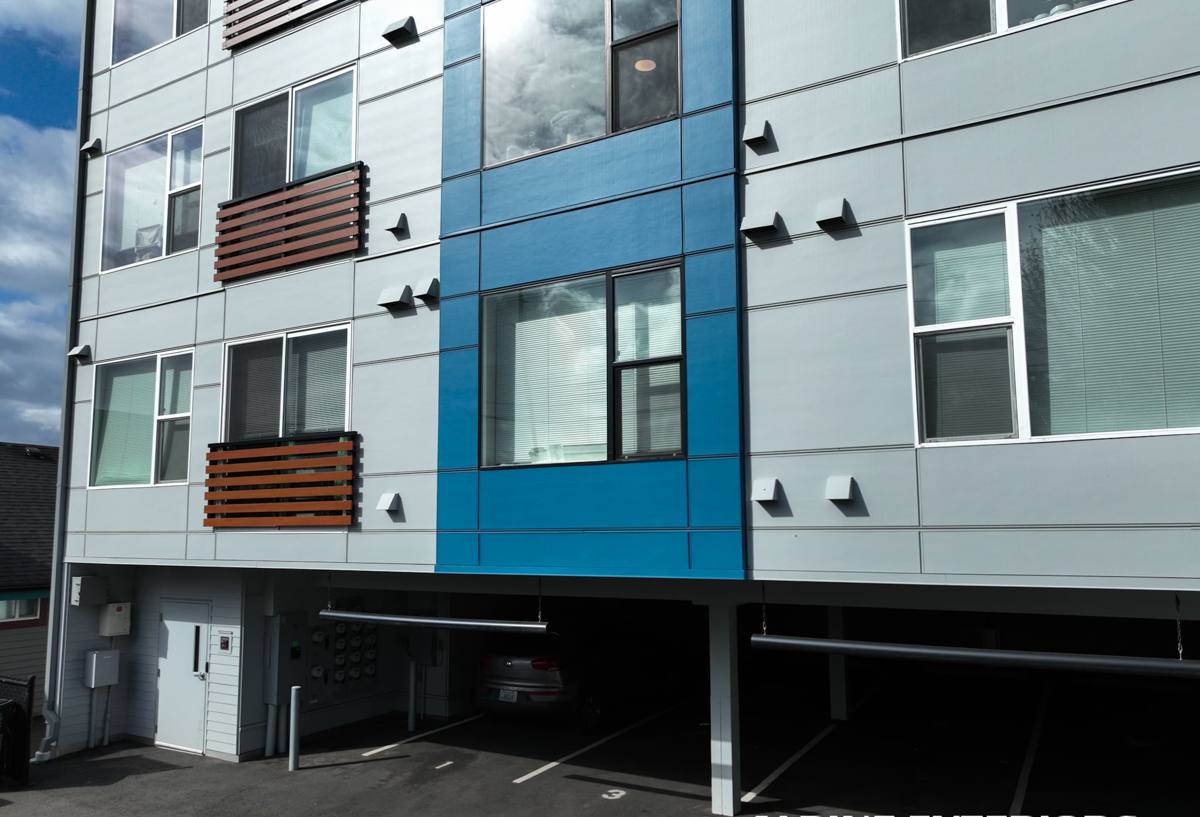
 Semiahmoo Exterior
 Why Blaine's Marine Climate Is Hard on Windows
Homes around Blaine and the Semiahmoo area sit right at the edge of Semiahmoo Bay and Drayton Harbor, which means windows here take a beating that inland Whatcom County homes simply don't face. Salt-laden air corrodes exposed hardware, fasteners, and lower-grade metal components faster than most manufacturers' warranties account for. Add in wind-driven rain that comes in almost sideways during winter storms, and you've got water finding its way into gaps that would stay dry in a calmer climate.
Then there's moss season, which in this part of Washington isn't really a season at all — it's most of the year. Constant dampness on north-facing walls and shaded window trim gives moss and algae a foothold on sills, cladding, and any wood trim that isn't well sealed. Once moisture gets trapped behind moss growth, it stays there, and that's exactly the kind of slow, hidden damage that leads to rot around a window opening long before anyone notices a problem from inside the house.
None of this means Blaine homes need exotic solutions. It means the details of a window replacement — flashing, sealants, frame material, hardware — have to be chosen and installed with this specific climate in mind, not treated the same as a replacement job in a drier part of the state.
Warning Signs It's Time to Replace, Not Just Repair
Some window problems are fixable with new weatherstripping or a re-glaze. Others mean the window has done its job and is done. Before you spend money on repairs, it's worth knowing which category you're in.
- Fogging or a permanent haze between panes of glass — the seal has failed and the insulating gas is gone, and this can't be repaired, only replaced
- Visible gaps, drafts, or daylight around the frame even when the window is fully latched
- Soft, spongy, or discolored wood at the sill or bottom corners of the frame — a sign of moisture that's already gotten in
- Windows that are difficult to open, close, or lock, especially older aluminum or wood units that have swollen or warped
- A noticeable rise in heating bills paired with cold spots near windows in winter
- Moss or dark staining building up on the sill or exterior trim year after year, even after cleaning
If you're seeing one or two of these, it may be a localized repair. If you're seeing several across the house, or the windows are original to an older home, replacement is usually the more honest recommendation — and often the more cost-effective one once you factor in ongoing repairs.
What a Correct Window Replacement Job Actually Involves
Removal and Inspection of the Framing
The work that matters most happens after the old window comes out and before the new one goes in. Pulling the sash and frame exposes the rough opening, and that's the only real chance to check for hidden rot, soft sheathing, or old flashing that's failed. Skipping this step and just fitting a new window into a compromised opening is how homeowners end up with the same water problem a few years later, just hidden behind new trim.
Flashing and Weatherproofing Detail
In a climate with this much wind-driven rain, flashing tape and sealant placement around the window opening is not optional detailing — it's the actual water management system. Flashing needs to be layered correctly (bottom to top, like shingles) so any water that does get past the window sheds back out rather than tracking down into the wall cavity. This is the step that's easiest to rush and hardest to inspect once the trim is back on, which is exactly why it deserves the most attention.
Insulation and Air Sealing
The gap between the new window frame and the rough opening needs to be filled with the right material — typically a low-expansion foam suited for windows — not stuffed with fiberglass batting or left mostly empty. Done right, this closes off both air leaks and a path for moisture to travel behind the frame.
Final Sealing and Hardware Check
Exterior caulking, interior sealing, and a functional check of every lock, latch, and operating mechanism close out the job. In a salt-air environment, hardware choice matters here too — cheaper coated fasteners and hinges corrode faster near the water than stainless or properly coated equivalents.
Choosing Frame Materials and Glass for This Climate
There's no single "best" window for every home, but some materials clearly hold up better than others in a coastal, high-moisture environment like Blaine's. Here's how the common options generally compare for this specific climate.
| Frame Material | Salt Air / Corrosion Resistance | Moisture & Rot Risk | Maintenance |
|---|---|---|---|
| Vinyl | Very good — won't corrode | Low, no rot risk in the frame itself | Low — occasional cleaning |
| Fiberglass | Excellent — very stable material | Very low | Low |
| Wood or Wood-Clad | Fair — cladding protects the exterior face, but exposed wood details need upkeep | Higher if seals or cladding fail | Higher — periodic finishing/inspection |
| Aluminum | Poor to fair unless marine-grade or well-coated | Low rot risk, but condensation and thermal performance are weaker | Moderate — watch for pitting and corrosion near the water |
For most homes in the Blaine and Semiahmoo area, vinyl or fiberglass frames offer the best balance of moisture resistance and low upkeep, which matters more here than in a drier climate. Wood-clad windows can still be the right call for a specific architectural style, but they need to be detailed and maintained with the salt air in mind, not treated like an inland installation.
Glass Packages Worth Discussing
Double-pane, low-E glass with argon gas fill is the standard baseline for this region and performs well against both heat loss and condensation. Triple-pane glass adds another layer of insulation and can help with sound and comfort near busier roads or more exposed, windy lots, though it comes at a higher cost and added weight on the frame and hardware. Whether that upgrade is worth it depends on the specific wall, orientation, and how exposed that side of the house is to wind and weather — something worth walking through during an estimate rather than deciding in the abstract.
Our Installation Process
- On-site assessment — we look at existing windows, framing condition, and how exposed each elevation of the house is to wind and rain
- Material and glass recommendation — matched to the specific window's exposure, not a one-size answer for the whole house
- Scheduling around weather — openings are only exposed for a short window during install, and we plan around forecasts rather than pushing through a storm
- Removal, inspection, and any needed framing repair — addressed before the new window goes in, not papered over
- Flashing, insulation, and installation — done in the sequence that actually sheds water, not just what's fastest
- Final sealing, hardware check, and cleanup — including debris removal and a walkthrough of how the new windows operate
Why Local Experience in Blaine and Semiahmoo Matters
A window replacement crew that mostly works drier, inland areas will still install a technically fine window — but they may not think twice about the extra flashing detail a west-facing wall needs on a lot exposed to the water, or why a particular hardware finish is a bad long-term choice this close to the bay. Working in Whatcom County's coastal communities regularly means those details become standard practice, not an afterthought.
It also means knowing what's realistic for scheduling. Install day needs a reasonably dry weather window, and in a place where rain and wind can move in quickly off the water, that takes local judgment, not just a general forecast check.
Local experience also matters for what happens after the crew leaves. A contractor who's still around and familiar with the area is easier to reach if a question comes up during the first heavy storm season after installation — something worth asking about with any contractor you're considering, regardless of who you hire.
Cost Factors to Expect
Every home is different, but a few factors consistently move the price of a window replacement project up or down, and it's worth understanding them before you get quotes:
| Factor | Effect on Cost |
|---|---|
| Frame material (vinyl vs. fiberglass vs. wood-clad) | Vinyl is typically the most affordable; fiberglass and wood-clad cost more upfront |
| Glass package (double vs. triple pane) | Triple-pane adds cost but can be worth it on more exposed walls |
| Number and size of windows | Larger openings and specialty shapes cost more per unit |
| Condition of the existing framing | Rot or water damage found during removal adds repair cost, but catching it now avoids bigger problems later |
| Access and site conditions | Second-story or hard-to-reach windows take more labor time |
As a general range, straightforward vinyl replacement windows often run from several hundred to a bit over a thousand dollars per window installed, with fiberglass, wood-clad, or larger custom units running higher. The only way to get a real number for your home is a walkthrough — broad averages don't account for your specific windows, framing condition, or exposure.
Keeping New Windows Performing Long-Term
New windows still need a little seasonal attention in this climate, especially with moss season lasting as long as it does around here.
- Rinse sills and lower frame sections periodically to keep salt residue and moss spores from building up
- Check exterior caulking once a year for cracking or separation, particularly after a hard winter
- Clear debris and moss from tracks and weep holes so water can drain the way it's designed to
- Operate every window a few times a year, even ones you rarely open, so hardware doesn't seize up
- Watch for any new drafts, sticking, or condensation between panes, and address it early rather than waiting
If you're weighing whether it's time to replace aging windows, or you just want an honest look at what a proper job would involve for your specific house in Blaine or Semiahmoo, we're happy to walk through it. Reach out for a free, no-pressure estimate using the form below.