 Semiahmoo Exterior
 Blaine Harbor Sits in One of the Toughest Microclimates in Whatcom County
Homes along Blaine Harbor and the Drayton Harbor waterfront take a different kind of weather beating than houses even a few miles inland. The combination of salt-laden air off Semiahmoo Bay, wind-driven rain that comes in sideways off the water, and a long, damp moss season that can run from October through May puts real stress on exterior siding. We've worked on enough homes in this stretch of Whatcom County to know that what holds up in Lynden or Sumas doesn't always hold up two blocks from the harbor.
This page is about one thing specifically: installing James Hardie fiber cement siding correctly on Blaine Harbor homes, and what that actually requires given the climate here. It's not a general siding overview — it's what we've learned putting Hardie products on houses that face salt spray and standing dampness for most of the year.
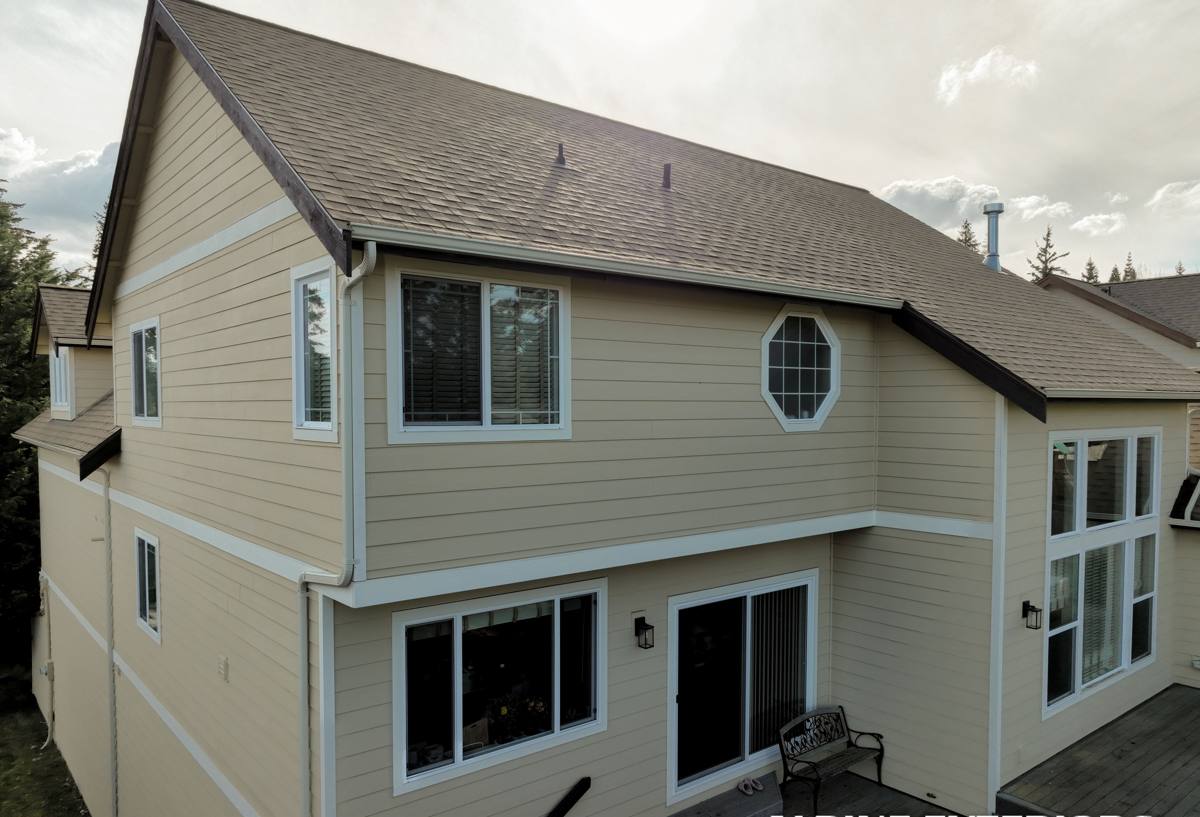
What Salt Air, Driving Rain, and Moss Season Do to a House
Each of these three conditions attacks siding in a different way, and Blaine Harbor homes deal with all three at once.
Salt Air
Airborne salt from Semiahmoo Bay and Drayton Harbor settles on exterior surfaces and accelerates corrosion of exposed metal — fasteners, flashing, trim screws, even light fixtures. Siding material that isn't inherently rot- and moisture-resistant, or that relies on caulk and paint film to keep water out, tends to fail faster in a salt-air environment because the protective layer breaks down sooner and the substrate underneath has nowhere to go but soft.
Wind-Driven Rain
Rain that falls straight down is manageable for almost any siding product. Rain that's pushed sideways by wind off the water finds every gap, lap joint, and penetration a house has. On harbor-facing walls in particular, water gets forced up and under laps rather than running down and off. That means the flashing details and water management behind the siding matter more here than they do on a sheltered inland lot.
Moss and Sustained Dampness
Whatcom County's marine climate keeps humidity high for much of the year, and Blaine Harbor's exposure to open water extends the wet season further than you'll see even a short drive inland. Moss and algae need sustained moisture to establish, and once they take hold on a north-facing wall or shaded trim board, they hold water against the surface long after the rain has stopped. On wood-based siding products, that's a slow path to rot. On the wrong composite products, it can mean swelling and edge deterioration.
Why We Only Install James Hardie in This Neighborhood
We install James Hardie fiber cement siding exclusively — not vinyl, not LP SmartSide, not cedar, not primed spruce. That's a standard we hold across every job, but it matters more in a harbor environment than almost anywhere else we work.
Fiber cement is made from cellulose fiber, sand, and portland cement. It doesn't have the wood content that gives engineered wood siding its vulnerability to moisture intrusion at cut edges and fastener penetrations, and it doesn't have the thermal expansion and contraction behavior that causes vinyl siding to buckle, gap, or blow off in sustained coastal wind. Hardie's ColorPlus factory finish is baked on under controlled conditions and backed by its own finish warranty, which matters in a climate where field-applied paint takes more of a beating from salt and UV than it does inland.
None of this means other products are junk — they're built for different conditions and different budgets, and we cover those trade-offs honestly on our product comparison pages. But for a harbor-facing home in Blaine, we don't think it's the honest recommendation, and we've built our business around only installing what we're willing to warranty on these lots.
What a Correct Installation Involves Here
James Hardie siding performs the way it's rated to perform only when it's installed to spec — and in a wind-driven-rain environment, the details that get skipped on an easy job are exactly the ones that cause problems within a few winters.
Water Management Behind the Siding
Every installation starts with a weather-resistant barrier and correctly lapped flashing at windows, doors, and any wall penetration. On harbor-exposed elevations we pay particular attention to head flashing above openings and kick-out flashing where roof lines meet walls, since those are the spots where wind-driven rain gets pushed uphill against gravity. The siding itself is the second line of defense — the water-resistive barrier underneath is the first, and it has to be continuous and properly integrated, not just present.
Fastening and Clearances
James Hardie specifies fastener type, spacing, and embedment depth, and those specs assume corrosion-resistant fasteners — which matters more here given the salt content in the air. We also hold the manufacturer's minimum clearances above grade, roofing, and decks so the bottom edge of the siding isn't sitting in a moisture trap. Skipping clearance is one of the most common shortcuts we see on older installs in this area, and it's usually the first place moss and rot show up.
Caulking and Joint Treatment
Hardie's install guidelines call for specific joint treatment at butt seams and trim intersections. In a lower-wind, drier climate a sloppy joint might go unnoticed for years. On a harbor-facing wall, a gap that lets wind-driven rain behind the siding will show up as a stain or soft spot much sooner. We treat every seam as if it's going to be tested by weather in its first winter, because on this stretch of coastline, it usually is.
Choosing the Right Hardie Product Line for a Blaine Harbor Home
James Hardie makes several siding profiles, and the right choice depends on the home's style, exposure, and how much of the wall faces the water directly.
| Product | Best Fit | Harbor Climate Notes |
|---|---|---|
| HardiePlank Lap Siding | Most home styles, straightforward re-siding jobs | Widest range of exposure options; horizontal laps shed wind-driven rain well when installed with correct overlap |
| HardiePanel Vertical Siding | Modern or mixed-material facades, accent walls | Fewer horizontal seams for water to find, often paired with board battens on exposed elevations |
| HardieShingle Siding | Craftsman or cottage-style homes | More detail work and joints, best kept on more sheltered elevations rather than the most wind-exposed wall |
| HardieTrim Boards | Corners, window/door trim, fascia | Matched material avoids the mismatched movement and moisture behavior you get pairing wood trim with fiber cement field siding |
On a lot with direct exposure to Semiahmoo Bay or Drayton Harbor, we'll often recommend HardiePlank or HardiePanel on the water-facing side for their simpler, more continuous water shed, while giving more decorative products like HardieShingle to sheltered or landward elevations where they'll take less of a beating.
Our Process for Blaine Harbor Projects
The steps are the same ones we follow everywhere, but the inspection and prep phases get extra attention on harbor lots because that's where existing damage tends to hide.
- Walkthrough and exposure assessment — we look at which elevations take the most direct wind and rain off the water, since that changes flashing detail and product choice.
- Removal and sheathing inspection — old siding comes off and we check the sheathing underneath for soft spots or existing moisture damage before anything new goes up.
- Water-resistive barrier and flashing — installed and inspected before a single piece of siding is hung.
- Hardie installation to manufacturer spec — correct fasteners, clearances, and joint treatment on every elevation, with extra care on harbor-facing walls.
- Trim, caulking, and final detail work — the finishing details that determine how the job ages, not just how it looks on day one.
- Walkthrough with the homeowner — so you know what was done and why, and what maintenance to expect going forward.
Maintaining Hardie Siding in a Marine Climate
One reason we recommend James Hardie for Blaine Harbor homes is that it needs less upkeep than most alternatives — but "less" isn't "none," especially with a moss season this long. A little seasonal attention keeps a correctly installed job looking and performing the way it should for decades.
- Rinse siding down once or twice a year, focusing on north-facing and shaded walls where moss and algae take hold first
- Keep gutters clear so overflow isn't running down the siding face during heavy rain
- Trim back vegetation and tree cover that's keeping any wall shaded and damp longer than the rest of the house
- Check caulked joints at trim and penetrations every year or two and have any cracked or missing caulk redone promptly
- Watch for chalking, fading, or peel at the factory finish and address it under warranty rather than waiting
- After major windstorms, do a quick visual check for any dislodged or cracked boards, particularly on the harbor-facing elevation
Why Hiring a Crew That Already Works Blaine Harbor Matters
Correct fastening schedules and flashing details are in the Hardie installation manual — any licensed contractor can read them. What's harder to get from a manual is judgment about which elevations on a specific harbor lot need extra flashing attention, which product line handles direct water exposure better, and what an early-stage moss or moisture problem looks like on a house that's only a few years old. That's the kind of thing you learn by working this specific stretch of coastline repeatedly, not by installing siding in a dozen different climates and treating them all the same.
We're a Semiahmoo-area crew that installs one product, to one standard, on homes that face this exact combination of salt air, wind-driven rain, and moss season. That focus is deliberate — it's easier to get details right when you're not trying to be the flexible answer for every siding brand and every climate at once.
Get a Free Estimate for Your Blaine Harbor Home
If you're weighing a siding replacement on a harbor-facing home, or you want a second opinion on an existing installation, we're happy to take a look and walk you through what we're seeing — no pressure, no obligation. Use the form below to request a free estimate.