 Semiahmoo Exterior
 Why Bellingham Siding Wears Out Faster Than the Warranty Card Says
Whatcom County homes sit in a climate that's rougher on exterior materials than most manufacturers account for. Bellingham and the greater Semiahmoo area get a combination of marine salt exposure, near-constant wind-driven rain off the Strait and bay, and long stretches of overcast, shaded dampness that keeps siding wet far longer than the national average. None of that is dramatic on any single day. It's the accumulation over years that separates siding that lasts three decades from siding that needs replacing at year twelve.
Salt Air and Marine Exposure
Homes closer to the water pick up airborne salt that settles on exterior surfaces and accelerates the breakdown of paint films, caulking, and fasteners. On wood-based and engineered wood sidings, that salt load combines with moisture to speed up swelling and edge deterioration. On metal flashing and trim fasteners, it contributes to corrosion well before a homeowner would expect it based on the product's rated lifespan.
Driving Rain and Wind-Driven Moisture
Bellingham doesn't just get rain, it gets rain pushed sideways by wind coming off the water. That matters because siding isn't just tested by how much water hits it, but by how much gets forced up under laps, around trim, and into seams. A siding system that performs fine in a calm climate can fail here simply because the installation details — flashing, lap spacing, caulk joints — weren't built for wind-driven exposure.
Moss, Shade, and the Long Wet Season
Mature tree cover and the region's long gray season mean many exterior walls stay damp for days at a time and rarely get direct sun to dry out. That's ideal territory for moss and algae growth on siding surfaces, and it means any siding with weak moisture resistance stays wet longer, which speeds up rot, delamination, or paint failure depending on the material.
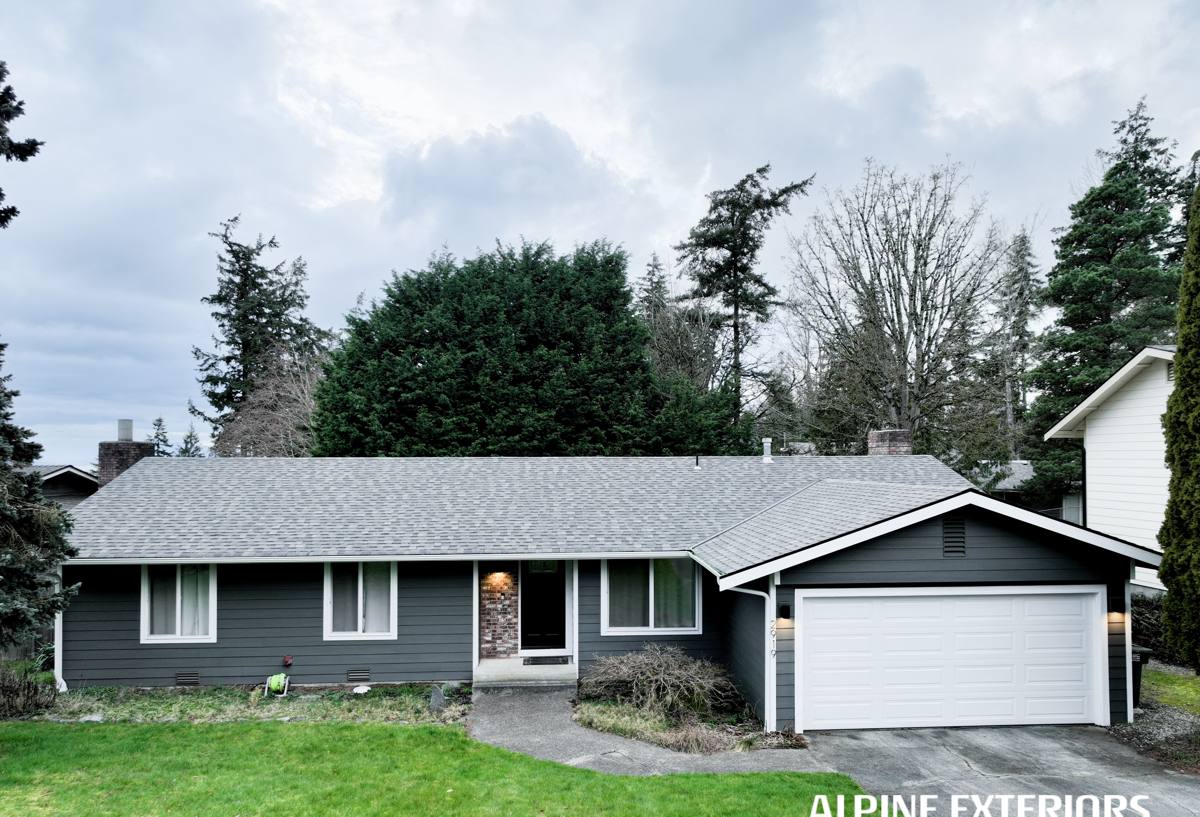
Signs Your Bellingham Home Needs Siding Replacement, Not Another Repair
Not every issue means a full tear-off. But in this climate, small problems compound quickly once moisture gets behind the siding plane. Here's what tells us a homeowner is past the point of patching:
- Soft or spongy spots when you press on the siding, especially near the bottom courses and under windows
- Paint that's bubbling, peeling, or won't hold a new coat for more than a couple of years
- Visible warping, cupping, or separation at panel seams
- Persistent moss or dark streaking that comes back within weeks of cleaning
- Soft trim boards or corner boards, which usually signal moisture has already reached the sheathing
- Rising energy bills with no other explanation, which can point to a compromised weather barrier
- Siding that's original to a home built more than 20-25 years ago, particularly if it's a wood composite or older vinyl product
What a Correct Siding Replacement Actually Involves
Siding replacement isn't just swapping old panels for new ones. In a climate like Semiahmoo's, the work that happens underneath the siding matters more than the siding itself.
Tear-Off and Sheathing Inspection
Once the old siding comes off, we inspect the sheathing and framing underneath for rot, soft spots, or prior water damage. This is often the first time a homeowner sees the real condition of their wall assembly. Any compromised sheathing gets replaced before anything new goes on — installing new siding over damaged sheathing just hides the problem for another few years.
Weather-Resistive Barrier and Flashing Details
A correctly installed weather-resistive barrier, properly lapped and taped, is what actually keeps wind-driven rain out of the wall assembly. Flashing around windows, doors, and any wall penetrations has to be detailed to shed water outward, not funnel it inward. This is the step that gets rushed on lower-end jobs and is the single biggest factor in whether a home stays dry through a Whatcom County winter.
Product Installation to Manufacturer Spec
Every siding product has fastener spacing, gapping, and clearance requirements that are engineered for specific performance — and those specs exist for climates exactly like this one. Skipping them (tight-nailing panels, ignoring expansion gaps, or skipping ground clearance) is the most common reason siding fails early, regardless of what brand is on the invoice.
Why We Install Only James Hardie Fiber Cement
We don't install every siding product on the market, and that's intentional. Vinyl, LP SmartSide, primed spruce, and cedar all have legitimate uses in the right setting, but none of them hold up as consistently as fiber cement in a coastal, high-moisture, low-sun climate like this one. We standardized on James Hardie because it's engineered specifically to handle the conditions that wear out other products fastest here.
Built for This Climate
James Hardie's HZ5 product line is engineered for exactly the combination of moisture, wind, and temperature swing that defines the Pacific Northwest coast. Fiber cement doesn't absorb water the way wood-based products do, doesn't warp or cup with humidity swings, and is non-combustible, which matters more each year as wildfire smoke and dry-season risk become part of the regional conversation even in a historically wet county.
ColorPlus Finish vs. Field-Painted Siding
Most siding failures we see aren't the substrate, they're the paint. A factory-applied ColorPlus finish is baked on under controlled conditions and backed by its own finish warranty, which means the color and the moisture barrier it provides aren't dependent on field weather conditions the day it was painted. Field-painted siding of any kind is only as good as the paint job and the weather when it was applied — and in this climate, that's a real gamble.
Comparing Siding Options for Bellingham's Climate
| Material | Moisture Resistance | Salt Air Durability | Maintenance Burden |
|---|---|---|---|
| James Hardie Fiber Cement | Excellent, does not absorb water like wood | Strong, factory finish resists salt-driven fade | Low, occasional wash |
| Vinyl | Fair, can warp with heat/cold cycling | Moderate, can chalk and fade near water | Low, but limited repair options if damaged |
| LP SmartSide | Fair, engineered wood still moisture-sensitive at cut edges | Moderate, edge sealing is critical and easy to miss | Moderate, edge maintenance required |
| Cedar / Primed Spruce | Weak without diligent upkeep | Weak, salt accelerates weathering | High, regular refinishing needed |
Our Process From Estimate to Finished Job
- Free on-site inspection where we check current siding condition, trim, flashing, and any visible moisture damage
- Honest assessment of whether the home needs full replacement or targeted repair
- Written estimate that spells out product line, color, and scope, no vague allowances
- Tear-off, sheathing inspection, and any necessary structural repair before new material goes on
- Weather barrier and flashing installed to manufacturer and code detail
- James Hardie installation to spec, including proper fastening, gapping, and clearance
- Final walkthrough so you know exactly what was done and what to expect going forward
What Drives Cost on a Bellingham Siding Replacement
Every home is different, but the same handful of factors move the price on most jobs in this area. We give firm written numbers after inspection rather than ballpark figures over the phone, because the variables below can swing a project significantly.
| Factor | Why It Matters Here |
|---|---|
| Sheathing condition | Hidden moisture damage from prior siding failures is common in older homes near the water |
| Home height and access | Multi-story homes and tight lot lines near neighboring structures add labor time |
| Trim and detail complexity | Homes with more corners, dormers, and window trim require more precise flashing work |
| Siding profile and color | Different Hardie plank widths and ColorPlus colors carry different material costs |
| Existing siding removal | Multiple layers of old siding or hidden rot add tear-off time |
Why Hiring a Crew That Already Works Bellingham Matters
A crew that only occasionally works this coastline can install siding perfectly well in theory and still get the details wrong for this specific environment. Flashing decisions, fastener choices, and even scheduling around Whatcom County's wet season all benefit from local experience. We know which wall orientations in this area take the worst of the driving rain, which lots hold shade and moisture longest, and how to sequence a job so it isn't left half-open during a stretch of bad weather. That local pattern recognition is the difference between a job that looks right on installation day and one that actually performs for 30 years.
Keeping New Siding Performing for the Long Haul
Even the right product installed correctly benefits from basic upkeep in this climate. A yearly rinse to knock down salt residue and organic growth, prompt attention to any caulking gaps around trim, and keeping gutters clear so water isn't sheeting down the wall face all go a long way. James Hardie siding is low-maintenance compared to the alternatives, but "low-maintenance" isn't "no-maintenance," especially this close to the water.
If your siding is showing its age or you're just planning ahead, we're happy to take a look and give you a straight answer about what your home actually needs. Fill out the form below for a free, no-pressure estimate — no obligation, no pressure, just an honest assessment from a crew that works this coastline every day.