 Semiahmoo Exterior
 Metal Roofing in the Wiser Lake Area: What's Actually Different Here
Homes around Wiser Lake sit in a stretch of Whatcom County where three things work on a roof at the same time: salt-laden air off the Strait, long stretches of driving rain, and a moss season that runs most of the year. None of that is unusual for coastal Washington, but it adds up faster than most homeowners expect. A metal roof handles this environment better than almost any other covering — if it's specified and installed with the coastal conditions in mind. A metal roof put on the same way you'd do it inland will underperform here, sometimes badly, within a decade.
This page is about one job: installing (or replacing) a metal roof on a home in the Wiser Lake area, done the way this climate actually requires. We're not going to give you a generic rundown of metal roofing in general — you can find that anywhere. This is what we look at, what we change, and why, when the roof in question is a few miles from salt water and under a marine cloud layer more days than not.
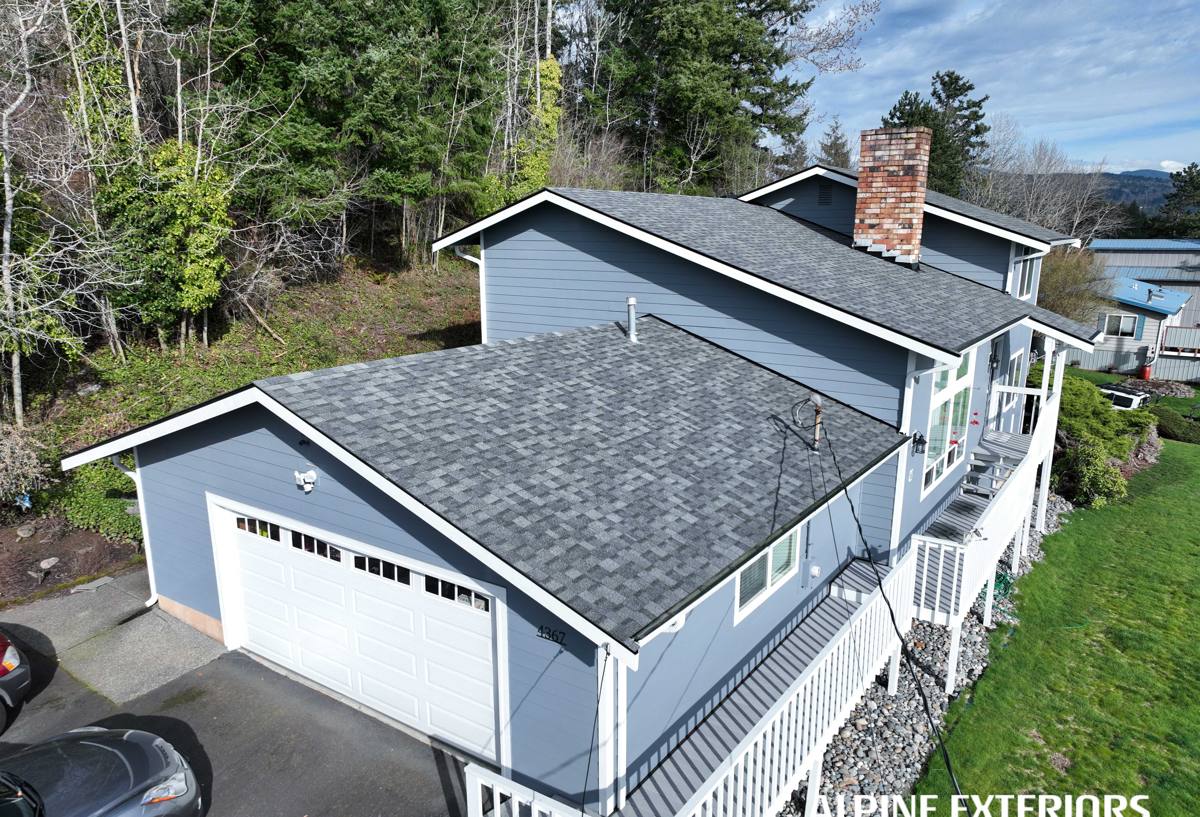
What Salt Air Does to a Roof That Isn't Built for It
Salt air is corrosive to bare and poorly coated metal, and it's persistent — it doesn't take a storm to carry it inland, just wind and humidity, both of which this area has in steady supply. The parts of a metal roof most at risk aren't always the big panels; it's the small stuff:
- Exposed fastener heads with worn or undersized neoprene washers
- Cut panel edges where the factory coating has been exposed by trimming
- Dissimilar metals in contact with each other (galvanic corrosion — for example, uncoated steel flashing against an aluminum panel)
- Low-grade fasteners that weren't rated for coastal exposure
- Scratches from foot traffic or careless installation that expose bare steel
None of this means metal roofing is a bad fit near the water — it's actually one of the better options, because a properly coated panel resists corrosion far longer than most other materials. It means the installer has to actually account for salt exposure: correct fastener grade, correct washer material, coated cut edges, and no mixed metals in the flashing details. Skipping any of these is where "metal roofs last 50 years" claims fall apart in a coastal microclimate.
Driving Rain and Water Management
Whatcom County doesn't usually get rain falling straight down — wind-driven rain off the Strait pushes water sideways under laps, around penetrations, and into valleys that would stay dry in a calmer climate. A metal roof's watertightness depends almost entirely on the details, not the panel itself:
Where water actually gets in
Underlayment quality and coverage matter more here than in drier parts of the state. We use a self-adhered, ice-and-water-shield-grade underlayment at valleys, eaves, and around every penetration — not just the minimum felt layer some installs get away with inland. Ridge caps, wall flashing, and skylight curbs get the same treatment. On a house exposed to open wind (which describes a lot of Wiser Lake-area lots), we also pay close attention to panel end laps and side-lap sealant, since wind pressure can force water backward under a lap that would shed fine in still conditions.
Gutters and drainage
Metal roofs shed water fast — much faster than a shingle roof, since there's no granule surface to slow it down. That's a benefit for the roof itself, but it means the gutter and downspout system underneath has to be sized to keep up, especially during the heavy rain events this area sees several times a year. Undersized or clogged gutters on a metal roof back water up at the eaves faster than most homeowners expect.
Moss Season and Metal Roofing
Moss struggles to get a foothold on bare, sloped metal the way it does on shingles or wood shakes — there's no rough surface for spores to grip. That's one of the real advantages of switching to metal in this area. But moss doesn't disappear entirely:
- Debris (needles, leaves, seed pods) collects in valleys and behind chimneys or dormers, and moss and algae will grow in that debris even on a metal roof
- Low-slope sections and shaded north faces stay damp longer and are more prone to organic growth than steep, sun-exposed panels
- Granular or textured metal finishes hold moisture and debris slightly more than smooth panels
We design roof layouts to shed debris where possible — panel orientation, valley width, and keeping penetrations out of low-flow areas — and we're upfront that a metal roof still needs occasional debris clearing near trees, even though it won't need moss treatment like a shingle roof does.
Choosing the Right Metal Roofing System
Not all metal roofing is the same product wearing different colors. The two main categories homeowners choose between are standing seam and exposed-fastener (corrugated or ribbed) panels, and the right call depends on budget, roof complexity, and how much maintenance you want to think about later.
| Factor | Standing Seam | Exposed Fastener |
|---|---|---|
| Fasteners | Concealed under the seam — not exposed to weather | Visible screws through the panel face |
| Coastal durability | Higher — no exposed fastener corrosion points | Lower — fastener/washer wear over time in salt air |
| Typical lifespan | 40–60+ years with proper install | 25–40 years, largely dependent on fastener maintenance |
| Upfront cost | Higher | Lower |
| Maintenance | Minimal | Periodic fastener/washer inspection recommended |
| Appearance | Clean, no visible hardware | Traditional ribbed look, visible screw lines |
For homes closest to open water or on exposed lots, we generally steer clients toward standing seam because it removes the weakest point in the system — exposed fasteners — from the equation entirely. On more sheltered lots, or where budget is the deciding factor, a properly installed exposed-fastener system with coastal-rated fasteners is still a solid, honest choice. We'll tell you which fits your specific site rather than pushing one system across the board.
What a Correct Metal Roof Job Involves
A metal roof is only as good as the layers underneath it and the details you never see once it's finished. Here's what should happen on a proper install:
- Full roof inspection and deck assessment — metal panels won't fix a soft or rotted deck, and covering one over is a problem for later, not a solution now
- Tear-off of the old roofing in most cases (overlay onto existing shingles is sometimes possible but limits underlayment coverage and isn't our default recommendation on a coastal home)
- Self-adhered, high-temp underlayment at all valleys, eaves, and penetrations; synthetic underlayment across the field
- Correct panel and fastener selection for the site's wind and salt exposure
- Properly lapped and sealed flashing at every wall, chimney, skylight, and vent penetration — no mixed metals in contact
- Ridge and hip caps installed with ventilation in mind, not just appearance
- Ice-and-water-shield detailing at valleys and low-slope transitions
- Final walk-through covering fastener torque, seam integrity, and cleanup
Signs your current roof needs attention
- Rust streaking at fastener heads or cut edges
- Panels that have loosened or "oil-canned" (visible waviness) in wind
- Moss or organic buildup concentrated in valleys or behind roof features
- Water staining on interior ceilings near valleys or penetrations
- Gutters overflowing during heavy rain even when clear of debris
- Visible gaps or shifted fasteners after a windstorm
Cost Factors for Wiser Lake-Area Metal Roofing
Metal roofing costs more upfront than asphalt shingles, and the final number depends on more than just square footage. The main factors we walk clients through:
| Factor | Why It Matters |
|---|---|
| Panel system (standing seam vs. exposed fastener) | Standing seam typically runs higher due to labor and concealed-fastener hardware |
| Metal gauge and coating grade | Heavier gauge and premium coatings (like PVDF-based finishes) cost more but resist coastal fading and corrosion longer |
| Roof complexity | Valleys, dormers, and multiple penetrations add flashing labor beyond simple gable roofs |
| Tear-off vs. overlay | Tear-off costs more upfront but allows full underlayment coverage — important given local rain exposure |
| Deck repair | Rotted or soft decking found during tear-off adds cost but has to be addressed, not covered over |
| Fastener/hardware grade | Coastal-rated fasteners and washers cost more than standard-grade but are not optional this close to salt water |
We'd rather walk you through these factors on your actual roof than quote a number that doesn't hold up once we're up there. Broad ranges vary widely by system and roof size, which is exactly why we do an in-person assessment before giving a real figure.
Why a Crew That Already Works the Wiser Lake Area Matters
A metal roof installed by a crew unfamiliar with this specific stretch of coastline is still a metal roof — but the details that make the difference between 20 years and 50 years are the ones you don't notice until they fail. A crew that regularly works Semiahmoo and the surrounding Whatcom County coastline already knows:
- Which fastener and coating grades hold up against local salt exposure, based on what we've seen fail and what hasn't
- How wind exposure differs lot to lot in this area, and where extra sealant or fastener spacing is worth the time
- Which roof lines collect debris fastest given the tree cover common around Wiser Lake and neighboring communities
- Local permitting and inspection expectations, so the job doesn't stall on paperwork
That local knowledge doesn't show up as a line item on a quote, but it's the difference between a roof that's still tight in year 30 and one that's showing rust streaks by year 12.
Our Process, Start to Finish
We keep the process straightforward: an on-site inspection where we look at the deck, current roofing, ventilation, and any problem areas; a written recommendation with material and system options suited to your specific exposure; a clear scope and timeline before any work starts; and a final walk-through where we show you what was done, not just tell you. We clean up thoroughly, including a magnetic sweep for stray fasteners — something that matters more on a metal roof job than most.
If you're weighing a metal roof for a home near Wiser Lake, or your current roof is showing the kind of wear this climate causes, we're glad to take a look and give you a straight assessment — no pressure, no inflated urgency. Reach out for a free estimate using the form below.