 Semiahmoo Exterior
 Siding Built for Custer's Coastline Exposure
Custer sits close enough to the Semiahmoo shoreline and the open water of Boundary Bay and the Strait of Georgia that homes here take a different kind of weathering than siding further inland. Salt-laden air corrodes fasteners and finishes faster, wind-driven rain off the water finds every gap in a poor installation, and the shaded, moisture-heavy stretches of Whatcom County keep moss and algae active nearly year-round. Siding that would hold up fine in a drier climate can fail early out here if it's the wrong material or it's put up wrong.
This page is about one job, done right, in one place: James Hardie fiber cement siding installation for homes in and around Custer. We're not going to give you a generic rundown of siding in general — we're going to walk through what this climate actually does to a house, what a correct installation looks like in response, and how our process handles it.
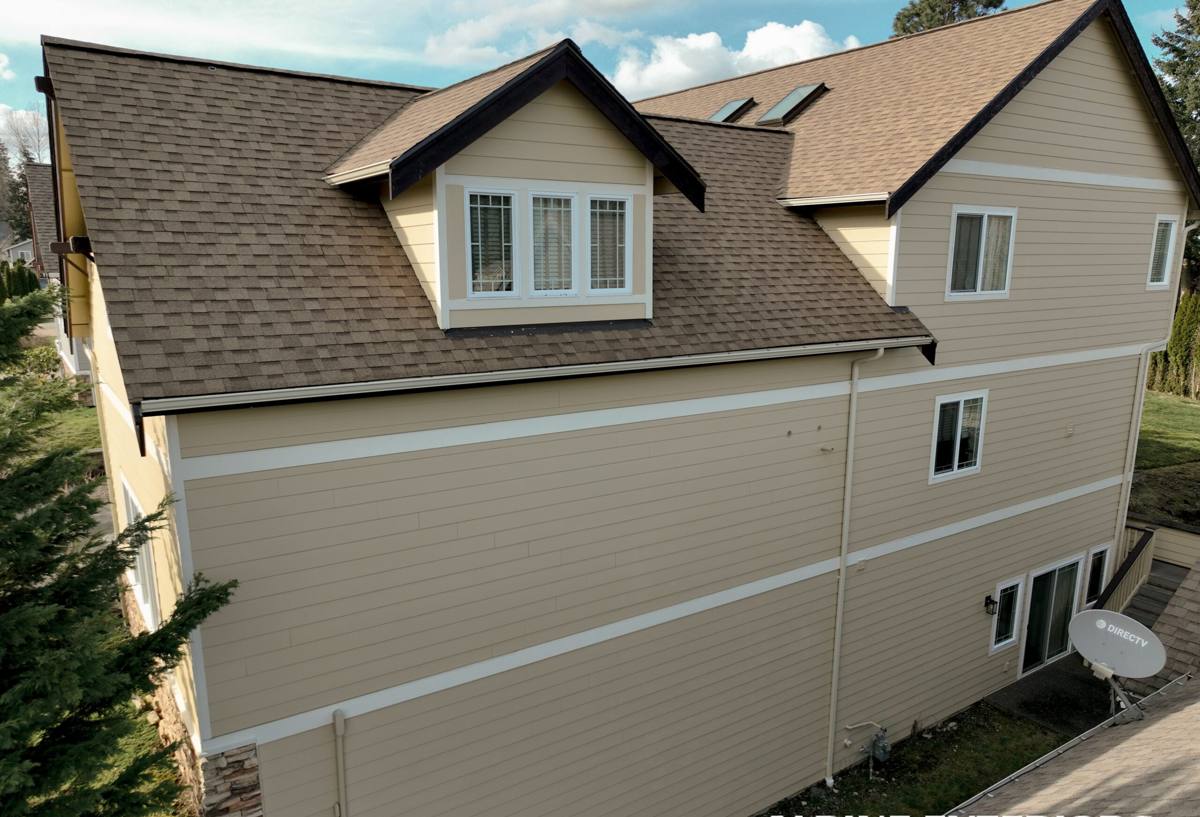
What Salt Air, Rain, and Moss Actually Do to a House
Salt Air
Airborne salt doesn't just sit on the surface — it works into fastener heads, trim joints, and any exposed cut edge. Over years, that accelerates corrosion on lower-grade fasteners and trim hardware, and it can degrade the finish on siding products that weren't engineered to handle a marine-influenced climate. It's a slow problem, which is exactly why it's easy to underestimate until you're repainting or replacing trim a decade earlier than you should have to.
Driving Rain
Storms coming off the water push rain sideways, not straight down. That means water gets tested against every seam, every window and door flashing, and every siding joint on the weather-facing walls of a house — areas that a calm-climate installation might get away with cutting corners on. If the water-resistive barrier, flashing, and siding overlaps aren't done correctly, driving rain will find the gap, and it usually takes months or years for the resulting rot to show itself from the outside.
Moss and Algae
Whatcom County's damp, mild climate keeps shaded and north-facing wall sections wet longer than sun-exposed ones, which is prime territory for moss and algae growth. On siding materials that absorb moisture or have a finish that traps it against the substrate, that growth isn't just cosmetic — it holds water against the wall and shortens the material's working life. On a properly finished, moisture-resistant siding, it's mostly a cleaning issue instead of a structural one.
Why We Standardized on James Hardie Fiber Cement
We install James Hardie siding exclusively. We don't install vinyl, LP SmartSide, primed spruce, cedar, or other fiber cement brands, and that's a deliberate call, not a default. Here's the reasoning that matters for a home in Custer specifically:
- Non-combustible core: fiber cement doesn't feed a fire the way wood-based products can, which matters for insurance and long-term risk regardless of coastal exposure.
- Climate-engineered product lines: Hardie's HZ5 product line is formulated for the Pacific Northwest's wet, temperate conditions specifically — it's not a one-size-fits-all national product.
- Factory-applied ColorPlus finish: the finish is baked on at the factory under controlled conditions, which holds up better against salt air and UV than field-applied paint and cuts down on repainting cycles.
- Dimensional stability: fiber cement doesn't swell, warp, or rot the way wood-based siding can when it takes on repeated moisture exposure.
- Transferable warranty backing: a strong, well-documented warranty structure that holds up when installed to Hardie's spec — which is where installation quality becomes the deciding factor, not just the product itself.
That last point is worth dwelling on: fiber cement siding is only as good as the installation behind it. A correctly installed vinyl job will sometimes outperform a poorly installed Hardie job. Material choice and installation quality both matter, and in a climate like Custer's, neither one can be an afterthought.
What a Correct Installation Involves Here
A siding job that's actually built for Custer's exposure isn't just nailing boards to the wall. The details that matter most in this climate are mostly invisible once the job is done:
Water-Resistive Barrier and Drainage Plane
Every wall gets a continuous water-resistive barrier behind the siding, with a drainage gap that lets any moisture that does get behind the cladding drain out and dry, rather than sitting against the sheathing. This is the single biggest factor in whether driving rain becomes a cosmetic non-issue or a hidden rot problem five years down the road.
Flashing at Every Penetration
Windows, doors, hose bibs, vents, and any other wall penetration get properly integrated flashing — not just caulk. Caulk is a maintenance item that degrades; correctly lapped flashing is a permanent water-shedding detail. On a wind-driven-rain coastline, this is where most failures actually start.
Fastener Selection
We use corrosion-resistant fasteners appropriate for Hardie's specifications and this climate's salt exposure, placed according to manufacturer nailing patterns — not gun-and-go at whatever spacing is fastest.
Proper Clearances
Hardie specifies minimum clearances from grade, roofing, and decking surfaces. Skipping these clearances is one of the most common corner-cutting mistakes we see on homes that come to us for repair — it lets moisture wick into the bottom edge of the siding and defeats the material's moisture resistance from the start.
Caulking and Joint Treatment
Butt joints, trim intersections, and penetrations get sealed per Hardie's published details, using sealants rated for the exposure. Done wrong, this is a five-year maintenance headache. Done right, it's a non-issue.
| Detail | Why It Matters in Custer |
|---|---|
| Continuous water-resistive barrier | Backstops driving rain that gets past the siding face |
| Integrated flashing (not just caulk) | Permanent water-shedding at windows, doors, and penetrations |
| Corrosion-resistant fasteners | Salt air accelerates corrosion on lower-grade hardware |
| Manufacturer clearances from grade/roof | Prevents moisture wicking into the siding's bottom edge |
| Factory ColorPlus finish | Holds color and resists moisture better than field paint in salt air |
How Our Process Works
1. On-Site Assessment
We walk the home, look at current siding condition (if any), check trim and window flashing, note shaded and wind-exposed walls, and assess what the substrate looks like once old siding comes off.
2. Product and Line Selection
We talk through Hardie's product lines and profiles — lap siding, panel, shingle-style — and help you land on what fits the home's style and this climate's demands, including HZ5 zone considerations for the Pacific Northwest.
3. Tear-Off and Substrate Check
Old siding comes off, and we inspect the sheathing underneath for any moisture damage before anything new goes up. This is the point where hidden problems from a prior installation typically surface, and it needs to be dealt with before new siding goes on top of it.
4. Water-Resistive Barrier and Flashing Installation
This is the step that determines how the house performs in a storm, and it happens before a single piece of visible siding is installed.
5. Siding Installation to Manufacturer Spec
Fastener pattern, clearances, joint treatment, and caulking are all done to Hardie's published installation guidelines — the same guidelines that back the manufacturer's warranty.
6. Final Walkthrough
We walk the finished job with you, so you know what was done and why, and what (if any) maintenance the finish requires going forward.
What to Check Before You Hire Anyone for This Job
- Ask whether the crew installs to the manufacturer's published nailing pattern and clearance specs, not just "how they've always done it."
- Ask what water-resistive barrier and flashing details they use, specifically at windows and doors.
- Ask whether they've worked in Custer or similarly exposed coastal areas of Whatcom County before — wind-driven rain and salt exposure aren't universal conditions, and experience here shows.
- Ask what fastener type they use and whether it's rated for coastal/salt exposure.
- Confirm whether the installation will qualify for the manufacturer's full warranty — a warranty only holds if the install meets spec.
- Get a clear scope in writing: tear-off, disposal, flashing details, and finish line included.
Why a Crew That Already Works This Area Matters
A siding crew that mostly works inland doesn't build the same instincts around flashing details, fastener choice, and drainage planes that a crew working Custer, Semiahmoo, and the rest of Whatcom County's coastline develops over time. The failures we get called out to fix are rarely about the siding material itself — they're almost always about a detail that got skipped because it wasn't necessary somewhere drier. Working this area regularly means we're not guessing at what this climate requires; we're building to it by default.
Get a Free Estimate
If you're planning a siding project in Custer and want a straight answer about what your home needs, we're happy to take a look and walk you through it — no pressure, no pushy sales pitch. Fill out the form below and we'll get in touch to schedule a free estimate.