 Semiahmoo Exterior
 Building New in Bellingham? The Windows Are Not a Commodity Item
On a new-construction job, windows often get treated like a line item on a materials list — pick a brand, order the sizes, set them, move on. That approach works fine in a dry climate. It does not work well in Whatcom County. Bellingham sits in a stretch of Washington where Pacific storms roll in wet and sideways, salt-laden air drifts in off the Strait and Bellingham Bay, and a long gray moss season keeps exterior surfaces damp for months at a stretch. A window opening that isn't detailed correctly on day one becomes a rot pocket, a mold source, or a warranty dispute three to five years down the road — right about the time nobody remembers who installed it.
We install new-construction windows for builders and owner-builders throughout the Semiahmoo and greater Bellingham area, and we treat the opening — not just the window unit — as the product. That means flashing sequence, sill pan drainage, house wrap integration, and fastening schedule all get the same attention as the glass itself.
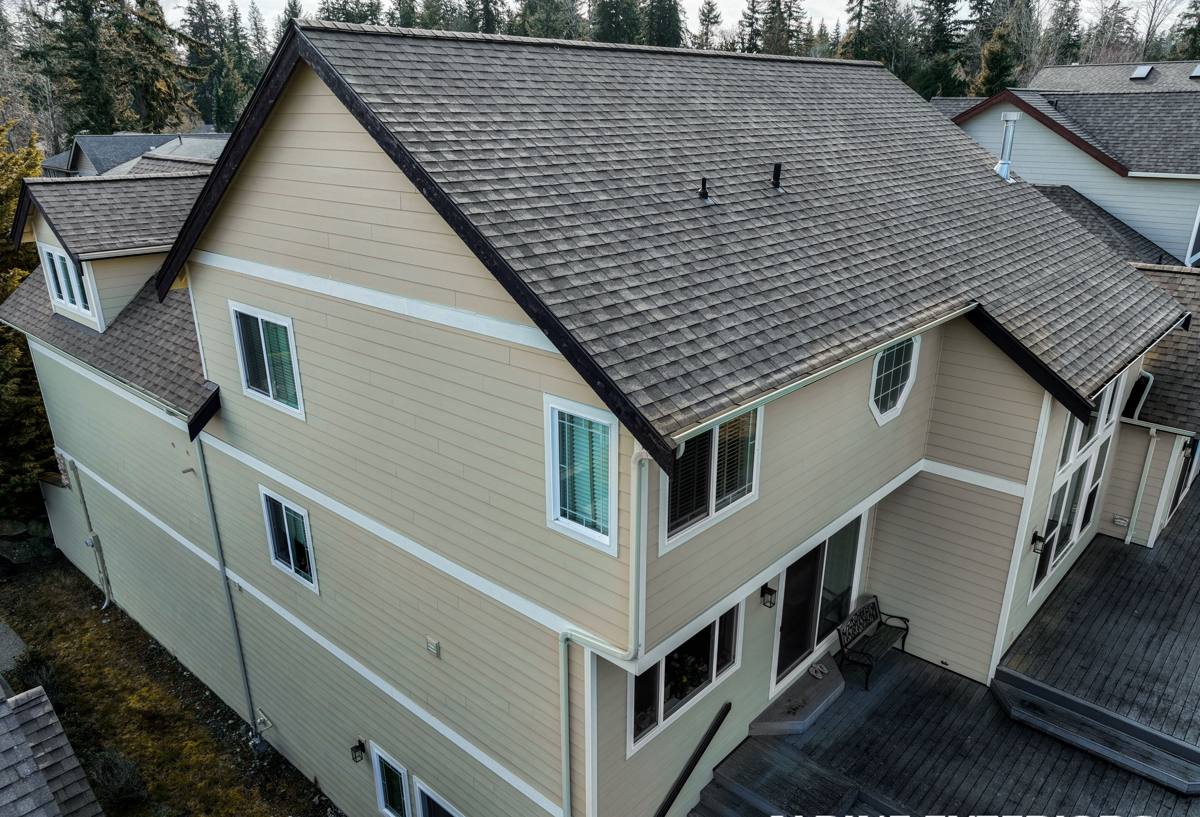
What Bellingham's Climate Actually Does to a Window Opening
Driving Rain and Wind-Driven Moisture
Storms coming off the Strait of Georgia and the Salish Sea don't just fall straight down — wind pushes rain sideways into wall assemblies, especially on west- and south-facing elevations. A window opening that relies on caulk alone as its water barrier will eventually leak. Correct flashing creates a shingled, gravity-fed drainage path so any water that gets past the exterior cladding runs back out, not into the wall cavity.
Salt Air
Proximity to Semiahmoo Bay and the broader Puget Sound/Salish Sea airshed means airborne salt is a real factor for exterior hardware, cladding fasteners, and window frame components — particularly on properties closer to the water. Salt accelerates corrosion on unprotected steel and lower-grade aluminum hardware, which is one reason we're careful about fastener and flashing material specs on coastal-adjacent lots.
Moss and Sustained Dampness
Whatcom County's moss season isn't cosmetic — it's a sign that surfaces stay wet for extended periods with limited dry-out time between storms. Any window detail that traps moisture instead of shedding it (a missing sill pan, a reversed flashing lap, house wrap tucked the wrong direction) sits wet for weeks at a time during fall and winter. That's the exact condition that grows rot in framing lumber and mold behind interior trim.
What a Correct New-Construction Window Install Actually Involves
New-construction installation is different from a retrofit or replacement job — the window goes into a raw rough opening before siding and often before the weather-resistive barrier is fully lapped, which means the sequence of work matters as much as the window itself.
The Core Steps, In Order
- Rough opening check — verify size, square, level, and plumb before the window ever arrives on site
- Sill pan installation — a sloped, self-flashing pan (site-built or manufactured) so any water that reaches the sill drains outward, not into the framing
- Back dam or end dams at the sill pan to stop water from migrating sideways under the window
- Window set into the opening, shimmed and fastened per the manufacturer's structural fastening schedule
- Head, jamb, and sill flashing integrated with the house wrap in proper shingle-lap order — head flashing goes in last, over the wrap, so water sheds down and out
- Interior air sealing with low-expansion foam or backer rod and sealant — this controls condensation and drafts as much as insulation does
- Final exterior sealant joints, sized and tooled correctly — sealant is a backup layer, not the primary water barrier
Skip or shortcut any one of these steps and the window itself — even a premium unit — won't perform the way its warranty implies.
Choosing Window Products for This Climate
We don't push one brand as the only answer, but we do steer clients toward products and specs that hold up under Whatcom County's rain load and temperature swings, and we're upfront about the trade-offs of each option rather than dismissing anything outright.
| Frame Material | How It Performs Here | Trade-Off to Know |
|---|---|---|
| Vinyl | Good moisture resistance, no paint upkeep, solid value | Limited color/finish options; can expand/contract with temperature swings if not sized correctly |
| Fiberglass | Very stable dimensionally, strong moisture and rot resistance | Higher upfront cost than vinyl |
| Wood or wood-clad | Classic look, good insulating properties | Exposed wood needs consistent maintenance in a wet climate; cladding must be detailed carefully at the sill |
| Aluminum | Strong and slim sightlines | Poor thermal performance and higher corrosion exposure in salt-influenced air unless it's a marine-rated or thermally broken product |
Glass Specs Worth Asking About
For Western Washington's climate zone, low-E dual-pane glass with a U-factor suited to our heating-dominated climate is the baseline, not an upgrade. Argon-filled units and a warm-edge spacer help control condensation on cold, humid mornings — a real issue here given how often indoor and outdoor humidity both run high in winter.
Our Process on a New-Construction Job
1. Plan Review and Coordination
We look at the window schedule and rough opening sizes against the actual framing before ordering anything. Catching a sizing conflict on paper is cheaper than catching it on site with a crane truck waiting.
2. Timing with the Build Schedule
Windows need to go in after the weather-resistive barrier is run but before siding closes the wall up. We coordinate directly with the general contractor or owner-builder's schedule so windows aren't sitting exposed for weeks, and so the flashing sequence lines up correctly with whoever is installing the house wrap.
3. Installation to Manufacturer Spec
Every window brand has a documented installation instruction sheet that governs its warranty. We follow it — fastening pattern, shim placement, sealant type — because deviating from it is one of the most common reasons a manufacturer denies a warranty claim later.
4. Walkthrough and Documentation
Before the openings get covered by siding or interior finish, we do a check pass — operation, seal, flashing lap — so nothing gets buried that shouldn't be.
Why Hiring a Crew That Already Works Bellingham Matters
New-construction window work sits at the intersection of a few trades — framing, weather barrier, cladding, and the windows themselves — and Whatcom County's inspection standards and climate expectations aren't identical to drier parts of the state. A crew that already works Bellingham and the surrounding Semiahmoo area knows:
- What local building departments expect to see documented at inspection for window flashing and water management
- Which rough opening tolerances actually hold up once framing lumber acclimates to our humidity
- How to sequence work around the wet-season weather windows so openings aren't left exposed during a storm system
- Which fastener and flashing materials hold up to salt-air exposure on lots closer to the water
That local familiarity isn't a marketing line — it shows up in fewer callbacks and fewer surprises during final inspection.
Cost Factors to Understand Before You Budget
New-construction window costs vary by project, and we'd rather explain what drives the number than quote a flat figure that doesn't hold up once we see your plans.
| Factor | Why It Moves the Price |
|---|---|
| Frame material and glass package | Vinyl, fiberglass, and wood-clad carry different material costs; upgraded low-E/argon glass adds a per-unit premium |
| Number and size of openings | Larger and custom-sized units cost more per unit than standard stock sizes |
| Site access and building height | Second-story and hard-to-access openings take more time and equipment |
| Flashing and sill pan detailing | Manufactured sill pan systems and premium flashing tape cost more than minimum-code approaches, but reduce long-term water risk |
| Scheduling coordination | Working around a tight framing-to-close-in timeline can affect crew scheduling and sequencing |
A Practical Checklist for Builders and Owner-Builders
- Confirm rough opening sizes against the window schedule before windows are ordered
- Ask your window contractor how they detail sill pans and flashing laps — get a specific answer, not a general one
- Verify glass specs (U-factor, SHGC) are appropriate for our climate zone, not a generic national default
- Coordinate window installation timing with your house wrap and siding contractor so openings aren't exposed longer than necessary
- Keep manufacturer installation instructions on file — they're what the warranty is measured against
- Photograph flashing and sill pan work before it's covered by siding or interior finish
Ready to Talk About Your Build?
If you're framing a new home or addition in Bellingham or anywhere around Semiahmoo, we're happy to walk through your window schedule, talk through product options for our climate, and give you a straightforward estimate — no pressure, no upsell script. Use the form below to get started.