 Semiahmoo Exterior
 Siding That Has to Work Against the Bay, Not With It
Peace Arch sits about as close to salt water and the Canadian border as a Whatcom County home can get. That location is part of what makes the area desirable, and it's also exactly what makes generic siding a bad long-term bet. Homes here take a steady diet of salt-laden air off Semiahmoo Bay and Drayton Harbor, wind-driven rain that comes in sideways during winter storms, and a damp, shaded off-season that keeps moss and algae established on north and west walls for months at a time. Siding that was engineered for a drier inland climate, or a siding system that depends on perfect caulking to stay watertight, tends to show its age here faster than it would twenty or thirty miles inland.
We install James Hardie fiber cement siding exclusively, and on Peace Arch homes specifically, that choice is driven by climate as much as anything else. This page covers what the salt-air and driving-rain environment actually demands from a siding system, what a correct James Hardie installation looks like on a home in this area, and how our process is built around those conditions rather than a generic install checklist.
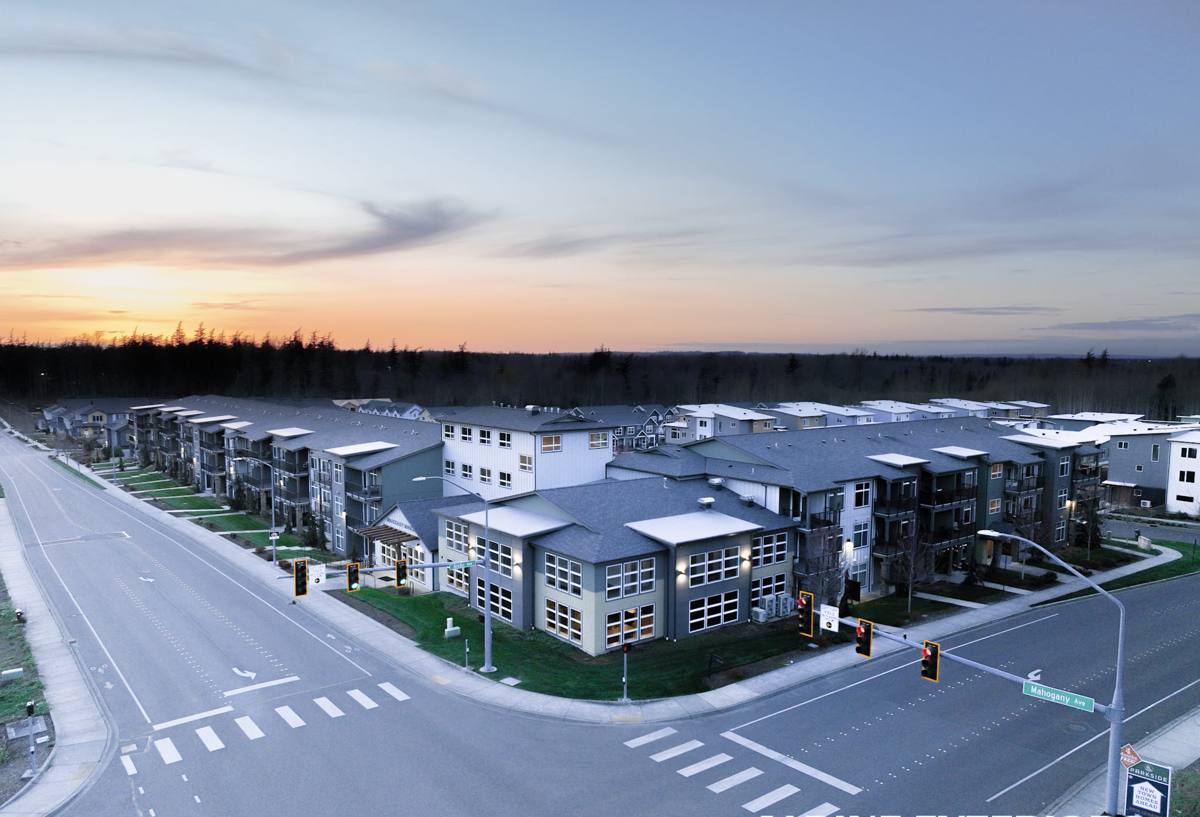
What Salt Air, Driving Rain, and Moss Actually Do to Siding
Salt air
Airborne salt is corrosive to metal and hard on organic building materials. Fasteners, flashing, and trim that aren't rated for a marine-influenced environment corrode faster near the water than they would even a short distance inland. Wood-based siding products absorb the moisture salt air carries and are more prone to swelling, cupping, and finish breakdown. Fiber cement doesn't corrode, and it doesn't absorb and release moisture the way wood-based products do, which is a meaningful advantage this close to the bay.
Driving rain
Wind off the water pushes rain into siding laterally instead of letting it run straight down the wall, which puts real pressure on laps, seams, and every penetration in the siding field — hose bibs, light fixtures, vents, and trim joints. A siding system is only as good as its weakest lap or seam in this kind of weather. This is an installation problem as much as a materials problem: the product can be right and the job can still leak if the laps, flashing, and gaps weren't done correctly for wind-driven conditions.
Moss and the long shoulder season
Whatcom County's damp season runs long, and shaded walls — especially north-facing elevations under mature trees, common throughout Peace Arch — can stay wet for days after a storm passes. That's exactly the environment moss and algae need to get established. Once organic growth takes hold on a porous or textured surface, it holds moisture against the siding and accelerates whatever deterioration process is already underway. A siding material's surface — how dense it is, how well it sheds water, how well its finish resists staining — has a direct effect on how much moss becomes a maintenance headache versus a cosmetic non-issue.
Why James Hardie Fits This Environment
James Hardie fiber cement is engineered specifically for regional climate demands, and the HardieZone system is built around exactly the kind of exposure Peace Arch homes deal with.
- Non-combustible, dimensionally stable material — fiber cement doesn't swell, rot, or delaminate the way wood-based sidings can when they take on repeated moisture.
- HZ5 engineering for the Pacific Northwest — Hardie's HZ5 product formulation is built for wetter, more moisture-intensive climates, which describes this part of Whatcom County well.
- ColorPlus factory finish — a baked-on, multi-coat finish that resists fading and holds up to UV and moisture exposure far better than field-applied paint, with a finish warranty separate from the product warranty.
- Dense, low-porosity surface — harder for moss and algae to grip and hold onto than a more porous or textured wood surface, which matters given how long the damp season runs here.
- Strong transferable warranty — meaningful for a coastal-adjacent home, where owners want confidence the product will perform over decades, not just look good the first year.
None of that removes the need for correct installation. A great product installed wrong will still leak, and a good installation on the wrong product still leaves you managing swelling, staining, or fading on a schedule that a house near the water shouldn't have to deal with. Both pieces have to be right.
What a Correct Install Actually Involves Here
Fasteners and hardware
This close to salt water, we don't treat fastener selection as an afterthought. Corrosion-resistant fasteners and flashing are specified for the exposure the wall actually faces, not just whatever is standard practice inland. A fastener that starts rusting in five years because it wasn't rated for a marine-influenced environment is a callback waiting to happen — and on a home that's supposed to last decades, that's not an acceptable trade-off to save a few dollars on hardware.
Water management behind the siding
Correct installation starts before the first plank goes up: weather-resistive barrier integrity, proper flashing at windows, doors, and any wall penetration, and a drainage plane that lets incidental moisture get out instead of trapping it against the sheathing. On a wall that takes wind-driven rain regularly, this layer matters as much as the siding itself.
Gapping, laps, and caulking
James Hardie's install specifications call for specific gapping at butt joints, correct lap dimensions, and factory-recommended sealants at the points that actually need them — not a bead of caulk smeared over every seam as a substitute for proper flashing. Over-caulking is a common shortcut that traps moisture rather than shedding it, and it's one of the fastest ways to void a warranty claim later.
Fastening pattern and clearance
Correct nail or screw placement, embedment depth, and clearance from panel edges all affect how the siding performs under wind load and how it holds up over time. Ground clearance and clearance from roof lines, decks, and grade are specified for a reason — closing that clearance is one of the more common ways older or poorly installed siding starts failing prematurely, and it's an easy thing to catch and correct during a proper install.
What Drives the Cost of a Correct Installation
Every siding quote should be built around the specifics of the house, not a flat per-square-foot number pulled from a generic estimate. On Peace Arch homes, these are the factors that actually move the number:
| Factor | Why It Matters Here | Effect on Cost |
|---|---|---|
| Substrate and sheathing condition | Homes with any history of moisture intrusion near the bay may need sheathing repair before new siding goes on | Can add material and labor if repair is needed |
| Wall exposure to wind-driven rain | Windward walls need more careful flashing and sealant detail than sheltered elevations | Moderate — more install time on exposed sides |
| Trim and corner complexity | Homes with more windows, dormers, or architectural detail have more penetrations to flash correctly | Increases labor time |
| Fastener and flashing spec | Corrosion-resistant hardware for a marine-influenced environment costs more than standard-grade hardware | Modest increase, offset by avoided future repairs |
| Color and finish choice | Factory ColorPlus finish versus field-applied paint after install | ColorPlus is typically the better long-term value despite a different upfront cost structure |
| Tear-off and disposal | Removing failing wood, vinyl, or older fiber cement adds a labor and disposal line | Varies by what's coming off the house |
Choosing the Right Line and Finish for This Location
James Hardie offers several siding profiles — lap siding, board and batten, and shingle-style panels among them — and all of them are available in the HZ5 formulation appropriate for this region. The bigger decision for most Peace Arch homeowners isn't which profile looks best (that's largely a style preference) but which ColorPlus color and sheen will hold up best against salt exposure and shaded, moss-prone walls. Darker colors absorb more heat and can show dust and salt film differently than lighter colors; on heavily shaded elevations, a finish with good algae resistance is worth prioritizing over a color choice made purely on curb appeal. We walk through these trade-offs with the actual walls of your house in mind — a south-facing wall and a shaded north wall under mature trees don't need to be treated the same way.
Our Process on a Peace Arch Home
- On-site assessment — we look at each elevation's exposure to wind, rain, and shade individually rather than quoting the house as one uniform surface.
- Sheathing and moisture check — especially important on older homes near the water, where hidden moisture damage behind existing siding is more common than homeowners expect.
- Tear-off and prep — removal of existing siding, repair of any compromised sheathing, and installation or repair of the weather-resistive barrier.
- Flashing and drainage detail — windows, doors, and penetrations flashed to manage wind-driven rain before a single plank goes up.
- James Hardie installation to spec — correct gapping, fastening, and lap detail, with corrosion-resistant hardware appropriate to a marine-influenced environment.
- Final inspection — a walk-through of every elevation, penetration, and trim detail before we consider the job finished.
Living With Hardie Siding in a Salt-Air, High-Moss Climate
Correctly installed James Hardie siding is low-maintenance, not zero-maintenance. A yearly rinse — plain water, low pressure, no harsh chemicals needed in most cases — keeps salt film and early moss growth from building up, especially on shaded walls. Because the ColorPlus finish is baked on rather than field-applied, it holds color and resists staining substantially longer than paint applied on site, which means repainting isn't part of the routine maintenance most owners plan for. Keeping gutters clear and vegetation trimmed back from walls also does more for long-term performance in this climate than most people expect, since it's standing moisture and prolonged shade — not the siding material itself — that drives most moss and algae problems.
Why Local Experience on This Coastline Matters
A siding crew that mostly works drier inland neighborhoods can install James Hardie correctly by the book and still under-spec the hardware, under-detail the flashing, or pick a finish that wasn't the right call for a shaded, salt-exposed wall — not because they did anything wrong by a generic standard, but because they weren't thinking about this specific coastline. Working Peace Arch and the surrounding Semiahmoo area regularly means we already know which elevations tend to take the worst of the winter wind, which wall orientations hold moss the longest, and which details matter most given how close this neighborhood sits to the water and the border. That's the difference between a siding job that meets spec on paper and one that's actually built for the house it's on.
Before you sign off on a siding contractor for a Peace Arch home, a few things are worth confirming up front:
- Are they installing James Hardie to the manufacturer's published specifications, including fastener and gapping requirements — not a generalized install method?
- Will they specify corrosion-resistant fasteners and flashing given the proximity to salt water?
- Do they inspect and address sheathing condition before new siding goes on, rather than siding over an existing problem?
- Can they explain how flashing and drainage detail differ between a sheltered wall and one that takes wind-driven rain directly?
- Are they a James Hardie-focused installer, or is fiber cement one of several products they install without a strong specialization in it?
If you're weighing a siding project on a Peace Arch home, we're happy to walk the house with you, look at each elevation's actual exposure, and give you a straight, no-pressure estimate based on what your home specifically needs — not a generic quote. Fill out the form below to get started.