 Semiahmoo Exterior
 Why Custer Decks Need to Be Built Differently
Custer sits close enough to the water that homes here deal with a different set of conditions than a deck going in twenty miles inland. Salt-laden air off the Strait works its way into fastener heads, hinges, and any exposed end-grain. Driving rain off Semiahmoo Bay doesn't just fall straight down — it gets pushed sideways under railings and against ledger boards. And the long, wet moss season that defines a Whatcom County winter means anything that traps moisture or organic debris on its surface is going to grow something green within a year or two if it isn't detailed correctly.
None of that makes composite decking a bad choice for Custer. It actually makes it a good one, when it's installed the right way. Composite doesn't rot, splinter, or need annual staining the way wood does. But composite decking still fails locally when it's installed like it's going into a dry inland yard — tight board spacing, poor drainage under the joists, or fasteners that aren't rated for a coastal environment. The material handles our climate well. Sloppy installation doesn't.
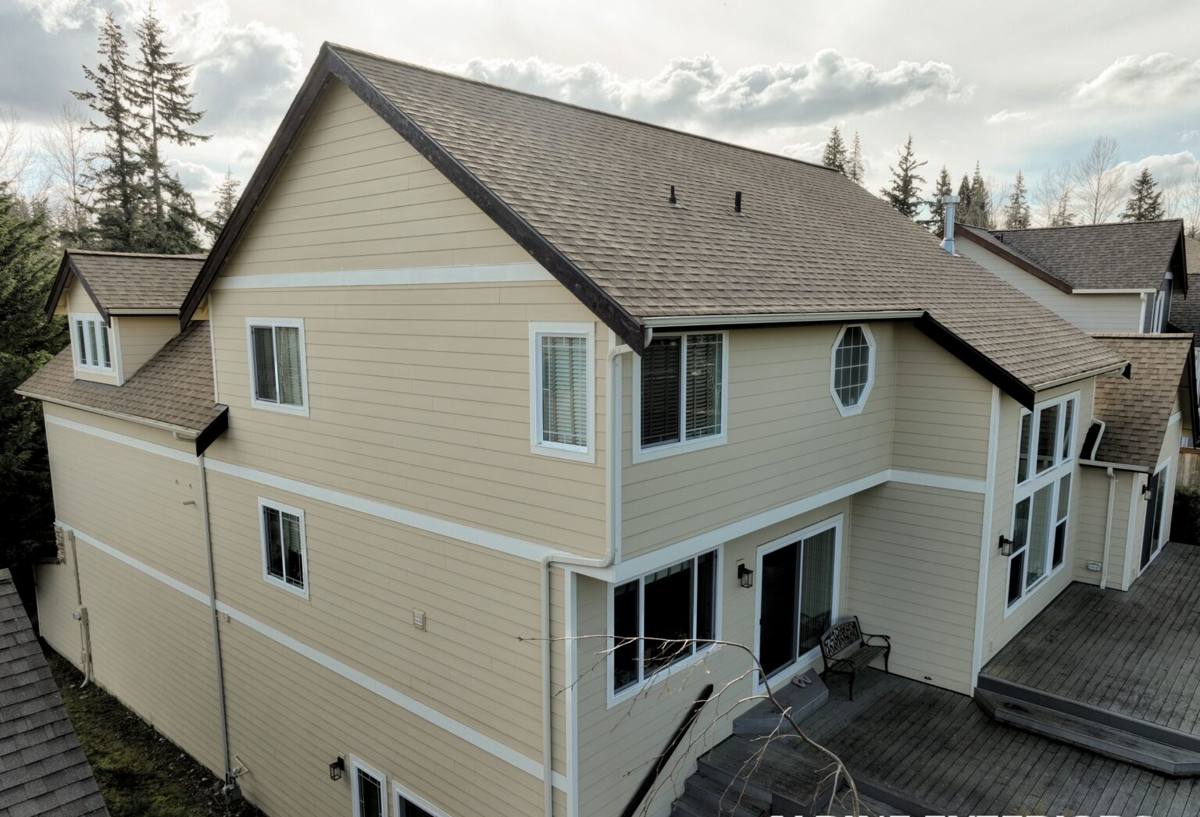
What a Correct Composite Deck Install Actually Involves
A composite deck is only as good as the structure underneath it, and in a wet climate that structure does most of the work of keeping the deck sound for the next 20-plus years.
Substructure and Ventilation
Joists need real airflow underneath and around them, not a tight crawlspace that stays damp from October through May. We frame with proper joist spacing for the composite board being used — composite deflects differently than wood and manufacturers publish specific span tables that we follow, not generic lumber spacing. Where a deck sits low to the ground, that airflow gap matters even more, because it's the difference between wood substructure that dries out between storms and one that stays wet all winter.
Fasteners and Hardware
Everything below the decking — joist hangers, structural screws, hidden fastener clips — needs to be stainless steel or coated for coastal/marine exposure, not standard galvanized. In an area with salt in the air, standard hardware corrodes faster than people expect, and once a hanger or clip starts failing it's hidden under the boards where nobody sees it until something moves.
Flashing and Ledger Connection
Where the deck attaches to the house, the ledger board and flashing are the single most common source of water damage on any deck, composite or wood. We flash that connection so water sheds away from the house framing, not into it. This is also where a lot of cut-rate deck jobs fail first, because it's invisible once the decking is down.
Drainage and Board Spacing
Composite boards need consistent gapping so water actually moves through and off the deck instead of sitting on the surface. Too tight, and you get standing water and algae buildup by the second wet season. We set spacing to the manufacturer's spec, adjusted slightly for our climate's higher average moisture load compared to drier parts of the state.
Composite vs. Wood vs. PVC: What Actually Fits a Custer Property
| Material | How it handles salt air & rain | Moss/algae resistance | Maintenance |
|---|---|---|---|
| Capped composite | Strong — cap layer resists moisture absorption | Good, especially with textured/streaked colors | Occasional wash; no staining or sealing |
| Uncapped composite (older style) | Weaker — core can absorb moisture over time | Fair — more prone to surface growth | More frequent cleaning |
| PVC decking | Very strong — fully synthetic, no wood fiber | Good | Low; can look more plastic in appearance |
| Pressure-treated wood | Fair — needs consistent sealing to hold up | Poor without upkeep | Annual cleaning, periodic staining/sealing |
| Cedar | Fair — natural rot resistance but still absorbs moisture | Poor without upkeep | Regular sealing to maintain color and integrity |
For most Custer homeowners, capped composite is the sweet spot — it's built for exactly the kind of moisture exposure this area sees, without the ongoing sealing schedule that wood demands. We do install PVC decking when a client wants it, but we're upfront that it comes at a higher price point and a slightly different look, and for most decks that trade-off isn't necessary to get good performance here.
Our Process, Start to Finish
- On-site assessment. We look at drainage, sun/shade exposure, proximity to the water side of the property, and the condition of any existing structure before quoting anything.
- Design and material selection. We walk through board colors, railing options, and fastening systems (hidden clips vs. face-screwed) based on your budget and how much upkeep you want to do.
- Permitting. Deck work above a certain height or attached to the structure typically requires a permit through Whatcom County. We handle that paperwork so it's not on you.
- Demo and structural build. Old decking comes out, substructure gets inspected or rebuilt, ledger flashing goes in correctly, and joists get set to the composite manufacturer's span spec.
- Composite installation. Boards go down with proper gapping and coastal-rated fasteners, followed by railing, stairs, and any trim or fascia.
- Final walkthrough. We check every board, fastener, and rail connection with you before calling the job done.
Local Conditions We Build Around in Custer
Custer's mix of open, wind-exposed lots and tree-lined properties means every deck here gets evaluated on its own terms. A deck that sits under fir or cedar cover deals with more organic debris and shade, which means more frequent surface cleaning to keep moss from getting a foothold even on composite. A deck that's more exposed to open air off the bay deals with more direct salt exposure and needs every piece of hardware built to handle it. We ask about both when we walk a property, because the right build for one isn't automatically right for the other.
Rain in this part of Whatcom County isn't just frequent — it's often driven sideways by wind coming off the water, which is why flashing details at the house connection and around any attached structure get extra attention on every job we do near Semiahmoo.
Maintenance Reality: What Composite Still Needs
Composite decking is low-maintenance, not no-maintenance. Homeowners who understand that up front get the most out of the material.
- Sweep off leaves, needles, and pollen regularly — organic debris left sitting is what feeds moss and algae growth
- Wash the deck surface once or twice a year with a mild soap and soft-bristle brush, especially shaded sections
- Keep gutters and downspouts near the deck clear so runoff isn't pooling onto or under the decking
- Check railing posts and stair connections annually for any movement
- Avoid pressure washing at close range or high PSI, which can damage the cap layer on composite boards
- Address any standing water on the deck surface — it usually points to a spacing or slope issue worth having looked at
What Drives the Cost of a Composite Deck
| Factor | Why it matters |
|---|---|
| Deck size and shape | More linear footage of board and framing, more cuts for angles or curves |
| Height off grade | Taller decks need more substructure, railings, and often stairs |
| Board tier | Entry-level capped composite vs. premium composite or PVC changes material cost significantly |
| Substructure condition | Full rebuild vs. reusing sound existing framing changes labor scope |
| Site access | Tight lots or limited equipment access can add labor time |
| Railing and fastener system | Hidden-fastener systems and upgraded railings cost more than basic options |
We give a firm, itemized quote after the on-site assessment rather than a rough number over the phone — decking costs vary enough between a straightforward rebuild and a complex multi-level deck that a phone estimate isn't honest.
Choosing a Contractor for a Custer Deck
Composite decking is a forgiving material in a lot of ways, but the installation details that matter most — flashing, fastener selection, drainage, span spacing — aren't visible once the job is finished. That makes the contractor's process more important than the brand of board on top of it.
- Ask what hardware and fasteners they use below the decking, not just the board brand on top
- Ask how they handle ledger flashing at the house connection
- Confirm they pull the required Whatcom County permit rather than skipping it
- Ask for their board spacing approach and why — a real answer references drainage and manufacturer spec, not just "that's how we always do it"
- Confirm they carry liability insurance and can produce it on request
- Ask whether they've worked on decks near the water in this area specifically, and what they do differently there
A crew that already works in and around Semiahmoo and Custer has already made the adjustments this climate requires — the hardware upgrades, the flashing details, the spacing calls — because they've seen what happens when those steps get skipped on a deck a mile down the road.
Ready to Talk About Your Deck
If you're weighing a new composite deck or replacing a tired wood deck at your Custer property, we're happy to take a look, walk the site, and give you a straight assessment of what it'll take. Reach out through the form below for a free, no-pressure estimate.