 Semiahmoo Exterior
 Board & Batten in a Marine Climate: Why It Matters in Cherry Point
Board and batten siding has a long history in rural and coastal Washington, and it's easy to see why it still shows up on farmhouses, waterfront homes, and newer builds around Cherry Point today. The vertical lines suit the open, low-density character of the area, and the deep shadow lines the battens create hold up visually against grey winter skies and bright summer light alike. But style is only half the story. Out here, sitting between the open water and the agricultural land north of Semiahmoo, a home's siding is doing real work every day: shedding wind-driven rain, resisting salt-laden air moving in off the water, and fighting a moss and algae season that can run most of the year. Board and batten looks great on a Cherry Point home. Whether it performs long-term comes down entirely to what it's made of and how it's installed.
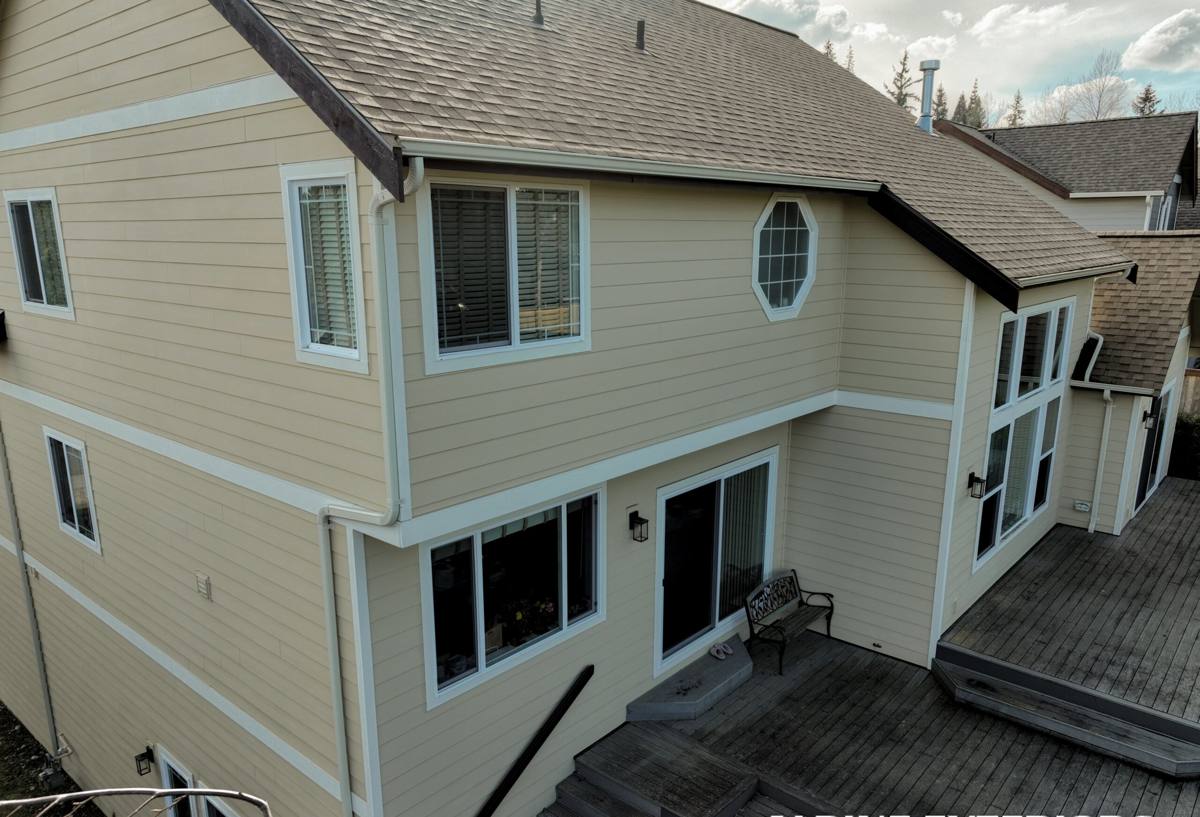
What Cherry Point's Climate Actually Demands From Vertical Siding
Whatcom County's marine climate is milder than it gets credit for, but "mild" doesn't mean easy on a house. Three conditions specific to this stretch of coastline matter more here than almost anywhere else siding gets installed:
Salt Air and Corrosion
Proximity to open water means airborne salt settles on every exterior surface, including siding, fasteners, and trim. Salt air accelerates corrosion in untreated or low-grade fasteners and can degrade certain paint systems and substrates faster than the same product would wear inland. Any siding material chosen for Cherry Point needs to tolerate that exposure without chalking, pitting, or losing its finish prematurely, and every fastener behind it needs to be corrosion-resistant, not just the visible surface.
Driving Rain
Storms coming off the water don't just fall straight down here, they come in sideways. Wind-driven rain finds any gap in a siding system: unsealed joints, poorly lapped flashing, or panels installed too tight to the surface below. Board and batten is particularly exposed to this because the vertical battens create long, continuous seams running from the eave to the foundation. If those seams aren't detailed correctly, water has a straight path down and behind the siding.
A Long Moss and Algae Season
Between the rainfall totals and the moderate year-round temperatures, moss and algae have a wide window to establish themselves on north-facing walls, under eaves, and anywhere airflow is limited. Some siding materials feed algae growth or trap moisture against a substrate that can't tolerate it. Others hold up cleanly for decades. This is one of the biggest visible differences between a good and a mediocre siding choice in this specific climate.
The Siding We Install: James Hardie Board & Batten
We install James Hardie fiber cement exclusively, and for board and batten projects that means either HardiePanel vertical siding paired with Hardie battens, or the Hardie Artisan board and batten system for a more refined, tighter-reveal look. Both are fiber cement: a mix of cement, sand, and cellulose fibers, engineered specifically to resist the conditions described above rather than just tolerate them.
A few specifics that matter for a Cherry Point installation:
- Non-combustible core. Fiber cement doesn't feed a fire the way wood-based or foam-backed products can, which matters in a rural area where wildfire risk and burn restrictions are part of normal life.
- Climate-engineered formulation. Hardie produces its siding in different formulations for different climate zones. The version specified for colder, wetter regions like ours is built to handle repeated moisture cycling and temperature swings without the cracking or swelling that generic fiber cement can suffer.
- Factory-applied ColorPlus finish. Instead of a job-site paint job that has to fight wind and moisture to cure properly, the color is baked on in a controlled factory environment, which gives far more consistent adhesion and color-hold in salt air than field-applied paint.
- Dimensionally stable. Fiber cement doesn't expand and contract with moisture the way wood does, which keeps butt joints and batten seams tighter over time instead of opening up and inviting water in.
We don't install vinyl, LP SmartSide, primed spruce or cedar board and batten, or lower-cost fiber cement alternatives. Each of those has a place somewhere, but none of them hold up to this specific combination of salt air, driving rain, and moss exposure as consistently as James Hardie does when it's installed correctly. That's a standard we set for our own work, not a claim about anyone else's product line.
What a Correct Board & Batten Installation Actually Involves
Board and batten is often treated as a simple siding style to install: panel up, batten over the seam, done. In a climate like Cherry Point's, that shortcut is exactly what causes premature failures. A correct installation includes several steps that don't show once the job is finished but determine whether it lasts fifteen years or fifty.
The Drainage Plane
Every wall needs a continuous water-resistive barrier behind the siding, with proper overlap and integration at every window, door, and penetration. This is what carries away any moisture that gets past the siding surface itself, which happens on every home in a driving-rain climate no matter how good the siding is.
Flashing at Every Transition
Window and door heads, roof-to-wall intersections, deck ledgers, and any place two surfaces meet all need properly lapped flashing, installed in the correct order relative to the drainage plane. This is the single most common place a siding job fails, and it has nothing to do with the siding brand.
Fastener Spacing and Material
Hardie publishes specific fastener requirements by product and exposure, and in a salt air environment the fastener material matters as much as the spacing. Under-fastening lets panels move and stress the joints; the wrong fastener material corrodes and stains the face of the siding over time.
Batten Placement and Gapping
Battens need consistent reveal spacing and correct gapping behind them to allow the wall to dry properly. Battens installed dead flat against the panel with no ventilation gap trap moisture right where board and batten is most vulnerable, at the seam.
Caulking and Sealant Standards
Manufacturer-approved sealants at the right joints, applied correctly, not everywhere and not nowhere. Over-caulking a fiber cement joint can trap moisture just as badly as leaving a real gap unsealed.
Board & Batten vs. Other Siding Approaches for This Climate
| Factor | James Hardie Board & Batten | Vinyl Board & Batten | Wood/LP Board & Batten |
|---|---|---|---|
| Salt air / corrosion resistance | Strong; factory finish holds up to marine exposure | Can chalk, fade, and become brittle over time | Vulnerable without diligent, repeated maintenance |
| Driving rain / moisture behavior | Dimensionally stable; doesn't swell or warp | Panels can bow or loosen; seams can gap | Prone to swelling, rot, and joint failure if moisture gets in |
| Moss / algae resistance | Factory finish resists growth better than most substrates | Can host algae in textured or shaded areas | Wood-based substrate is naturally more susceptible |
| Fire performance | Non-combustible core | Combustible; can melt or deform near heat | Combustible |
| Upfront cost | Mid-to-higher | Lower | Mid |
| Long-term maintenance | Low, with periodic recaulk and inspection | Low but shorter realistic lifespan in this climate | Higher; repainting and rot repair over time |
None of this means every other product is a bad choice everywhere. It means that for the specific combination of conditions a Cherry Point home faces, we've standardized on the material and installation approach that gives homeowners the fewest surprises fifteen and twenty years down the road.
Our Process, Start to Finish
A board and batten project on an existing home is different from new construction, and Cherry Point homes span both. Here's how we approach it:
- On-site assessment. We look at existing siding condition, current moisture damage if any, wall assembly, and any problem areas specific to your home's exposure to wind and water.
- Removal and inspection. Old siding comes off and we inspect the sheathing underneath before anything new goes on. Hidden rot or moisture damage gets addressed before the new drainage plane goes up, not covered over.
- Drainage plane and flashing installation. This is the step that determines long-term performance more than any other, and it happens before a single piece of visible siding is installed.
- Panel and batten installation to manufacturer spec. Correct fastener type and spacing, correct reveal and gapping, correct sealant at approved joints only.
- Final inspection and cleanup. We walk the finished job against the original scope before calling it complete.
Maintenance in a Salt Air, High-Moisture Environment
James Hardie board and batten is low-maintenance, not zero-maintenance. A few habits keep it performing at its best for decades in this climate:
- Rinse the exterior periodically to remove accumulated salt and airborne grime, especially on walls facing open water or prevailing wind.
- Keep gutters and downspouts clear so water isn't overflowing directly onto siding or pooling at the base of a wall.
- Trim back vegetation and landscaping that keeps a wall shaded and damp, which is exactly where moss and algae take hold first.
- Inspect caulking at joints, window trim, and penetrations every year or two, and have any cracked or failed sealant redone before winter's driving rain sets in.
- Address any impact damage promptly. Fiber cement resists most everyday wear, but a cracked panel left unaddressed can become a water entry point.
Why Local Experience in Cherry Point Specifically Matters
Siding crews that mostly work drier, inland climates tend to under-detail flashing and drainage planes because they can get away with it where they usually work. That approach doesn't survive a season on the water side of Whatcom County. A crew that already works Cherry Point and the surrounding Semiahmoo area knows which walls take the worst of the wind-driven rain, which sides of a house need extra attention for moss, and how the salt air here actually behaves over a few winters, not just on the day the siding goes up. That's the difference between a board and batten install that looks right at completion and one that's still performing correctly in year fifteen.
If you're considering board and batten siding for a home in Cherry Point, we're happy to take a look and walk you through what your specific house needs. There's no cost and no pressure for an estimate, just a straight answer about your options.