 Semiahmoo Exterior
 Building a Deck That Actually Holds Up in Bellingham
Bellingham sits close enough to the water that every outdoor structure on your property deals with a version of the same three problems: salt-laden air drifting in off the Strait, long stretches of driving rain most of the year, and a moss season that seems to start earlier and last longer every winter. A deck built the way it might be built in a drier inland climate simply won't hold up the same way here. Fasteners corrode faster, framing stays damp longer between dry spells, and any flat or shaded surface becomes a moss farm if it isn't detailed correctly from day one.
We build decks for homes in and around Bellingham with that climate in mind, not as an afterthought. That means specific choices about framing material, fastener grade, ledger flashing, and decking surface that are easy to skip if a crew is used to building in a milder or drier region. This page walks through what actually matters for a deck in this part of Whatcom County, what a correct build looks like, and how we approach the work.
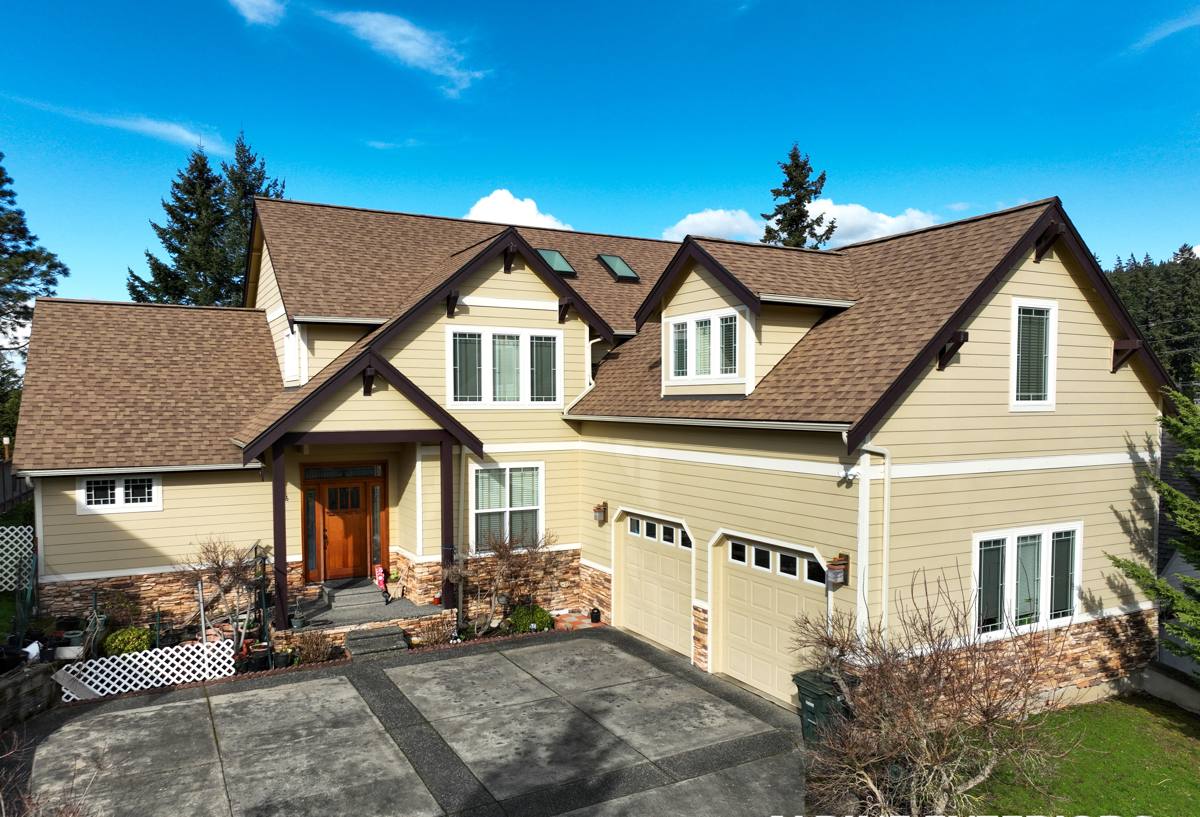
What Bellingham's Climate Actually Does to a Deck
It helps to understand the specific failure modes before talking about the fix. Three things drive almost every deck problem we see in this area:
Salt Air
Proximity to Semiahmoo Bay and the broader Salish Sea means airborne salt settles on metal hardware, fasteners, and railing components over time. Standard galvanized coatings that hold up fine 50 miles inland can start showing rust streaks and pitting within a few years this close to saltwater.
Driving Rain
Rain here doesn't just fall straight down — wind-driven rain gets pushed sideways into ledger connections, under poorly lapped flashing, and into end grain on cut boards. A deck detail that would pass in a calmer, drier climate can leak or trap moisture here.
Moss and Algae
Cool, damp, shaded conditions for much of the year are exactly what moss and algae need to establish. Decking with poor drainage, tight board spacing, or a north-facing shaded footprint will grow a green film faster than most homeowners expect, and that film turns a deck surface slick and dangerous in wet weather.
What a Correctly Built Deck Needs Here
Ledger Board and Flashing
The ledger connection — where the deck attaches to the house — is the single most common source of hidden rot in decks we're called out to repair or rebuild. It needs proper flashing that sheds water away from the house sheathing, not just caulk or a wrap-and-hope approach. In a climate with this much sustained rain, a poorly flashed ledger will eventually let water into the wall framing behind it, and that damage is invisible until it's serious.
Fasteners and Hardware
Given the salt exposure in this area, we don't treat fastener grade as a place to save money. Stainless steel or high-quality coated fasteners rated for coastal exposure cost more up front than standard deck screws, but the difference shows up in year five, not year one, when standard hardware is already showing rust bleed into the decking around each screw head.
Framing Material
Pressure-treated framing lumber is standard, but the grade and treatment level matter more here than in a drier climate. Framing that stays damp for extended stretches between rain events needs a treatment rated for ground contact or persistent moisture exposure, even when it's technically above grade, because "above grade" doesn't mean "dry" for months at a time in this region.
Drainage and Airflow Underneath
A deck built tight to the ground or against a foundation wall with no airflow underneath holds moisture longer after every rain. We build in clearance and, where the site allows it, drainage that keeps the underside of the deck from becoming a permanently damp, shaded environment — which is exactly the environment moss and wood rot both prefer.
Decking Material Comparison for This Climate
Every decking material handles Bellingham's conditions differently. There's no single right answer — it depends on your budget, how much upkeep you want to take on, and how the deck sits relative to sun and shade.
| Material | Moisture/Moss Behavior | Maintenance | Typical Lifespan |
|---|---|---|---|
| Pressure-treated wood | Absorbs moisture, needs regular sealing to resist moss and rot | Annual cleaning and re-sealing recommended | 10-15 years with upkeep |
| Cedar | Naturally rot-resistant but still needs sealing in shaded, damp areas | Periodic cleaning and oil/sealer | 15-20 years with upkeep |
| Capped composite | Sheds water well, resists moss better than wood but not immune in deep shade | Occasional washing, no sealing | 25+ years |
| PVC decking | Fully synthetic, minimal moisture absorption | Occasional washing | 25-30+ years |
We're upfront with homeowners about trade-offs rather than pushing whatever has the best margin. Wood costs less to install but asks more of you every year. Composite and PVC cost more up front but ask almost nothing of you afterward — which matters in a climate where "just leave it alone" isn't really an option with untreated wood.
Moss and Algae: The Ongoing Reality, Not a One-Time Fix
No decking material is permanently moss-proof in a Whatcom County winter. What changes between materials is how much moss actually takes hold and how hard it is to remove. Board spacing, surface texture, and how much direct sun a deck gets all matter as much as the material itself. Part of doing this job right is designing for drainage and airflow at the outset — spacing boards correctly, avoiding dead zones where water pools, and being honest with homeowners about which areas of their yard are going to need more seasonal attention regardless of what decking goes down.
Permits and Local Requirements
Deck projects in and around Bellingham typically go through the local building department, and permit requirements often depend on factors like deck height, whether it's attached to the house, and proximity to property lines. Requirements can vary by jurisdiction within Whatcom County, so we handle the permit process as part of the job rather than leaving homeowners to sort it out themselves. If you're near shoreline-adjacent property, there can also be additional review depending on setback rules — something worth flagging early rather than discovering mid-project.
Our Process for a Bellingham Deck Build
- Site visit and assessment — we look at sun exposure, drainage, soil, and how close you are to salt air exposure to inform material recommendations.
- Design and material selection — sized to your home and budget, with an honest walkthrough of maintenance trade-offs for each decking option.
- Permit handling — we manage the paperwork with the local building department so you're not chasing it down yourself.
- Framing and ledger work — built with fastener grades and flashing details suited to this climate, not generic minimums.
- Decking installation — attention to board spacing and drainage to reduce moss buildup over time.
- Final walkthrough — we go over basic seasonal maintenance so you know what to expect year one versus year five.
Why It Matters to Hire a Crew That Already Works This Area
A deck built by a crew unfamiliar with this specific climate can look identical to a correctly built one on install day — the differences show up two, three, five years later, in rust bleed, soft ledger connections, or a deck surface that's slick with moss every winter. We work in Bellingham and the surrounding Semiahmoo area regularly, so the fastener grades, flashing details, and drainage decisions described above aren't special upgrades we mention in a sales pitch — they're the default for how we build here, because building any other way just means a callback in a few years.
Questions Worth Asking Before You Sign a Deck Contract
- What fastener and hardware grade will be used, and is it rated for coastal/salt-air exposure?
- How will the ledger board be flashed, and can you explain the approach in plain terms?
- Is the framing lumber rated for the moisture exposure this specific deck will see?
- Who is pulling the permit, and is that included in the quote?
- What does realistic year-one and year-five maintenance look like for the decking material you're recommending?
- Is the quote itemized enough that you can see what you're paying for materials versus labor?
Get a Free, No-Pressure Estimate
If you're planning a new deck or replacing one that's showing its age in Bellingham or the wider Semiahmoo area, we're happy to come take a look, talk through material options honestly, and put together a straightforward estimate — no pressure, no obligation. Use the form below to get started.