 Semiahmoo Exterior
 Why Decks Take a Beating at Semiahmoo Resort
Homes around Semiahmoo Resort sit about as close to the marine environment as a house in Whatcom County can get. That's part of what makes the setting special, and it's also exactly why decks here don't last as long as decks fifteen or twenty miles inland. Salt-laden air off the water accelerates corrosion on every piece of exposed metal — fasteners, joist hangers, railing hardware, even the heads of screws that are supposedly coated for outdoor use. Add in driving rain that comes in sideways during winter storms, and water gets pushed into joints and seams that a standard deck detail was never built to handle.
Then there's moss. Whatcom County's damp, mild winters and long shoulder seasons give moss and algae months to establish themselves on any shaded or north-facing deck surface. Once moss takes hold, it holds moisture against the decking boards and framing underneath, which speeds up wood rot even on wood that's rated for outdoor use. A deck built without that combination of salt exposure, wind-driven rain, and moss season in mind will show it early — soft spots, corroding hardware, and boards that stay damp long after the rain has stopped.
We work on decks in this stretch of Whatcom County regularly, so we're not guessing at what holds up here. We're specifying materials and details based on what actually survives a Semiahmoo winter, not just what looks good on installation day.
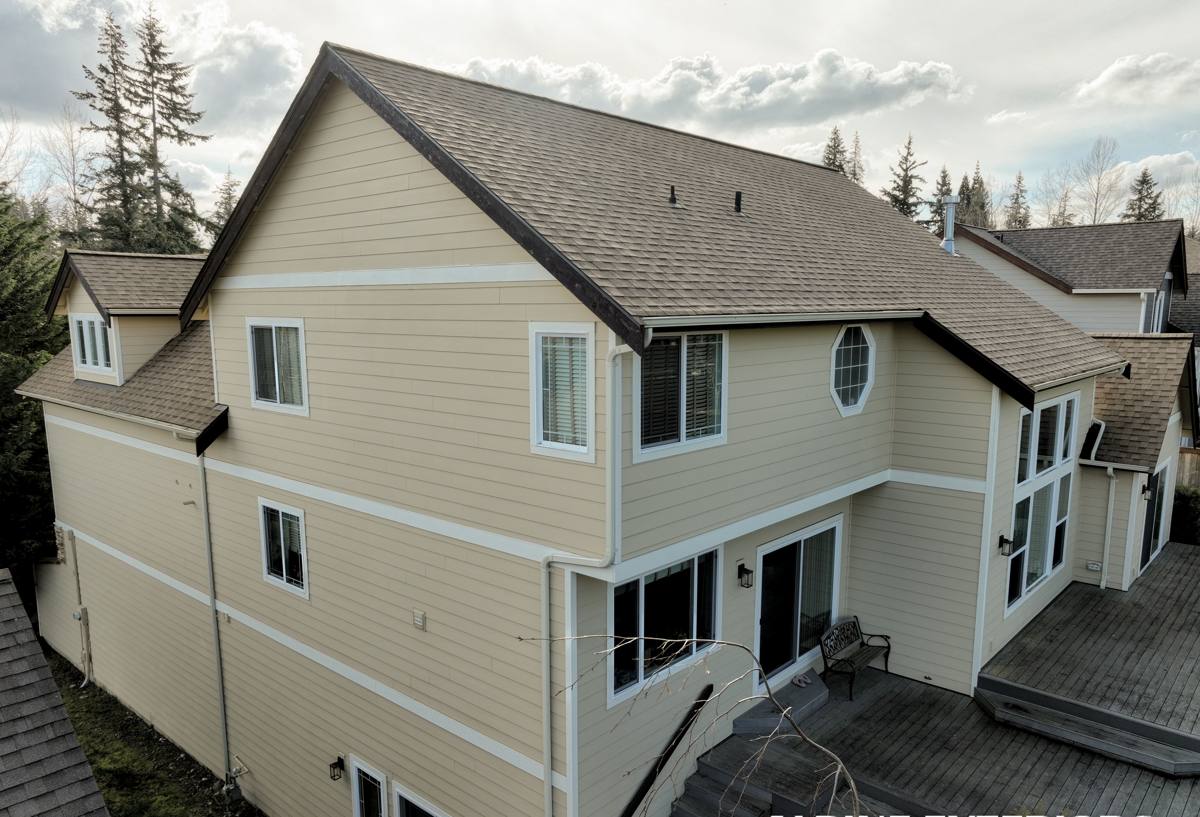
Signs Your Deck Is a Replacement Job, Not a Repair
Not every tired-looking deck needs to come out. But there's a point where patching boards or re-staining stops being a real fix and starts being a way to delay the inevitable. Here's what tells us a deck has crossed that line:
- Soft, spongy, or springy spots in the decking or framing when you walk across it
- Rust streaks bleeding out from screw heads or connector hardware
- A ledger board (where the deck attaches to the house) that's stained, swollen, or separating from the siding
- Posts or footings that have shifted, settled, or show visible rot at the base
- Railings that flex or wiggle under normal hand pressure
- Persistent moss or black staining that comes back within weeks of cleaning
- A deck older than 20-25 years that has never had the structure inspected below the surface boards
If you're only seeing surface graying or minor board cupping, that's often a refinishing or partial board-replacement job. If you're seeing any of the structural signs above, replacement is the honest recommendation — patching a compromised frame just moves the failure point somewhere else.
What a Correct Deck Replacement Actually Involves
Structural Framing and Footings
The framing is the part nobody sees once the decking goes down, which is exactly why it's the part worth getting right the first time. That means footings sized and set to local frost and soil conditions, properly sized joists and beams for the actual span and load, and joist spacing tight enough to support whatever decking material goes on top — composite and PVC boards generally need closer spacing than solid wood.
Ledger Board and Flashing
In a climate that gets as much wind-driven rain as this one does, the ledger board connection is where a lot of deck failures start. Water finds its way behind an improperly flashed ledger and rots the rim joist and sheathing behind it — often invisibly, for years. A correct installation uses proper flashing that sheds water away from the house, not just a bead of caulk and a prayer.
Decking Surface and Fastening
Once the frame is sound, the decking surface and how it's attached determines how the deck actually performs day to day — grip when wet, resistance to moss buildup, and how it looks after a few winters. We'll walk through material choice with you based on your home's exposure, budget, and how much upkeep you actually want to do.
Choosing Decking Material for a Marine Climate
There's no single "best" decking material — there's a best material for your specific deck, its sun and shade pattern, and how much maintenance you want to sign up for. Here's how the common options actually perform in a salt-air, high-moss environment like Semiahmoo:
| Material | Salt Air Resistance | Moss Resistance | Maintenance | Typical Lifespan |
|---|---|---|---|---|
| Pressure-treated wood | Good if hardware is stainless | Needs regular cleaning | Annual cleaning/sealing | 10-15 years |
| Cedar | Good, naturally rot-resistant | Moderate; still needs cleaning | Sealing every 1-2 years | 15-20 years |
| Capped composite | Excellent | Good; textured surface can hold spores | Occasional wash | 25-30+ years |
| PVC decking | Excellent | Very good; low water absorption | Occasional wash | 25-30+ years |
Composite and PVC cost more up front, but for a deck exposed to this much salt air and rain, the lower long-term maintenance and better rot resistance often make the math work out in their favor over the life of the deck. Wood is still a legitimate choice, especially if you like the natural look and are willing to keep up with sealing — we're happy to install it correctly either way. What we won't do is install any material in a way that ignores how it actually behaves in wet, salty conditions.
Fasteners and Hardware — the Detail Salt Air Punishes First
More decks near the water fail at the hardware than at the decking boards. Standard coated deck screws and galvanized joist hangers are built for general outdoor use, not sustained salt exposure, and they'll show rust and pitting well before the wood around them gives out. Two details matter more here than almost anywhere else in the build:
- Fastener grade: stainless steel fasteners (typically 305 or 316 grade near the water) resist salt corrosion far longer than standard galvanized options
- Galvanic compatibility: mixing incompatible metals — say, the wrong hanger with the wrong fastener — can trigger galvanic corrosion that eats through hardware faster than salt air alone would
Hidden fastener systems, common with composite and PVC decking, also help here — fewer exposed screw heads means fewer entry points for water and fewer spots for rust streaking to show up on the surface.
Our Process Working in Semiahmoo Resort
We start with an on-site look at the existing deck — not just the surface, but the framing, footings, and ledger connection underneath — so the estimate reflects what's actually there, not a guess from a photo. From there we walk through material and layout options that fit the home and the budget, get the permit paperwork handled, and set a schedule that works around the coastal weather window rather than fighting it.
Because we already work homes in this community, we're familiar with the typical lot layouts, the wind exposure on the water side versus the more sheltered side, and the kind of access and staging that resort-area properties usually require. That familiarity saves time on-site and means fewer surprises once demolition starts.
Permits and Local Considerations in Whatcom County
Most deck replacements — especially any that involve new footings or a change in size or height — require a building permit in Whatcom County. If your property is close to the shoreline, there may be additional review involved depending on setback and shoreline management rules that apply to the specific parcel. We handle the permit application as part of the project, but the exact requirements depend on your property's zoning and shoreline designation, so we confirm the specifics for your address before finalizing plans rather than assuming a blanket answer applies to every lot in the area.
Keeping a New Deck Ahead of the Moss and Rain
A well-built deck in this climate still needs some seasonal attention — the goal is just to make that attention minor instead of major. A few habits go a long way:
- Sweep leaves and debris off the surface regularly, especially in shaded corners where moisture lingers
- Rinse or lightly scrub moss and algae buildup before it has a chance to stain or embed itself, ideally before winter sets in
- Keep gutters and downspouts near the deck clear so runoff isn't dumping directly onto the surface or framing below
- Check railing hardware and fastener heads once a year for early rust or looseness
- For wood decks, plan on resealing on the schedule appropriate to the species rather than waiting until it visibly needs it
None of this is complicated, but skipping it is how a 25-year composite deck or a well-built wood deck ends up looking tired at year eight instead of year twenty.
What Replacement Typically Costs
Every deck is different, but the factors that move the price are consistent. This gives you a general sense of what drives cost up or down on a Semiahmoo-area project:
| Cost Factor | Why It Matters |
|---|---|
| Deck size and shape | More square footage and complex angles mean more material and labor |
| Decking material | Wood is typically the lowest upfront cost; composite and PVC cost more but need less upkeep |
| Framing condition | Reusable footings and posts lower cost; full structural replacement raises it |
| Height and railing requirements | Taller decks and code-required railings add material and labor |
| Hardware grade | Stainless fasteners cost more than standard but pay off in a marine climate |
| Site access | Tight or waterfront-adjacent access can add time for material staging and demolition removal |
Rather than quote a number that doesn't reflect your actual deck, we'd rather look at the site and give you a real range based on what's there.
If your deck is showing its age or you're just ready to stop patching it every spring, we're glad to come take a look and give you a straightforward, no-pressure estimate — use the form below to get started.