 Semiahmoo Exterior
 Salt Air, Driving Rain, and a Long Moss Season: What Drayton Harbor Siding Is Up Against
Homes around Drayton Harbor sit right where marine air off the water meets Whatcom County's wet winters, and that combination is hard on exterior materials. The harbor puts a steady dose of salt-laden moisture into the air, which accelerates corrosion on fasteners and trim and speeds up the breakdown of finishes that aren't built for it. Add driving rain that comes in off Semiahmoo Bay and the harbor during fall and winter storms, and siding has to shed water at the seams and laps, not just on the flat face of the board.
Then there's the moss. Whatcom County's damp shoulder seasons stretch from early fall through late spring, and anywhere shaded by trees, fences, or the north side of a house stays wet long enough for moss and algae to take hold. On some siding materials that's just a cosmetic nuisance. On others — especially wood-based products — it holds moisture against the substrate and sets up rot from the inside out, long before it's visible from the yard.
None of this is unique to one street or subdivision near the harbor. It's the baseline climate load every home in this stretch of Whatcom County has to handle, and it's the starting point for how we spec and install siding here.
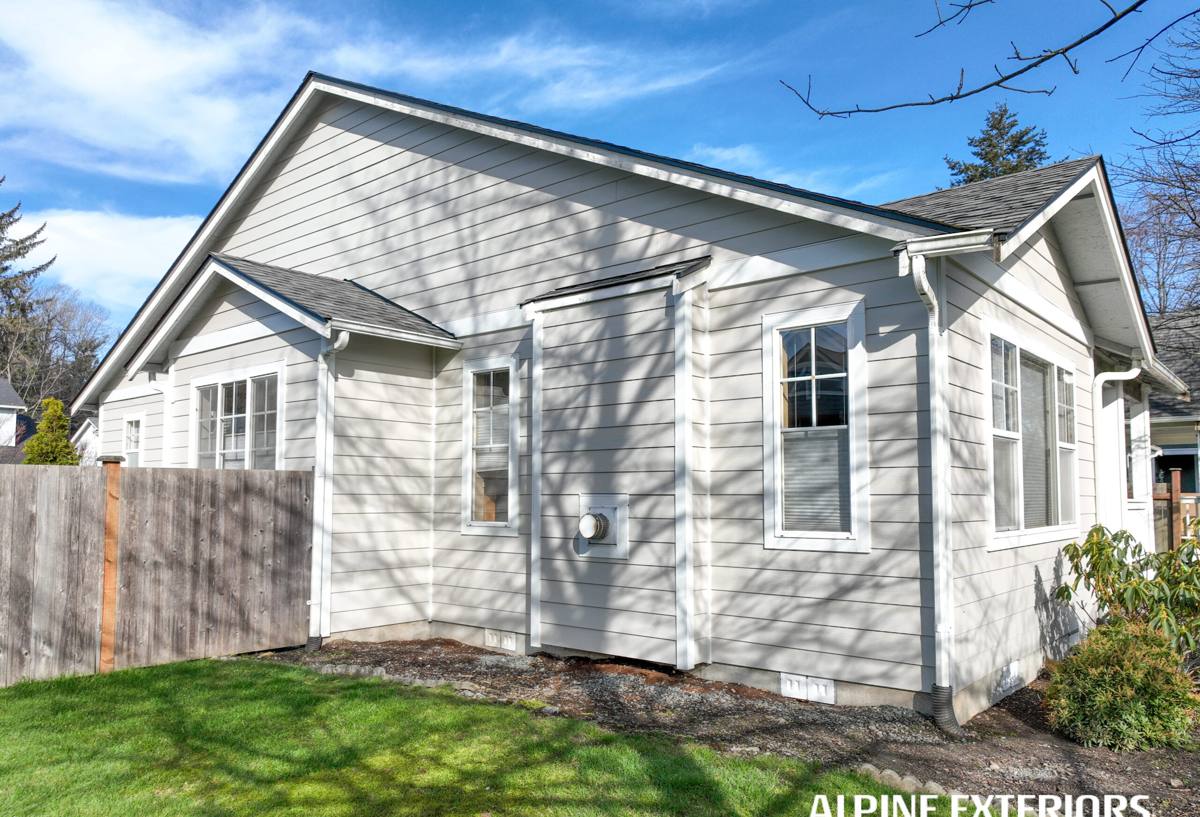
Why We Install James Hardie Fiber Cement — and Only Hardie
We install James Hardie fiber cement siding exclusively. Not LP SmartSide, not vinyl, not Cemplank or Allura, not primed spruce or cedar. That's a deliberate standard, not a sales preference, and it comes down to how each of those materials handles the conditions described above.
Fiber cement itself is a mix of cement, sand, and cellulose fibers, which makes it non-combustible and dimensionally stable — it doesn't expand and contract with humidity swings the way wood or wood-composite products do, and it doesn't soften or deform in sustained damp the way vinyl can. Within fiber cement, James Hardie engineers its boards for specific climate zones. The formulation used in our region, Hardie's HZ5 line, is built for the Pacific Northwest's wet, moderate-temperature climate rather than a one-size-fits-all mix, which matters when a board is going to spend eight or nine months a year damp.
Hardie's factory-applied ColorPlus finish is the other half of the argument. It's baked on under controlled conditions rather than field-applied, which gives more consistent coverage and adhesion than job-site painting, and it carries its own finish warranty separate from the product warranty. In a marine environment where UV, salt, and moisture all work on a finish at once, that factory cure holds up better over time than most field-applied coatings.
What a Correct Installation Involves Here
Fiber cement siding is only as good as the assembly behind it, and near the harbor that assembly has to do real work. A correct install isn't just nailing boards to the wall — it's a system:
- A code-compliant weather-resistive barrier behind the siding, lapped correctly so water sheds outward at every seam
- A drainage gap where the wall assembly calls for one, so incidental moisture that gets behind the cladding can drain and dry instead of sitting against the sheathing
- Correct fastener type, spacing, and penetration depth — under- or over-driven fasteners are one of the most common causes of early siding failure
- Proper flashing at every window, door, and roofline penetration, installed before the siding goes on, not caulked over after
- Factory-cut, factory-primed edges wherever boards are trimmed, so cut ends aren't left exposed to absorb water
- Manufacturer-specified clearances at grade, decks, and roof lines to keep siding from sitting in standing water or snow
Every one of those details matters more in a driving-rain, high-humidity environment than it would in a dry climate, because there's less margin for error. A gap in the weather barrier or a missed flashing detail that might go unnoticed for years somewhere drier can turn into a moisture problem within a season or two this close to the water.
HardiePlank, HardiePanel, and Trim: Matching the Product to the Home
James Hardie makes several siding profiles, and picking the right one is about how a specific home is built and how it faces the weather, not just style preference.
| Product | Typical use | Why it fits here |
|---|---|---|
| HardiePlank lap siding | Traditional horizontal siding, most common on single-family homes | Overlapping laps shed driving rain well when installed with correct exposure and fastening |
| HardiePanel vertical siding | Modern vertical look, often paired with board-and-batten trim | Clean lines that hold up well when battens and joints are flashed correctly |
| HardieTrim boards | Corners, window and door casing, fascia | Matches the siding's moisture resistance so trim doesn't become the weak point |
| HardieSoffit panels | Eaves and overhangs | Vented options help manage moisture in roof and attic assemblies exposed to marine humidity |
We'll walk through which profile and ColorPlus color fit a given home during the estimate — the right call depends on how much wind-driven rain a wall takes, how much shade it gets, and what's already on the walls.
Our Process, Start to Finish
The work follows the same sequence on every job, adjusted for what we find once the old siding comes off:
- On-site assessment. We look at existing siding condition, sheathing, trim, flashing, and any signs of past moisture intrusion before quoting anything.
- Tear-off and inspection. Removing the old cladding is when we actually see the sheathing and framing underneath — this is where hidden rot or missing flashing shows up, and we address it before anything new goes on.
- Weather barrier and drainage plane. New house wrap or building paper goes on correctly lapped, with a drainage gap where the assembly calls for one.
- Flashing. Windows, doors, and any roof-to-wall transitions get flashed before siding installation begins.
- Siding installation. HardiePlank, HardiePanel, and trim go up to manufacturer fastening and clearance specs, not shortcuts.
- Final detailing and cleanup. Caulking at appropriate joints, touch-up where needed, and job-site cleanup around the property.
What It Costs
Every home is different, but the same handful of factors drive the price on most Drayton Harbor projects:
| Factor | Why it matters |
|---|---|
| Total wall square footage | The largest single driver of material and labor cost |
| Condition of existing sheathing | Rot or damage found at tear-off adds repair work before new siding can go on |
| Trim and detail complexity | Multiple gables, dormers, and window trim take more time than a simple rectangular wall |
| Siding profile chosen | Lap, panel, and board-and-batten looks vary in material and labor cost |
| Site access | Waterfront lots, tight setbacks, or steep grades can affect staging and labor time |
We won't throw out a number without seeing the home. A walk-through lets us see the actual wall condition and give a real, itemized quote instead of a rough guess that changes once work starts.
Living With Fiber Cement in a Salt Air, High-Moss Climate
Correctly installed Hardie siding is low-maintenance, but "low" isn't "none," especially this close to the harbor. A short seasonal routine keeps it performing the way it's built to:
- Rinse salt residue and grime off the siding periodically, especially on walls facing the water
- Keep gutters clear so overflow doesn't run down the wall face and feed moss growth
- Trim back vegetation and branches that shade siding and keep it damp longer than it should be
- Check caulking at trim joints and penetrations yearly and re-caulk where it's cracked or pulled away
- Address any impact damage or exposed cut edges promptly so bare fiber cement isn't left absorbing water
- Watch for moss or algae buildup on north-facing and shaded walls and clean it before it spreads
None of this is heavy work, but skipping it is how a well-installed system starts looking tired years before it should.
Why Hiring a Crew That Already Works Drayton Harbor Matters
A siding crew that's worked this specific stretch of Whatcom County waterfront knows what to expect before the first board comes off: how much moisture is typically hiding behind older siding on harbor-facing walls, which flashing details tend to fail first in this climate, and how to sequence a job around the region's rain patterns instead of fighting them. That local pattern recognition is worth more than it sounds — it's the difference between catching a problem during tear-off and finding it two winters later as a stain on the drywall.
It also matters for warranty registration and long-term accountability. James Hardie's product warranty depends on correct installation, and a crew that installs Hardie exclusively — rather than juggling several different siding brands — has fewer gaps in how consistently that installation gets done.
If you're considering fiber cement siding for a home near Drayton Harbor or anywhere in the Semiahmoo area, we're happy to take a look and put together a straightforward, no-pressure estimate — use the form below to get started.