 Semiahmoo Exterior
 Drayton Harbor Siding Takes a Different Kind of Beating
Homes along Drayton Harbor sit close enough to the water that siding damage rarely shows up the way it does further inland. Salt-laden air moves off the harbor and settles on exterior walls day after day, working into seams, fastener heads, and any spot where the original installation left a gap. Add Whatcom County's driving rain, which often comes in sideways off Semiahmoo Bay, and you get moisture pushed into joints that a calmer climate would never test. Then there's moss season, which here isn't really a season at all — it's most of the year. Shaded north walls and anything under overhanging trees stay damp long enough for moss and algae to take hold, and once they do, they hold water against the siding surface far longer than bare material would.
This combination — salt exposure, wind-driven rain, and near-constant moisture from moss and shade — is why siding repair in Drayton Harbor is a different job than siding repair in a drier part of the state. A patch that would hold up fine in eastern Washington can fail here within a season if it doesn't account for how water actually moves across a wall in this environment.
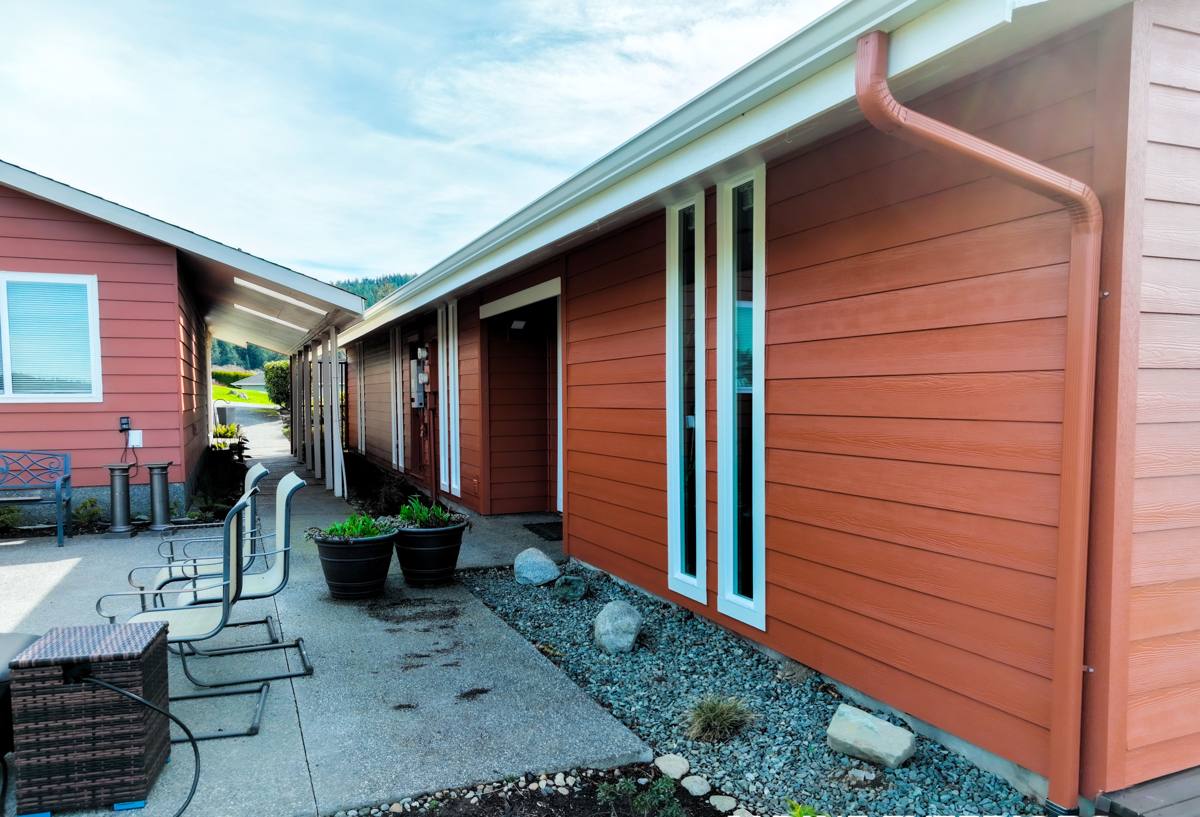
Signs Your Siding Needs Repair, Not Replacement
Most homeowners call us because they've noticed something specific, not because they've decided their whole exterior needs work. Here's what we typically find when we walk a Drayton Harbor property:
- Soft or spongy spots when you press on the siding, usually near the bottom courses or around window trim
- Visible cracking or splitting, especially on sun-exposed south and west walls where temperature swings stress the material
- Paint or finish failure — peeling, bubbling, or chalking — that shows up faster than it should for the product's age
- Staining or dark streaking below joints, a sign water is tracking behind the siding rather than shedding off the face
- Moss or algae buildup that's thick enough to trap moisture against the surface rather than just sitting on top
- Gaps at trim, corners, or butt joints where caulking has shrunk, cracked, or pulled away entirely
Any one of these can usually be repaired in place. It's when several show up together across multiple walls, or when the underlying sheathing has been wet long enough to soften, that a repair stops making sense and replacement of that section — or the whole elevation — becomes the honest recommendation.
Why Waiting Costs More Here Specifically
In a drier climate, a small gap or crack might sit unaddressed for a year or two without much consequence. In Drayton Harbor's combination of salt humidity and driving rain, that same gap is a moisture entry point almost every week of the year. Small problems compound faster here, which is the main reason we push homeowners to address visible damage promptly rather than waiting for a slow season or a bigger project.
What a Correct Siding Repair Actually Involves
A proper repair isn't just replacing the damaged board and moving on. It starts with figuring out why that section failed in the first place — because if the underlying cause isn't addressed, the same spot will fail again, often faster the second time.
Our repair process typically includes:
- Diagnosis before demo. We remove the damaged section carefully and check the sheathing, house wrap, and flashing behind it. If there's hidden rot or a failed water-resistive barrier, that gets fixed first — patching over a wet wall just hides the problem.
- Matching the material correctly. Fiber cement siding has specific profiles, exposures, and factory finishes. A mismatched patch is visible immediately and can also create a seam that behaves differently in weather than the surrounding material.
- Flashing and drainage first. Before any new siding goes back on, we make sure water has a clear path down and away from the wall — proper head flashing over openings, correct laps, and a drainage plane behind the cladding.
- Fastening to spec. Fiber cement has specific nailing patterns and clearances. Over-driven or misplaced fasteners are one of the most common causes of the cracking we get called out to fix.
- Sealing and finishing. Cut edges get properly sealed, joints get the right sealant (not just a bead of whatever's on the truck), and the finish is matched or refinished so the repair blends rather than standing out.
Repair or Replace: How We Make the Call
Homeowners often ask up front whether their situation is a repair or a bigger job. Here's the general framework we use when walking a Drayton Harbor property:
| Condition | Usually a Repair | Usually Points to Replacement |
|---|---|---|
| Extent of damage | Isolated to one or two wall sections | Recurring across multiple elevations |
| Sheathing condition | Dry, solid behind the damaged area | Soft, delaminated, or visibly wet |
| Age of existing siding | Well within expected service life | Nearing or past manufacturer lifespan |
| Cause | Impact damage, a failed caulk joint, one bad board | Systemic moisture intrusion or original installation errors |
| Finish condition | Localized fading or chipping | Widespread paint failure across the house |
We'll always tell you honestly which category your home falls into. A patch job on a wall with underlying rot is money spent on a problem that will resurface, and we'd rather explain that up front than sell a repair that won't hold.
Why We Repair — and Replace — With James Hardie Fiber Cement Only
When a repair calls for new material, we use James Hardie fiber cement, and that's it. We don't stock or install vinyl, LP SmartSide, or other fiber cement brands, and in a harbor-adjacent climate like this one, the reasoning is practical rather than a matter of loyalty to one manufacturer.
Vinyl siding can warp and become brittle with UV and temperature cycling, and its seams and J-channels give salt-laden moisture more places to work its way behind the panel over time. Wood-based siding products, even engineered ones, rely on their exterior coating staying intact to keep moisture out — in a climate with this much sustained dampness and moss growth, that coating is under constant stress. James Hardie's fiber cement is non-combustible, dimensionally stable across temperature swings, and doesn't feed moss or fungal growth the way wood-based products can. Its ColorPlus factory finish is baked on under controlled conditions, which holds up better against salt air and UV than most field-applied paint systems.
None of this means other products are unusable everywhere — plenty of siding types perform fine in drier, more sheltered locations. But for a property exposed to Drayton Harbor's salt air and rain, we standardized on Hardie because it's the product we're comfortable warranting our work on in this specific environment.
Repairing Existing Non-Hardie Siding
If your home currently has vinyl, wood, or another fiber cement brand and only needs a small repair, we'll still do honest work matching what's there when that's the sensible short-term fix. Where we draw the line is recommending a full re-side in a product we don't stand behind for this climate — if your siding is failing broadly, we'll tell you that directly and explain why Hardie is what we'd put on instead.
Our Process for Drayton Harbor Homes
Working a coastal property means adjusting the sequence a little compared to an inland job:
- Site walk and moisture check. We inspect not just the visibly damaged area but adjacent sections, especially north-facing and shaded walls where moss and trapped moisture are most common.
- Weather-aware scheduling. Fiber cement repairs need dry substrate and proper cure time for sealants and finish coats — we plan around Semiahmoo's rain patterns rather than fighting them.
- Salt-air-appropriate fasteners and flashing. We use corrosion-resistant fasteners and flashing details suited to a marine-influenced environment, not generic inland-grade hardware.
- Cleanup that respects the property. Old siding, cut-offs, and debris are contained and removed — we're not leaving cement dust or scraps in your yard or gutters.
Living With Moss Season: Maintenance That Actually Helps
Repair work goes further when it's paired with maintenance habits suited to this climate. A few things we recommend to every Drayton Harbor homeowner:
- Trim back vegetation and tree cover that keeps walls shaded and damp — moss needs sustained moisture to establish, and reducing shade slows it down significantly
- Rinse visible moss and algae buildup before it thickens, using a gentle wash rather than high-pressure spray that can force water behind panels or damage the finish
- Check caulking at trim, corners, and penetrations annually — salt air and UV break down sealants faster here than in drier climates
- Keep gutters and downspouts clear so overflow isn't running down the siding face during heavy rain events
- Walk the exterior after any significant storm and note new cracks, staining, or soft spots while they're still small
None of this replaces a proper repair when damage exists, but it does slow down how fast new damage develops — which matters in an environment that doesn't give siding much of a break.
Why Hiring a Crew That Already Works Drayton Harbor Matters
A siding repair crew that mostly works inland jobs will often treat a Drayton Harbor property like any other — same fasteners, same sealants, same assumptions about how fast moisture moves. That approach shows up as callbacks: caulk that fails in a year instead of five, hardware that shows rust streaks, a patch that doesn't account for how wind-driven rain actually hits a harbor-facing wall.
Working this area regularly means we already know which walls take the worst of the salt spray, which shaded corners hold moss longest, and which storm directions actually stress a repair. That's not something you can fully substitute with a manufacturer spec sheet — it comes from doing the work here, on homes like yours, in this specific stretch of Whatcom County.
Get a Straight Answer on Your Siding
If you've got a soft spot, a cracked board, or a section of siding that just doesn't look right anymore, we're happy to take a look and tell you plainly whether it's a repair or something bigger. We offer free, no-pressure estimates for Drayton Harbor homeowners — fill out the form below and we'll get back to you with an honest assessment.