 Semiahmoo Exterior
 Decking on Semiahmoo Bay Isn't a Standard Job
Semiahmoo Resort sits right on the water, and that changes what a deck has to survive. Homes here take salt-laden air off Semiahmoo Bay almost year-round, get hit with driving, wind-blown rain for months at a time, and then sit through a long, damp moss season where shaded, low-airflow areas rarely get a chance to fully dry out. A deck that would hold up fine twenty miles inland can start showing problems within a couple of seasons out here — fastener corrosion, surface staining, slick moss growth, and boards that cup or warp because moisture is getting trapped underneath instead of draining away.
Composite decking is a good match for this environment when it's specified and installed correctly. It's a poor match when it's treated like a generic product and installed the same way you'd install it in a dry inland yard. The material matters, but the framing, fasteners, ventilation, and drainage details underneath it matter just as much — arguably more, because that's where salt air and standing moisture do their damage first.
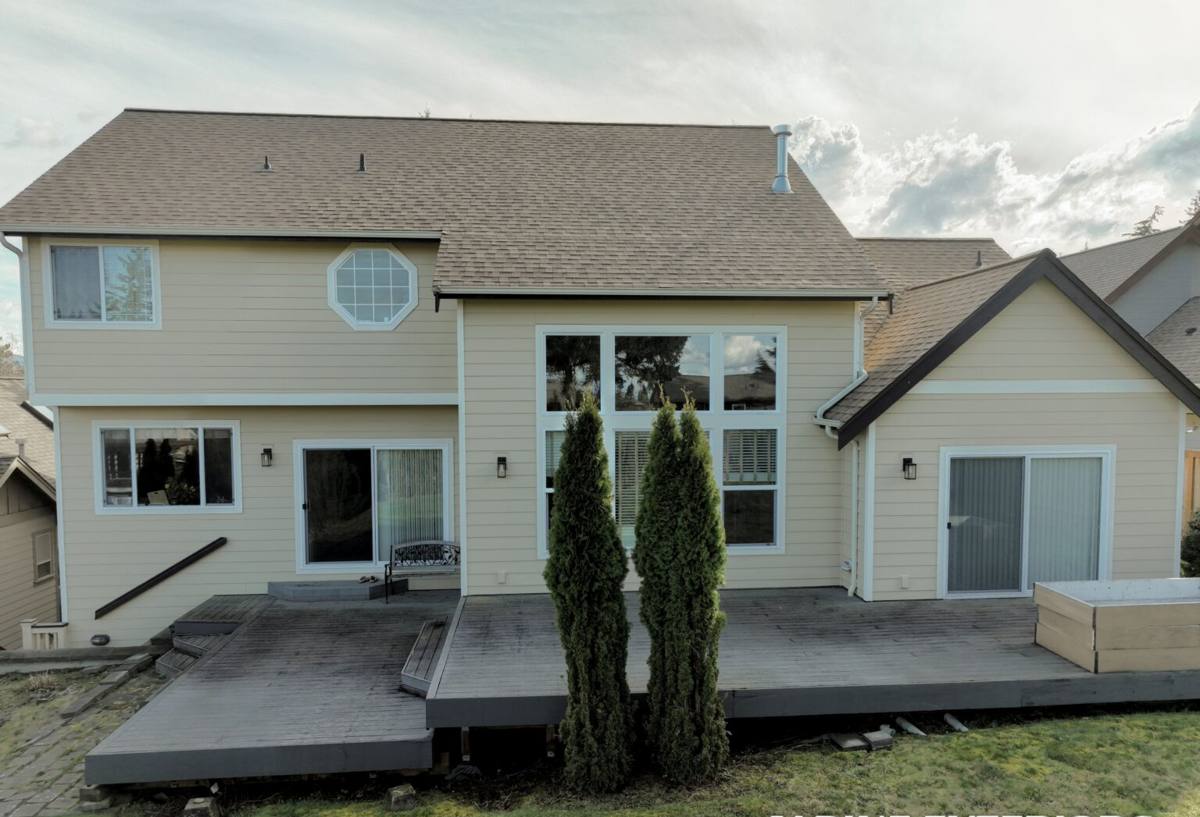
What Salt Air, Rain, and Moss Actually Do to a Deck
Salt Air and Metal Hardware
Salt-laden air accelerates corrosion on any exposed or marginally-rated metal — screws, joist hangers, structural screws, railing brackets. Once corrosion starts on a fastener, it weakens the connection long before it's visibly obvious from the surface. On a waterfront property like Semiahmoo Resort, hardware rated for standard exterior use often isn't enough.
Driving Rain and Water Intrusion
Wind-driven rain doesn't just fall on a deck, it gets pushed sideways and up under rail posts, ledger boards, and stair stringers. Any gap in flashing or any fastener penetration that isn't properly sealed becomes a path for water to reach the framing underneath, where it can sit against wood that never fully dries between storms.
Moss and Prolonged Dampness
Whatcom County's long wet season means shaded decks, north-facing decks, and decks with poor airflow underneath can stay damp for weeks at a stretch. That's exactly the condition moss and algae need to establish themselves on a deck surface, and it's also the condition that causes the underside of framing and the bottoms of deck boards to hold moisture instead of shedding it.
What a Correctly Built Composite Deck Includes
A composite deck built for this stretch of Whatcom County coastline should include a specific set of details that a generic installation often skips:
- Capped composite boards on all four sides, not just the top surface, so moisture can't wick into the exposed core at cut ends or edges
- Corrosion-resistant, coated or stainless structural fasteners and hardware throughout — not standard galvanized
- Joist tape over all framing to seal end grain and screw penetrations against moisture
- A hidden fastening system rated for the specific composite product, sized correctly for board expansion and contraction
- Proper board spacing and picture-frame trim details that account for thermal movement in a climate with real temperature swings between summer sun and winter cold snaps
- Adequate ground clearance and underside airflow, especially on lower decks close to grade
- Flashing at every ledger connection and any place the deck meets siding or a wall
Skip any one of these and you're not really getting the low-maintenance performance composite decking is supposed to deliver — you're just getting a plastic-look surface over the same moisture and corrosion problems a wood deck would have.
Framing and Substructure: The Part Nobody Sees
Most deck failures near the water start below the boards, not on top of them. Ledger flashing that wasn't detailed for wind-driven rain, joist hangers that were left uncoated, or framing set too close to grade with no airflow underneath — these are the issues that turn into soft spots, rot, and hardware failure years down the road, usually long after the composite surface still looks fine.
For a Semiahmoo Resort project, we look closely at ledger attachment and flashing, joist hanger and fastener specification, ground clearance and drainage slope away from the house, and airflow underneath the deck. On lower decks or ones built over patios, we also pay attention to whether water has anywhere to go once it gets under the boards — standing water under a deck is a slow, quiet way to shorten its life.
Choosing a Composite Board for This Climate
Not every composite product performs the same way in a coastal, high-moisture environment. Fully capped boards with a solid track record for moisture resistance are the right call here — uncapped or lightly capped composites tend to absorb more moisture at cut edges and are more prone to surface staining and mold growth in shaded, damp conditions.
| Factor | Fully Capped Composite | Uncapped / Partially Capped |
|---|---|---|
| Moisture resistance at cut edges | Sealed on all sides, resists wicking | Exposed core can absorb moisture |
| Mold/algae resistance in shade | Better resistance, easier to clean | More prone to surface growth |
| Fading and staining near salt air | Generally more stable | Can show staining sooner |
| Upfront cost | Higher | Lower |
| Long-term maintenance | Lower | Higher, especially in shaded areas |
Color also matters more here than people expect. Very dark boards get hot in direct summer sun but generally show moss and water spotting less obviously; lighter and mid-tone boards stay cooler but can show green or black staining sooner in shaded, damp spots if the deck isn't cleaned periodically. Neither is wrong — it's a tradeoff worth talking through based on how much sun and shade your specific lot gets.
Our Installation Process for Semiahmoo Resort Homes
- On-site assessment of the deck location, sun/shade exposure, drainage path, and existing structure or grade conditions
- Framing inspection or new framing build-out, sized and fastened for coastal conditions
- Ledger flashing and any wall or siding transition detailing to shed wind-driven rain
- Joist taping and corrosion-resistant hardware installation throughout the substructure
- Composite board installation with a hidden fastening system, correct spacing, and picture-frame or trim detailing
- Railing, stair, and any lighting or accessory installation
- Final walkthrough covering how the specific board product handles cleaning and what to watch for seasonally
Living With a Composite Deck in a Wet, Salty Climate
Composite decking cuts down on maintenance dramatically compared to wood, but "low-maintenance" doesn't mean "no maintenance" — especially this close to the water. A simple seasonal routine keeps a composite deck performing the way it should:
- Sweep debris and standing leaves off the surface regularly, especially in shaded corners where moss takes hold first
- Rinse or wash the deck a few times a year to clear salt residue and organic buildup before it stains
- Clean out gaps between boards where they run along the house or against trim, since debris there holds moisture longest
- Check railing posts and stair connections annually for any looseness, which can signal hardware corrosion underneath
- Keep gutters and downspouts near the deck clear so runoff isn't dumping extra water onto or under the structure
Why Hire a Crew That Already Works This Area
Semiahmoo Resort isn't a typical inland lot, and a deck built to a generic spec sheet often underperforms here within a few years. We build decks throughout Whatcom County, and the difference on a project like this comes down to the details you can't see once the boards are down — the fastener grade, the flashing at the ledger, the airflow under the frame. Those choices are what determine whether a composite deck actually delivers on the low-maintenance promise in a salt air, high-rainfall environment, or whether it just delays the same old problems by a few years.
Cost Factors to Expect
| Factor | Impact on Cost |
|---|---|
| Deck size and shape (multi-level, curves, cutouts) | More linear footage and labor |
| Board tier (fully capped vs. economy composite) | Higher upfront cost, lower long-term maintenance |
| Existing framing condition | Repair or full rebuild adds cost vs. resurfacing sound framing |
| Height above grade and ground access | Taller decks need more substructure and railing |
| Railing style and material | Composite/metal/glass railing systems vary widely in price |
| Site access for materials and equipment | Tight waterfront lots can add labor time |
Every property on Semiahmoo Resort is a little different in terms of exposure, existing structure, and layout, so real numbers only come from actually looking at the site. If you'd like a straightforward, no-pressure estimate on a composite deck for your home, the form below gets us started — we'll take a look and walk you through what your specific lot needs.