 Semiahmoo Exterior
 Why Cherry Point Siding Has to Work Harder
Cherry Point sits close enough to the water that homes here deal with a combination most inland Washington properties never see: salt-laden air off the Strait, wind-driven rain that hits siding sideways instead of straight down, and a shoulder season damp enough to grow moss on almost any north-facing wall that isn't detailed correctly. None of these factors are dramatic on their own. Together, over years, they're exactly what separates siding that looks good at year three from siding that still looks good at year twenty.
Whatcom County's marine climate means long stretches of low-intensity moisture rather than a few big storms. Siding doesn't fail here because of one bad event — it fails because water finds a way in slowly, over dozens of wet seasons, through a seam, a fastener hole, or a butt joint that was never properly sealed or flashed in the first place.
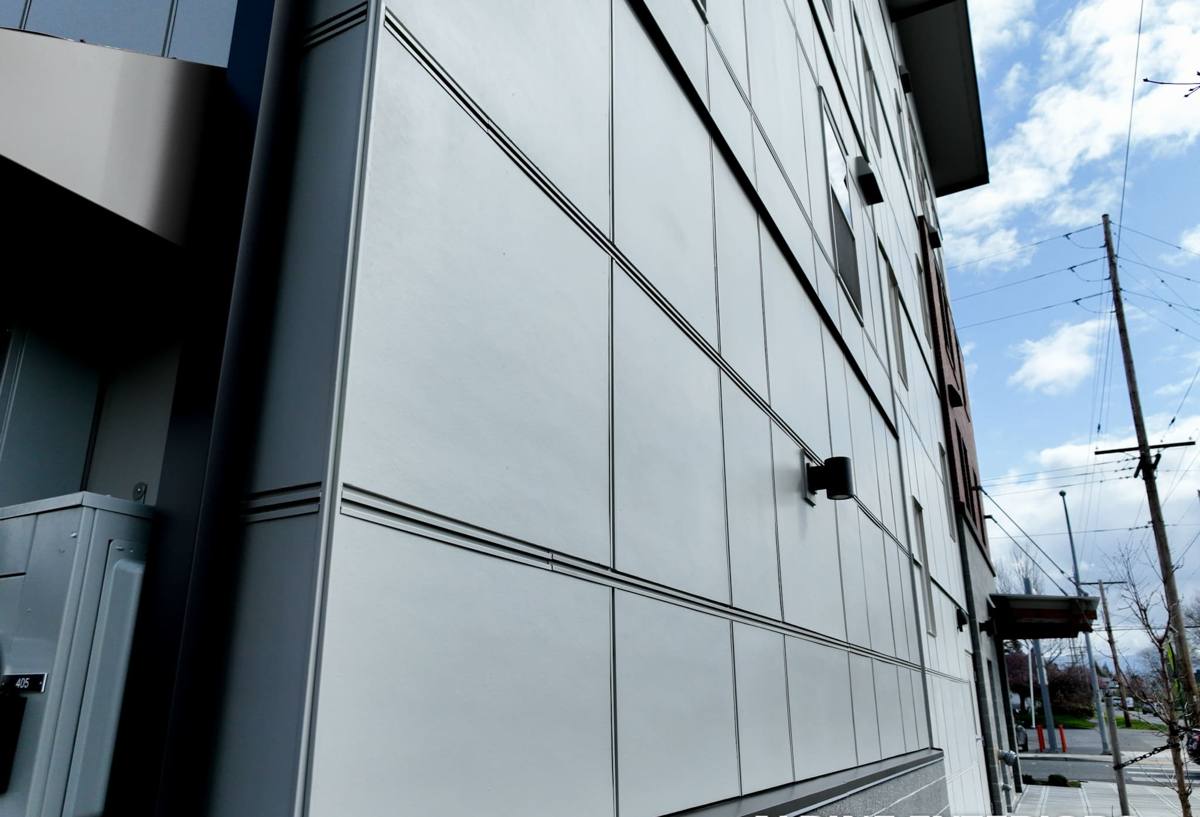
What Salt Air and Moss Actually Do to Siding
Salt Air
Airborne salt is corrosive to exposed metal fasteners and trim, and it's abrasive to finishes that aren't formulated to take it. Paint film that would hold up fine forty miles inland can chalk, fade, or lose adhesion faster near the Strait. This is a finish problem as much as a material problem — the substrate underneath can be sound while the surface coating breaks down years ahead of schedule.
Driving Rain
Wind-driven rain pushes water sideways and upward, testing every horizontal lap, corner, and penetration on a wall. Siding systems that rely on face-sealing — caulk and paint doing the work that flashing and drainage gaps should be doing — tend to hold up in calm rain and fail in driving rain. Cherry Point gets enough of the latter that this distinction matters.
Moss and Sustained Dampness
Shaded, north- and west-facing walls near mature trees or close to the water stay damp longer between dry spells. Materials that absorb moisture rather than shed it — untreated wood, some composite products, siding installed without adequate ground clearance — give moss and mildew a foothold that spreads and holds moisture against the wall long-term.
Why We Install Only James Hardie Fiber Cement
We don't install vinyl, LP SmartSide, Cemplank, Allura, or unfinished wood siding, and in a climate like this one, that's a deliberate call rather than a brand preference. Fiber cement is non-combustible and dimensionally stable — it doesn't expand and contract with moisture the way wood-based products do, which matters when a wall is wet as often as it's dry. Within fiber cement, we standardized on James Hardie specifically because of three things that hold up to independent scrutiny:
- ColorPlus factory finish — baked-on in a controlled environment rather than field-applied, so the coating adheres more consistently and resists the fading and chalking that salt air accelerates on job-site paint.
- Climate-engineered HZ product lines — Hardie formulates its HZ5 line specifically for wetter, harsher climates, which is a closer match to Whatcom County conditions than a generic national product.
- A transferable warranty backed by a large manufacturer — meaningful mainly because it reflects Hardie's confidence in long-term performance, not just a sales point.
Vinyl softens, warps, and becomes brittle with UV and temperature swings, and its seams rely on overlap rather than a sealed system. Wood and primed spruce need real maintenance discipline to survive marine air. LP SmartSide and similar engineered wood products perform reasonably in dry climates but are more sensitive to sustained moisture exposure at cut edges and seams — exactly the condition Cherry Point's rain pattern creates. We'd rather tell a homeowner that up front than install something we don't expect to hold up.
What a Correct Fiber Cement Installation Involves
Fiber cement is only as good as its installation. Most of the failures we get called out to inspect on other contractors' work trace back to shortcuts in a handful of specific places:
Water Management Behind the Siding
A drainage plane and rainscreen gap behind the siding let any water that does get past the face dry out instead of sitting against the sheathing. This is more important in a driving-rain climate than in most of the country, and it's invisible once the job is done — which is exactly why it gets skipped by crews trying to save time.
Flashing and Fastening
Every window, door, and penetration needs proper flashing integrated with the water-resistive barrier, not just caulked over. Fasteners need to be corrosion-resistant and placed per Hardie's fastening schedule — over-driven or under-driven nails are one of the most common causes of premature board failure and are easy to spot on a bad install.
Clearances and Joints
Hardie specifies minimum clearances from grade, roofing, and decks, and butt joints need to be caulked and sealed or flashed correctly, not just butted together. Getting this wrong is how moisture gets a starting point at the bottom of a wall, which is also where moss tends to establish first in shaded Cherry Point yards.
Painting and Touch-Up Discipline
Cut edges need to be sealed with the correct primer before installation, and any field-cut or touched-up area needs a compatible coating — not a generic exterior paint that will weather differently than the factory finish around it.
How We Approach a Cherry Point Job
- On-site assessment — we look at wall exposure, existing moisture or moss patterns, trim and flashing condition, and how the home is oriented to prevailing wind and rain.
- Tear-off and sheathing check — old siding comes off and we inspect the sheathing underneath for rot or hidden moisture damage before anything new goes up.
- Water-resistive barrier and rainscreen — installed to spec, with particular attention to window and door integration.
- Hardie board installation — HZ5 product, correct fastening schedule, proper clearances, sealed joints.
- Trim, caulk, and touch-up — using products compatible with the ColorPlus finish so the whole wall weathers evenly.
- Final walk-through — we go over clearances, drainage, and finish with the homeowner before calling the job done.
Siding Options Compared for This Climate
| Material | Behavior in Salt Air / Driving Rain | Moss and Moisture Resistance | Long-Term Finish Durability |
|---|---|---|---|
| James Hardie Fiber Cement (HZ5) | Dimensionally stable, non-combustible, engineered for wet climates | Doesn't absorb moisture the way wood does; performs well with correct drainage detailing | Factory ColorPlus finish resists fading and chalking |
| Vinyl | Can warp, become brittle, and lose color with UV and temperature cycling | Won't absorb water itself, but seams and laps allow moisture behind the panel | Fades over time; not repaintable in a way that matches well |
| LP SmartSide / Engineered Wood | More sensitive to sustained moisture at cut edges and seams | Can swell or deteriorate faster under prolonged damp conditions | Field-applied finishes weather less consistently |
| Primed Spruce / Cedar | Requires disciplined maintenance to resist marine moisture | Susceptible to moss and rot without regular upkeep | Needs repainting/resealing on a recurring schedule |
Cost Factors Homeowners Should Understand
| Factor | Why It Matters Here |
|---|---|
| Wall exposure and orientation | North and west-facing walls near the water may need extra attention to drainage and clearance detailing |
| Condition of existing sheathing | Hidden moisture damage found during tear-off adds scope but has to be addressed, not covered over |
| Trim and flashing complexity | Homes with more windows, dormers, and roof-wall intersections require more flashing work per square foot |
| Product line (HZ5 vs. standard) | Climate-engineered lines cost more upfront but are matched to this region's conditions |
| Access and site conditions | Tree cover, slope, and setback affect scaffolding and staging time |
Maintenance Checklist for Cherry Point Homes
- Rinse siding annually, focusing on shaded or moss-prone walls, to keep organic growth from establishing
- Keep vegetation and tree canopy trimmed back from exterior walls to improve airflow and drying time
- Check caulking at joints, trim, and penetrations every year or two and re-seal where it's cracked or pulling away
- Watch for chalking or fading on south- and west-facing walls, which take the most direct sun and salt exposure
- Confirm gutters and downspouts are directing water away from the base of the walls, not saturating the ground next to the siding
- Have a professional inspect flashing at windows, doors, and roof lines periodically — most water intrusion starts at these transitions, not the field of the wall
Why a Crew That Already Works Cherry Point Matters
Siding installation isn't just about the product — it's about how that product is detailed for the specific conditions of a specific wall. A crew that regularly works this stretch of Whatcom County already understands how far driving rain pushes water up a wall, which orientations grow moss first, and how salt air treats fasteners and trim over time. That familiarity shows up in the details that don't get noticed until they fail: clearance heights, joint sealing, flashing integration, and fastener choice. It's the difference between siding installed to a generic spec sheet and siding installed for the wall it's actually going on.
If you're considering new siding or replacing something that's failing early, we're happy to take a look and give you a straightforward read on what your home needs. Reach out for a free, no-pressure estimate — we'll walk the exterior with you, point out anything worth knowing, and explain exactly what a correct James Hardie installation would involve on your specific home.